AI Agent Development Cost: The Complete 2026 Pricing Guide
October 1, 2026 · Asma Nawaz · Technical Content Writer, Vision Nexera · 15 min read
Updated
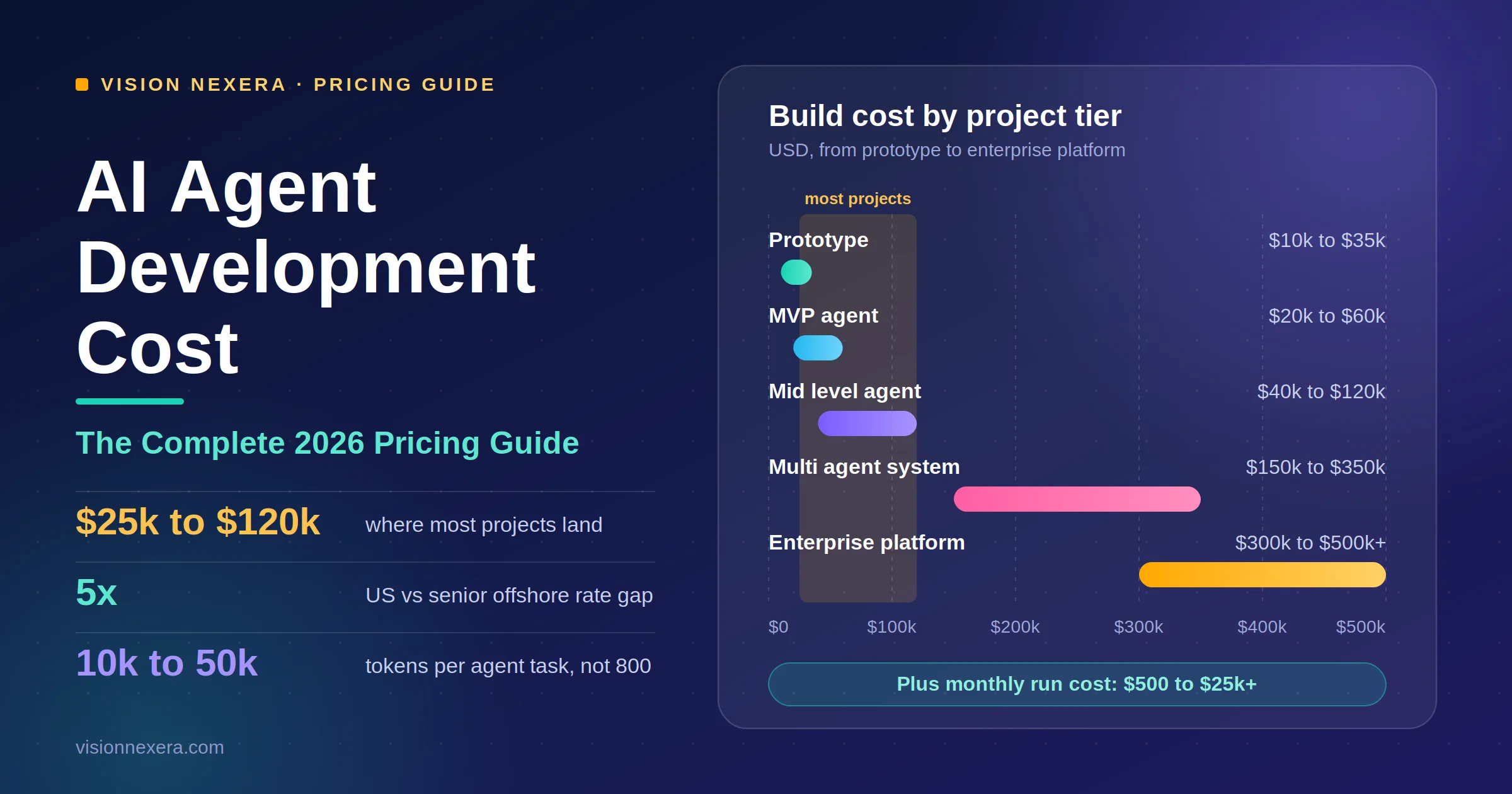
What AI agents really cost in 2026. Build-cost tiers from $10k to $500k+, regional rates, monthly run costs, token economics, build vs buy, and how to spend less.
AI Agent Development Cost: The Complete 2026 Pricing Guide
Most custom AI agents cost between $25,000 and $120,000 to build in 2026. A simple single purpose agent can start near $10,000, and a full enterprise multi agent system can pass $500,000. That range is wide because the phrase AI agent covers everything from a rule based FAQ bot to an autonomous system that reasons, calls tools, and acts across your business.
The build cost, though, is only half the story, and it is the half most people fixate on. An AI agent is not a website you pay for once. It runs on a loop of model calls that cost money on every task, forever, and that running cost is where budgets quietly blow up. This guide covers both halves honestly: what it costs to build an AI agent in 2026, what it costs to run one, what actually drives the number, and how to spend less without ending up with something that breaks in production.
It is written for founders and operators who are getting quotes that range from $8,000 to $400,000 for what sounds like the same thing, and want to understand why.
The quick answer: AI agent cost by tier in 2026
Across 2026 market pricing, custom AI agent projects fall into six tiers. The figures below are build cost, typical timeline, and rough monthly running cost once live.
Prototype or proof of concept. $10,000 to $35,000. 4 to 8 weeks. Minimal run cost. One narrow use case built to prove feasibility, not to put in front of real users.
MVP or simple single task agent. $20,000 to $60,000. 6 to 12 weeks. Run cost roughly $500 to $3,000 a month. One real workflow, a few integrations, retrieval over your data, and a production ready core.
Mid level custom agent. $40,000 to $120,000. 10 to 16 weeks. Run cost roughly $1,500 to $6,000 a month. Multi step automation of a real business process with orchestration and several integrations.
Production multi tool agent. $80,000 to $200,000. 14 to 24 weeks. Run cost roughly $4,000 to $12,000 a month. Serious orchestration, security, observability, and an evaluation suite.
Multi agent system. $150,000 to $350,000. 16 to 28 weeks. Run cost roughly $8,000 to $20,000 a month. Several agents coordinating across systems with governance.
Enterprise agentic platform. $300,000 to $500,000 and up. 24 to 40 weeks or more. Run cost roughly $10,000 to $25,000 or more a month. Organization wide automation with compliance, fine tuning, and high scale infrastructure.
There is also a seventh path that sits outside custom development: a low code or no code agent platform build, which runs about $5,000 to $40,000 plus the platform subscription. It is fast and cheap to start, and it scales poorly once your needs get complex, which is the build versus buy question covered further down.
Most mid market projects land between $25,000 and $120,000. If a quote is far below that for anything beyond a simple bot, the reliability work has probably been left out, and you will pay for it later.
What actually drives AI agent development cost
Two agents with the same one line description can differ in price by ten times. Here is what moves the number, in rough order of impact.
Team rate and geography. This is the single largest variable, and most guides bury it. A senior AI engineer at a US agency runs about $150 to $250 an hour. A nearshore team in Eastern Europe or Latin America runs about $35 to $100. A senior offshore team in South Asia runs about $20 to $60. For comparable quality, a US build is often around five times the cost of a senior offshore build, which is why where you hire matters as much as what you build.
Scope, complexity, and autonomy. A reflex agent that follows fixed rules is cheap. An agent that reasons over ambiguous input, decides between actions, and operates with real autonomy is not. Every increase in how much the agent decides for itself increases the engineering, testing, and guardrail work behind it.
Integrations. Each system the agent connects to, a CRM, a database, a telephony provider, an internal API, adds design, authentication, error handling, and testing. One integration is cheap. Five is not. Legacy or poorly documented systems cost more again. This is the work behind AI integration.
Data and retrieval. If the agent needs to answer from your documents or data, you are also paying for a retrieval pipeline: ingestion, chunking, a vector store, and evaluation. The cost depends on how messy and how large your data is. We break the retrieval decisions down in RAG versus fine tuning.
Reliability engineering. Guardrails, an evaluation suite, error handling, retries, monitoring, and a human in the loop for consequential actions are the difference between a demo and a system you can trust. They are also the line items the cheapest quotes skip, which is exactly why those agents fail in production.
The model and the loop. The reasoning model is a running cost, not a build cost, but the choices made at build time set it for the life of the agent. More on this below, because it is the part most budgets underestimate.
Security and compliance. If the agent handles personal or regulated data, or serves a market like Saudi Arabia under PDPL, you are paying for data residency, access control, encryption, and audit trails. This is real work, covered in our guide to PDPL compliant AI in Saudi Arabia, and it is cheaper to build in than to retrofit.
The cost most teams forget: running the agent
Here is the number that surprises people. A single chat request to a language model uses roughly 800 tokens. A single agent task uses around 10,000 to 50,000. The reason is the loop: an agent plans, calls a tool, reads the result, reasons again, calls another tool, and repeats, and every turn in that loop is more tokens. You are not paying for one model call per task, you are paying for many.
That is why the rule is to budget for the loop, not the model. The per token price looks tiny until you multiply it by the loop and by your task volume.
Model pricing in 2026 sits in three broad tiers, per million tokens, and prices change often, so treat these as current to late 2026 rather than fixed. Budget models run roughly $0.10 to $0.50 for input. Mid tier workhorse models, the default for most production agents, run roughly $2 to $3 for input and $10 to $15 for output. Frontier models run roughly $5 for input and $25 to $30 for output, with premium tiers reaching about $10 and $50. Across every provider, output tokens cost two to six times more than input, so verbose agents cost more.
Put together, running costs by tier land roughly where the quick answer table showed: a few hundred dollars a month for a simple agent, a few thousand for a mid level one, and tens of thousands for a busy multi agent or enterprise system. A single hard working coding agent processing tens of millions of tokens a day can run into thousands of dollars a month on its own.
The good news is that run cost is highly controllable, and a team that has operated agents in production knows the levers:
Model routing. Use a cheap model for easy steps and escalate to an expensive one only for the steps that measurably need it.
Prompt caching. Reusing a cached context can cut input cost by up to around ninety percent on supported providers.
Batch processing. Non urgent work run through a batch API is often around fifty percent cheaper.
Smaller models and shorter context. Most steps do not need the biggest model or the whole history in the prompt.
Caching results. Do not pay the model twice for the same answer.
Choosing the model at build time and wiring in these controls is the difference between an agent that is cheap to run and one that quietly costs more than the person it replaced. Any vendor who quotes a build price and never mentions run cost is leaving out half the bill.
Pricing models: how AI agencies charge
Fixed price, phased. The agency scopes the work and quotes a fixed price per phase, often split into staged payments. This gives you budget certainty and is the safest structure for a first engagement, as long as the scope is written down clearly.
Time and materials. You pay for hours at an agreed rate. This suits open ended or evolving work, and it needs trust and good reporting, because the meter is always running.
Retainer. A monthly fee for ongoing development, maintenance, and monitoring after launch. Sensible once an agent is live, because an agent is never truly finished.
Platform plus subscription. With a low code or no code platform you pay a lower build fee plus a recurring platform subscription that scales with usage. Cheap to start, and the subscription and scaling limits are the catch.
At Vision Nexera the pattern is deliberately conservative: a scoping call produces a written scope and an honest estimate, a paid Discovery de risks the build before you commit to it, and larger builds use staged payments so cost tracks delivery. You can see the shape of it on the process and pricing pages.
Build versus buy: custom agent or off the shelf platform
If an off the shelf platform genuinely covers your workflow, use it. A platform build at $5,000 to $40,000 plus subscription is the right call for internal tools, simple workflows, and fast prototyping. The trade off is that platforms scale poorly for complex, deeply integrated, or highly regulated needs, and you do not own the result.
A custom build at $40,000 to $400,000 and up makes sense when the workflow is unique, the integrations are deep, the data is sensitive, or the agent is core enough to your business that you need to own the IP and control the behavior. The honest test is whether a template can do the job. If it can, buy. If it cannot, build. We walk through this decision in build versus buy for AI features.
Why so many AI agent budgets are wasted
Before spending anything, it is worth knowing how often this goes wrong. Gartner has estimated that more than forty percent of agentic AI projects will be canceled by the end of 2027, and MIT research found that ninety five percent of generative AI pilots showed no measurable return on the profit and loss statement. The money is not usually wasted on building the wrong model. It is wasted in predictable ways:
The demo to production gap. A demo that works on clean test data is cheap. The production system that survives real, messy input is where the real cost lives, and teams that budget for the demo get a nasty surprise. We wrote about this in the demo is not the product.
No evaluation. Without a test suite, quality drifts silently and the agent slowly stops being trusted, so the investment is written off.
Scope creep. An agent that was meant to do one thing grows to do five, and the budget grows with it, usually without anyone deciding to let it.
Building what you should have bought, or the reverse. Paying for a custom build when a template would do, or forcing a template to do something it never could.
Over autonomy. Giving an agent more autonomy than the task needs multiplies the engineering and the risk for no real benefit.
The common thread is that the waste is avoidable with a scoped first step and an honest view of what production actually requires.
How to reduce AI agent development cost without wrecking quality
Start with a scoped MVP or a paid Discovery. Validate one high value use case for $20,000 to $60,000 before committing to a multi agent or enterprise build. This is the single biggest lever on total spend.
Choose the geography deliberately. A senior offshore team can deliver comparable quality to a US agency at a fraction of the rate. Optimize for total delivered cost and seniority, not the headline hourly rate.
Right size the model and wire in cost controls from day one: routing, caching, batching, shorter context.
Reuse before you build. Existing platforms, open models, and prior work often cover more than you expect.
Do not buy autonomy you do not need. Keep a human in the loop where the task warrants it, which is cheaper and safer.
Build reliability in rather than bolting it on later. Fixing a fragile agent after launch costs more than building it properly once.
Hourly rates for AI agent development by region in 2026
Because team rate is the biggest cost variable, it is worth seeing it plainly. A US based AI or ML engineer runs roughly $150 to $250 an hour at agency rates. A nearshore engineer in Eastern Europe or Latin America runs roughly $35 to $100. A senior offshore engineer in South Asia, including Pakistan, runs roughly $20 to $60. For the same scope and quality, that is often around a five times difference between a US and a senior offshore build.
This is the honest reason Pakistani and other offshore teams win this work in 2026. The engineers who started in the late 2010s are now senior, fluent in the modern agent stack, and cost a fraction of their US equivalents. The gap is in rate, not in capability, provided you pick a team with real production experience. Vision Nexera keeps teams in both Lahore and Doha for exactly this reason, which you can see on the locations page.
Hidden and ongoing costs to budget for
The build price is not the last cheque you write. Budget also for monitoring and observability, periodic re evaluation as your data and the models change, model migrations when a provider changes prices or retires a model, maintenance and bug fixes, infrastructure and vector database hosting, and security or compliance audits if you operate in a regulated space. A useful planning assumption is that running and maintaining an agent costs a meaningful fraction of the build cost every year. The exact figure depends on usage and complexity, which is why a credible estimate always includes the run cost, not just the build.
How Vision Nexera approaches AI agent cost
Vision Nexera is an AI product engineering company that builds AI agents, RAG systems, and full AI powered products, and the way it handles cost is built to avoid the waste above. A scoping call produces a written scope and an honest estimate, including a straight answer on whether you need a custom agent at all or whether an off the shelf tool would do the job for a tenth of the price. A paid Discovery de risks the build before you commit, and larger engagements use staged payments so what you pay tracks what is delivered.
On running cost, the team is deliberately vendor neutral across models, and wires in routing, caching, and the other controls from the start, because it runs its own agents in production and pays its own token bills. Repo Fixer, its autonomous coding orchestrator, is a working example of an agent on a plan, execute, and verify loop, which is exactly the kind of system whose run cost you have to engineer rather than hope about. That operating experience is the difference between an estimate based on a spreadsheet and one based on having actually run the thing.
The limitation worth stating plainly: no honest number exists without a scope. Anyone who quotes a precise price for an AI agent before understanding your workflow, your integrations, and your data is guessing. The first step is always a written scope.
If you are budgeting an AI agent, book a scoping call and leave with a written scope, an honest estimate that includes run cost, and a clear view of whether to build or buy.
Frequently asked questions
How much does it cost to build an AI agent in 2026?
Most custom AI agents cost between $25,000 and $120,000. A simple single purpose agent can start near $10,000, an MVP runs about $20,000 to $60,000, a mid level custom agent about $40,000 to $120,000, and enterprise multi agent systems can exceed $500,000. The biggest single variable is the team's rate and location.
What is the cheapest way to build an AI agent?
A low code or no code platform build, roughly $5,000 to $40,000 plus subscription, is the cheapest route, and it suits simple internal workflows. Beyond that, the cheapest sensible path to a custom agent is a scoped MVP, around $20,000 to $60,000, built by a senior offshore team, which validates value before you scale spend.
How much do AI agent developers charge per hour in 2026?
Roughly $150 to $250 an hour for a US agency, $35 to $100 for nearshore teams in Eastern Europe or Latin America, and $20 to $60 for senior offshore teams in South Asia, including Pakistan. For comparable quality, a US build is often around five times the cost of a senior offshore build.
What are the monthly running costs of an AI agent?
Roughly $500 to $3,000 a month for a simple agent, $1,500 to $6,000 for a mid level one, $8,000 to $20,000 for a multi agent system, and $10,000 to $25,000 or more for an enterprise platform. The main drivers are model token usage, vector database hosting, and monitoring.
Why is my AI agent's token bill so high?
Because of the loop. A single chat request uses roughly 800 tokens, while an agent task uses around 10,000 to 50,000, since the agent plans, calls tools, reads results, and reasons repeatedly, and every turn is more tokens. Model routing, prompt caching, batching, and shorter context are the main ways to bring it down.
Should I build a custom AI agent or buy an off the shelf platform?
If a template genuinely covers your workflow, buy, because it is cheaper and faster. Build when the workflow is unique, the integrations are deep, the data is sensitive, or you need to own the result. The test is simple: if an off the shelf tool can do the job, there is no reason to pay for a custom one.
How long does it take to build an AI agent?
Roughly 4 to 8 weeks for a prototype, 6 to 12 weeks for an MVP, 10 to 16 weeks for a mid level custom agent, and 16 weeks or more for multi agent and enterprise systems. A scoping call and a short Discovery give you a reliable timeline before the build starts.
Does compliance add to the cost?
Yes. If the agent handles personal or regulated data, or serves a market like Saudi Arabia under PDPL, you are paying for data residency, access control, encryption, and audit trails. It is real work, and it is far cheaper to design in from the first sprint than to retrofit after a failed review.
The honest version of AI agent pricing
AI agent development cost in 2026 runs from about $10,000 for a simple bot to $500,000 and beyond for an enterprise platform, with most real projects between $25,000 and $120,000. But the number that decides whether the project succeeds is not the build price, it is the total cost of ownership: the build, plus the loop that runs forever, plus the reliability work that keeps it trustworthy. The teams that get burned are the ones who budgeted for the demo. The teams that succeed scoped a first step, built for production, and knew their run cost before they started.
If you want a real number for your use case, start with a written scope. Book a scoping call with Vision Nexera and leave with an honest estimate that includes what it costs to build and what it costs to run.
Related reading
Build vs buy for AI features: https://www.visionnexera.com/insights/build-vs-buy-ai-features
The Demo Is Not the Product: https://www.visionnexera.com/insights/ai-product-development-demo-to-production
RAG vs fine-tuning: https://www.visionnexera.com/insights/rag-vs-fine-tuning
PDPL-Compliant AI Agent Development in Saudi Arabia: https://www.visionnexera.com/insights/pdpl-compliant-ai-agent-development-saudi-arabia
Top AI Agent Development Companies in Pakistan 2026: https://www.visionnexera.com/insights/top-ai-agent-development-companies-in-pakistan-2026
AI Agents service: https://www.visionnexera.com/services/ai-agents
AI Integration service: https://www.visionnexera.com/services/ai-integration
Pricing: https://www.visionnexera.com/pricing
Process: https://www.visionnexera.com/process