PDPL Compliant AI Agent Development Companies in Saudi Arabia
September 17, 2026 · Asma Nawaz · Technical Content Writer, Vision Nexera · 17 min read
Updated
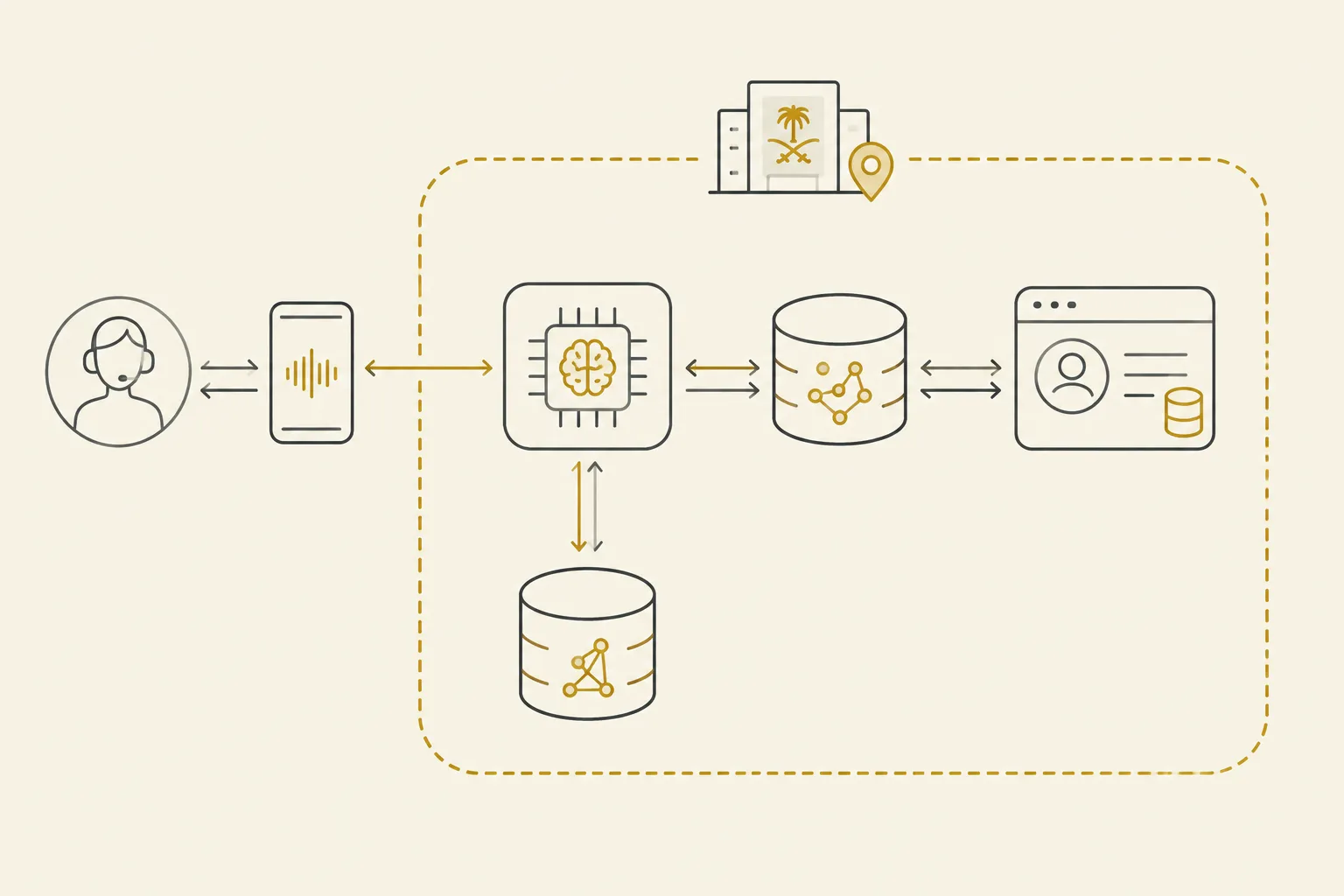
A data residency guide to PDPL-compliant AI agent development in Saudi Arabia. What SDAIA requires, where Saudi data and AI models can run in 2026, and how to choose a partner.
PDPL Compliant AI Agent Development Companies in Saudi Arabia: A Data Residency Guide
If you searched for AI agent development companies in Saudi Arabia, you probably expected another ranked list of logos sorted by team size or review count. This is not that. In the Kingdom in 2026, with the Personal Data Protection Law under active enforcement, the question that actually decides your project is narrower and harder: who can build an AI agent that keeps Saudi personal data compliant, and ideally keeps it inside the Kingdom.
That is the data residency question, and most AI agent projects get it wrong quietly. An agent that works beautifully in a demo can be shipping the personal data of Saudi residents to servers in the United States or Europe on every single request, without anyone in the room noticing. Under the Personal Data Protection Law, that is a regulated cross border transfer, and the Saudi Data and Artificial Intelligence Authority has started issuing decisions against organizations that get it wrong.
This guide reframes the search. Instead of ranking companies, it explains what the Personal Data Protection Law requires, why data residency is the real test for AI agents specifically, where Saudi data and AI models can legally live in 2026, what a compliant agent architecture looks like, and how to evaluate any development partner through that lens. It is written for Saudi enterprises, banks and fintechs under SAMA supervision, healthcare and government adjacent organizations, and international companies that serve Saudi users and are now inside the law's reach.
One note before anything else. This is engineering guidance, not legal advice. The Personal Data Protection Law is a serious regulatory regime, and any real deployment should be reviewed with Saudi counsel and, where required, registered with the Saudi Data and Artificial Intelligence Authority. What follows is how to build systems that support compliance, not a substitute for a lawyer.
Why data residency is the real question for AI agents
An AI agent is not a static database. It is software that moves personal data constantly, and every movement is a place where data can cross a border you did not intend.
Think about what happens on a single request. A customer's message, which may contain a name, a phone number, a national ID, or account details, gets sent to a large language model for reasoning. If that model is a direct API from a provider hosted outside the Kingdom, the personal data in that prompt has just left Saudi Arabia. The agent then retrieves context from a knowledge base, so personal data sits in a vector database somewhere, and the question is where that somewhere is. It calls tools and updates a CRM, moving data again. If it is a voice agent, it records the call, sends the audio to a speech to text service, and sends its reply to a text to speech service, and both the recording and the transcript are personal data, often processed abroad.
None of this is visible in a demo. The demo uses a clean test input and nobody checks the network path. But in production, a naive AI agent architecture becomes a steady, automated pipeline that exports Saudi personal data to foreign infrastructure thousands of times a day. That is exactly the activity the Personal Data Protection Law regulates, which is why the choice of development partner and the choice of architecture matter far more than the brand of model or the size of the team.
What the Personal Data Protection Law actually requires
The Personal Data Protection Law was issued in 2021, amended in 2023, and came into force in September 2023, with a compliance grace period that ran to September 2024. The regulator and enforcement body is the Saudi Data and Artificial Intelligence Authority, usually shortened to SDAIA. The law is supported by two connected sets of rules, the Implementing Regulations and the Regulations on Personal Data Transfer Outside the Kingdom.
A few features of the law matter more than the rest for anyone building AI agents.
It reaches beyond Saudi borders. The Personal Data Protection Law applies to any organization, public or private, local or foreign, that processes the personal data of individuals in Saudi Arabia, regardless of where that organization is incorporated. A London based SaaS company serving Saudi users is as bound as a Riyadh based fintech, and there are no carve outs for small companies or early stage startups.
It defines personal data broadly. Names, email addresses, phone numbers, national IDs, IP addresses, location data, biometric data, health records, financial data, and even prospect and lead data all count. If it can identify a person directly or indirectly, it is in scope.
Cross border transfer is restricted, not free. Under the law, personal data can be sent outside the Kingdom only on a valid basis and with proper safeguards. SDAIA has not yet published a list of countries it considers adequate, which means, in practice, that transfers out of Saudi Arabia require appropriate safeguards regardless of destination. The main mechanisms are SDAIA approved Standard Contractual Clauses, which come in four versions covering controller to processor, controller to controller, processor to controller, and processor to processor, or Binding Corporate Rules for intra group transfers. In early 2025 SDAIA also published a risk assessment guideline for cross border transfers, so the expectation now is a documented transfer impact assessment, transfers limited to the minimum data needed, and no prejudice to national security or the vital interests of the Kingdom.
Some data effectively has to stay in the Kingdom. Saudi Arabia's data governance rests on a four tier data classification framework overseen by the National Data Management Office. The higher tiers carry stricter controls, and for government agency data the localization requirement is effectively exclusive, meaning it must remain within Saudi Arabia subject only to narrow exceptions. Sector rules stack on top. The SAMA Cloud Computing Framework pushes financial institutions toward in Kingdom storage of sensitive customer and transaction data, and the National Cybersecurity Authority's Cloud Cybersecurity Controls address localization for regulated workloads. The practical reading for most builders is simple: in Kingdom residency is the safe default, and for sensitive, regulated, or government data it is close to mandatory.
Enforcement is real and fast. SDAIA has moved out of the transitional phase into active enforcement, with dozens of formal decisions issued across 2025 and 2026 covering failures like processing without a valid legal basis, unauthorized disclosure, weak safeguards, and marketing without consent. Once an organization is notified of a violation, the window to respond can be as short as five days. Compliance is now an operational requirement, not a policy document you write once and file away.
Where Saudi data and AI models can actually live in 2026
Data residency is only useful if there is somewhere in the Kingdom to put the data and run the model. This is the part that changes fastest, so treat the status below as current to September 2026 and verify the specifics before you commit, because cloud regions and in region model availability move quarter by quarter.
Google Cloud is the option you can use in the Kingdom today. Its Dammam region opened in November 2023, the earliest in country region from a major provider, and in 2024 it added a set of sovereign controls for Saudi Arabia covering data residency at rest, in use, and in transit, along with sovereignty keys. Vertex AI, and with it Gemini models, is available in the region, and Google Cloud is offered in the Kingdom through CNTXT as the licensed reseller. For an organization that needs Saudi data residency and in region AI inference right now, this is the most direct path.
Microsoft Azure is close behind. Microsoft has confirmed a Saudi Arabia East region carrying customer workloads from the fourth quarter of 2026, with full data residency and the Azure AI portfolio, including Azure OpenAI and Copilot, inside Saudi borders, along with alignment to SAMA requirements for financial institutions. It is not a region you can deploy into today, so for now Azure workloads that need residency tend to run in a nearby region under review, with a migration planned once Saudi Arabia East is live.
Amazon Web Services has committed to a Saudi region, with a large multi year investment announced in 2024 and a target of 2026, but as of this writing it has not confirmed a specific launch date and is not yet a region you can deploy into. Amazon Bedrock, which gives access to Claude, Llama, Mistral, and others behind one interface, is available from other regions in the meantime. Oracle also operates in country regions in the Kingdom, which widens the options for organizations already on its stack.
On the sovereign side, HUMAIN, the Kingdom's own AI company, is building national AI compute capacity, though it is not yet a purchasable public cloud at commercial scale. There are also local and sovereign cloud arrangements through operators such as STC. One honest caveat worth stating plainly: heavy model training and frontier scale inference are not well served inside the Kingdom yet, so some workloads still need an offshore region with a proper residency review, or a self hosted open weight model on whatever in region compute is available.
A last point that trips up almost everyone. The direct APIs from OpenAI, Anthropic, and similar providers default to global routing, which means a call to them from Saudi Arabia is a cross border transfer unless you have specifically arranged otherwise. Running the same models through an in region endpoint, such as Vertex AI in Dammam or Azure OpenAI in Saudi Arabia East once it launches, or self hosting an open weight model, is what keeps the personal data in those prompts inside the Kingdom.
What a PDPL compliant AI agent architecture looks like
Compliance is not a feature you bolt on at the end. It is a set of architectural decisions made before the first line of code. Here is what a data residency first AI agent looks like in practice.
Classify the data first. Apply the National Data Management Office tiers to everything the agent will touch before you design anything. The classification decides which data must stay in the Kingdom and which controls apply, and it structures every decision after it.
Pin the whole stack to an in Kingdom region. Not just the application, but the database, the vector store used for retrieval, the queues, the logs, and the backups. Personal data leaks through logs and backups as often as through the main data path.
Keep inference in the Kingdom. Run the reasoning model through an in region endpoint, or self host an open weight model such as Llama or Mistral, or an Arabic capable model like the Kingdom's own ALLaM for Arabic heavy work, on in country compute, so prompts that contain personal data never cross the border.
Redact and minimize at the edge. Where a call must reach a service that is only available offshore, strip or pseudonymize identifiers before the data leaves, in a gateway that runs in tens of milliseconds. Edge redaction is the cheapest residency control there is, and it removes an entire class of transfer questions.
Hold the keys in the Kingdom. Encrypt data at rest and in transit, and keep the encryption keys under your control and inside Saudi Arabia, rather than handing key management to a service outside it.
Lock down what the agent can do. Give the agent least privilege access to tools and systems, validate its inputs and outputs, and treat the model's output as untrusted rather than trusting it to touch production systems directly. This is the same discipline behind our natural language to database MCP server, where the safety comes from structure the prompt cannot talk its way past.
Keep a human in the loop for consequential actions, and log everything. Anything with legal or financial weight should pass a human gate, and every access and action should be auditable, both to control the agent and to demonstrate compliance if SDAIA asks.
Build in data subject rights and breach response. The agent's data stores need to support access and deletion requests, and the team needs a breach response plan that can move inside SDAIA's short deadlines.
Document any residual transfer. If one model or service genuinely has to sit offshore, put the SDAIA Standard Contractual Clauses in place, complete a transfer risk assessment, and keep the records. A justified, documented transfer is defensible. An undocumented one is the thing that gets penalized.
For voice agents the same rules apply with one extra edge. Call recordings and transcripts are personal data, and a voice print can count as biometric data, which sits in the more sensitive tiers, so keeping speech to text and text to speech in region, or redacting before they run, matters even more. We go deeper into the voice stack itself in our guide to AI voice agent development.
How to evaluate an AI agent development company through the PDPL lens
This is where a logo ranking fails you. Two companies with identical portfolios can sit on opposite sides of the compliance line depending on how they build. So rather than a list, here are the questions that separate a partner who can deliver a PDPL compliant AI agent from one who will hand you a demo and a data protection problem.
Can you deploy the entire agent and all its data stores in a Saudi cloud region, and which region, today? A confident, specific answer is the first filter.
Where does inference run, and does any personal data leave the Kingdom on a model call? If it does, on what legal basis and with what safeguard?
How do you classify data against the National Data Management Office tiers, and how do you handle the sensitive and regulated tiers?
How do you redact or minimize personal data before anything that would cross the border?
Who holds the encryption keys, and where are they stored?
Will you sign a Personal Data Protection Law compliant data processing agreement and the SDAIA Standard Contractual Clauses, and support a transfer risk assessment?
Can you support data subject access and deletion, and respond to a breach within SDAIA's timelines?
Show me an agent you run in production, not a demo. What breaks, how often, and how is the data handled when it does?
As for the kinds of partners in the market, it helps to sort them by their residency posture rather than by fame. There are global builders who work on the hyperscalers and can deploy into Dammam today or Saudi Arabia East once it lands. There are local Saudi cloud and sovereign integrators who are close to the regulators and the in country infrastructure. And there are international AI product engineering partners who architect for residency from the start and deploy in region on the client's behalf. SDAIA and HUMAIN sit behind all of this as the regulatory and sovereign compute backdrop. The right choice depends less on who has the biggest logo wall and more on who answers the eight questions above without flinching.
Vision Nexera's approach to PDPL and data residency
Vision Nexera is an AI product engineering company that designs, builds, and runs AI agents, RAG systems, and full AI powered products, with teams in Lahore and Doha and registration in Pakistan and Qatar. For Gulf clients, the Doha presence means real time zone and cultural proximity, and the company already works with clients across the region, including active engagements in Saudi Arabia.
On data residency specifically, the approach is architecture first and deliberately vendor neutral, so that residency dictates the deployment rather than the other way around. In practice that means the agent, its database, its vector store, and its logs can be deployed into a Saudi cloud region, using Google Cloud's Dammam region today or Azure Saudi Arabia East once it is live, with inference kept in region or served by a self hosted open weight model so personal data in prompts stays inside the Kingdom. Where a residual service has to sit offshore, personal data is redacted at the edge first, and encryption keys stay under the client's control. Agents are grounded through RAG and LLM application development and connected to existing systems through AI integration behind a clean boundary, so the client is never locked to a single vendor, which is exactly the flexibility residency requirements demand.
The way the work runs is published rather than promised. A scoping call produces a written scope and an honest estimate, an architecture sprint produces a system design document that includes the data flows and residency decisions, delivery happens in weekly demos, and launch includes monitoring, evaluation, and a handover the client's own team can operate. You can read the full process and the security and data practices before any contract, and see the Gulf and Pakistan locations behind the delivery. The credibility comes from operating its own AI products in production, including NexeraHR, rather than from stock photography.
The limitation is worth stating as plainly as the capability. Vision Nexera builds the systems that support Personal Data Protection Law compliance. It is not a law firm, and under the law the client remains the data controller responsible for compliance. The right setup pairs a data residency first build with Saudi legal counsel and, where required, registration with SDAIA. Any partner who tells you their software alone makes you compliant is telling you something the law does not support.
What PDPL compliant AI agent development costs in Saudi Arabia
Building for data residency and Personal Data Protection Law compliance does add cost. In region infrastructure, PII redaction, in Kingdom key management, data subject rights tooling, audit logging, and the data processing agreements all take real work, and they sit on top of the agent itself. As a rough guide, the same logic we lay out in what it costs to build an AI agent holds here, with the price driven far more by integrations, the reliability bar, and the residency requirements than by the model. A scoped, compliant production pilot for one workflow typically lands in the low to mid five figures in US dollars, with multi workflow deployments higher.
The more useful way to frame the cost is against the alternative. A rebuild after a failed compliance review, or a penalty from an active regulator, costs far more than designing for residency from the start, and the reason so many impressive AI demos never survive contact with production is exactly the sort of engineering discipline described here, which we wrote about in the demo is not the product.
Frequently asked questions
Does the Personal Data Protection Law require storing data in Saudi Arabia?
Not as a single blanket rule, but the practical answer is close to yes for most cases. The law restricts cross border transfer and, because SDAIA has not published an adequacy list, requires safeguards like Standard Contractual Clauses and a risk assessment for any transfer out of the Kingdom. For sensitive data, regulated sectors like finance, and government data, in Kingdom storage is effectively required. Treating Saudi residency as the default is the safe position.
Can I use ChatGPT or Claude directly for a Saudi AI agent?
You can use those models, but the direct APIs default to routing data outside the Kingdom, which is a cross border transfer of any personal data in the prompt. To keep it compliant you either run the models through an in region endpoint such as Vertex AI in Dammam, or Azure OpenAI in Saudi Arabia East once it launches, self host an open weight model in country, or redact personal data before the call and put the appropriate safeguards in place.
Which cloud gives Saudi data residency today?
As of September 2026, Google Cloud's Dammam region is the in country option you can deploy into now, with Vertex AI available in region. Microsoft Azure's Saudi Arabia East region is confirmed for the fourth quarter of 2026, and Amazon Web Services has committed to a Saudi region without a confirmed launch date yet. Oracle also operates in country regions. Always verify the specific service and model availability in a region before you commit.
Does a company outside Saudi Arabia have to comply?
Yes. The Personal Data Protection Law has explicit extraterritorial reach. If you process the personal data of people in Saudi Arabia, the law applies to you no matter where your company is registered, and there are no exemptions for foreign or small companies.
What happens if we get PDPL wrong?
SDAIA is now in active enforcement, with dozens of formal decisions issued across 2025 and 2026 and penalties applied for common failures. Once you are notified of a violation, the window to respond can be as short as five days, so compliance needs to be built in rather than retrofitted under deadline.
Can Vision Nexera build a PDPL compliant voice agent?
Yes. A compliant voice agent keeps call recording, speech to text, and text to speech in region or redacts before they run, and it treats voice prints as sensitive biometric data. The residency principles are the same as for a text agent, with extra care around the audio. The voice stack itself is covered in the AI voice agent development guide.
Is this article legal advice?
No. It is engineering guidance on building AI agents that support Personal Data Protection Law compliance. Any real deployment should be reviewed with Saudi legal counsel and registered with SDAIA where the law requires it.
The right question leads to the right partner
The reason to stop searching for the biggest AI agent development company in Saudi Arabia and start asking about data residency is that, in 2026, residency is the constraint that everything else bends around. A partner who cannot deploy your agent in the Kingdom, keep inference in region, classify your data, and sign the right agreements is not a cheaper option. They are a compliance risk wearing a nicer portfolio.
Vision Nexera builds AI agents for the Gulf with data residency and Personal Data Protection Law requirements designed in from the first architecture decision, deploying in Saudi cloud regions, keeping personal data in the Kingdom, and publishing its security and data practices in the open. If you are planning an AI agent for the Saudi market, the fastest way to a real answer is a written scope. Book a scoping call and leave with an architecture that puts residency first, an honest estimate, and a clear view of what compliance will actually take.
Related reading
Top AI Agent Development Companies in Pakistan 2026: https://www.visionnexera.com/insights/top-ai-agent-development-companies-in-pakistan-2026
Top AI Voice Agent Development Companies in Pakistan 2026: https://www.visionnexera.com/insights/top-ai-voice-agent-companies-pakistan-2026
AI Engineering Company, Building Production Ready AI Solutions: https://www.visionnexera.com/insights/ai-engineering-company-production-ready
How much does it cost to build an AI agent: https://www.visionnexera.com/insights/ai-agent-development-cost
The Demo Is Not the Product: https://www.visionnexera.com/insights/ai-product-development-demo-to-production
Anatomy of a natural language to MongoDB MCP server: https://www.visionnexera.com/insights/mongodb-mcp-server-architecture
AI Agents service: https://www.visionnexera.com/services/ai-agents
RAG and LLM Applications service: https://www.visionnexera.com/services/rag-development
AI Integration service: https://www.visionnexera.com/services/ai-integration
Security and data practices: https://www.visionnexera.com/security
Locations: https://www.visionnexera.com/locations