The Demo Is Not the Product: What It Actually Takes to Ship AI Software
August 21, 2026 · Muhammad Hammad · Co-founder & Engineer, Vision Nexera · 9 min read
Updated
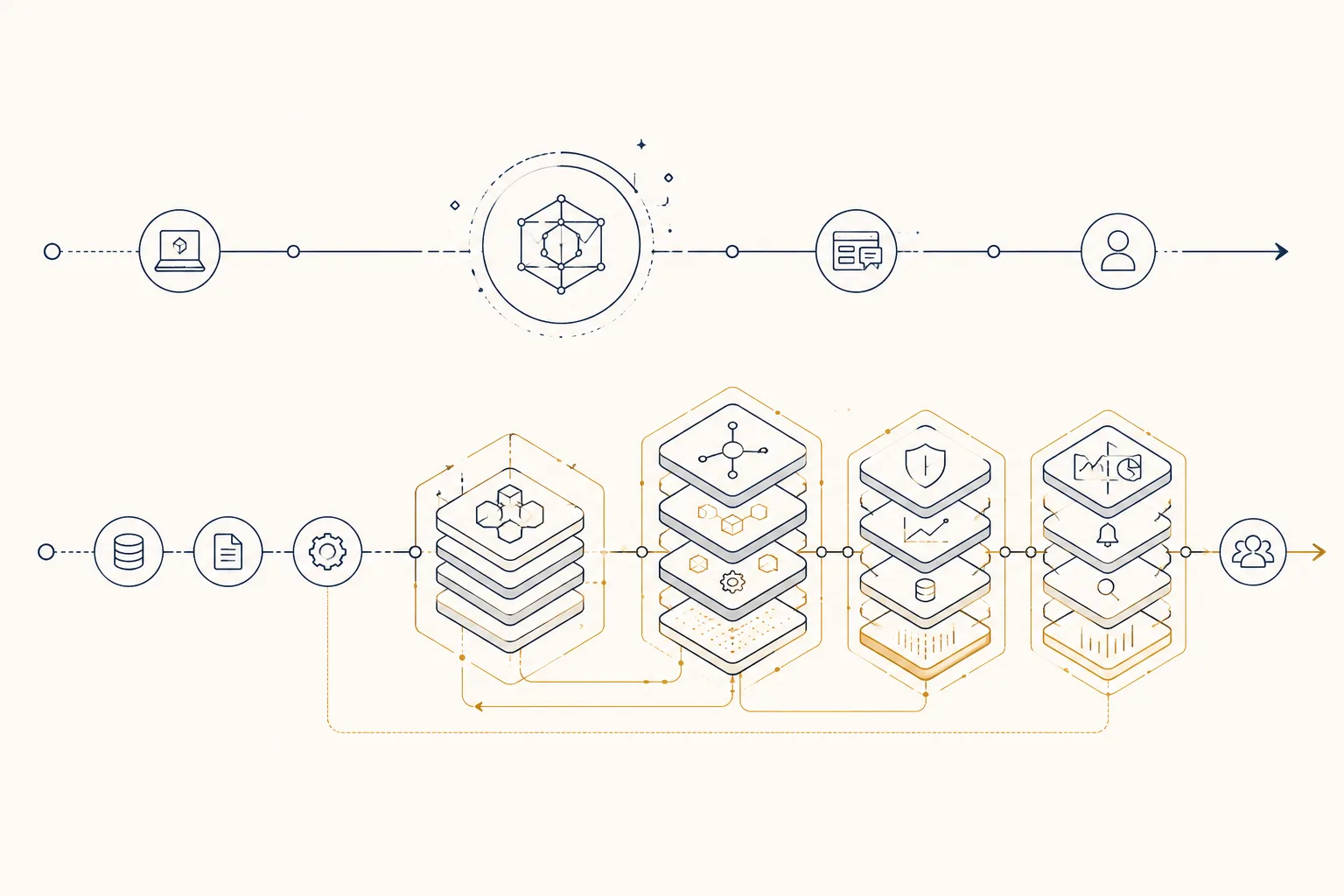
Every AI product has two lives. The first one lasts about four days. Someone wires a model to a prompt, feeds it a clean input, and the output is good enough that the room goes quiet. Budgets get approved on the strength of that moment.
Every AI product has two lives. The first one lasts about four days. Someone wires a model to a prompt, feeds it a clean input, and the output is good enough that the room goes quiet. Budgets get approved on the strength of that moment.
The second life starts when a real user sends a badly scanned PDF at 2am from a network that drops packets, and expects an answer in under three seconds, for the ten-thousandth time that week, at a unit cost that leaves a margin.
Almost all of the engineering lives in the gap between those two moments. After four years of building AI-native products, most recently across applicant tracking, marketplace, and workflow automation systems, my view is that AI product development is not primarily a modeling problem. It is a systems problem wearing a modeling costume. This piece is about what that system actually looks like when it is built properly.
Why the demo lies to you
A demo optimizes for the best case. Production is defined by the worst case, and the worst case in an AI system has a different shape than in traditional software.
Conventional software fails loudly. A null pointer throws, a request 500s, a test goes red. AI systems fail quietly and fluently. The model returns a well formatted, confident, plausible answer that happens to be wrong. Nothing in your stack raises an alarm, because from the infrastructure's point of view nothing broke. The response was 200 OK.
This changes the engineering problem in three concrete ways.
Correctness becomes statistical, not binary. You cannot assert that the output equals an expected value. You can only measure that the output is acceptable often enough, on a distribution of inputs you have deliberately assembled.
Regressions are invisible without instrumentation. Change a prompt, swap a model version, adjust a chunking strategy, and you may improve six things while breaking two others. Without a measurement harness you will not know which.
Failure is a product surface, not an exception path. How the system behaves when it is uncertain is part of the user experience, and it deserves as much design attention as the happy path.
Teams that skip these three realities do not fail immediately. They fail at month four, when the product works but nobody trusts it, and no one on the team can explain why last week's version felt better.
Evaluation is the actual foundation
If there is one investment that separates AI products that reach production from those that stay in perpetual pilot, it is a serious evaluation layer built early.
An evaluation framework does not need to be sophisticated to be useful. It needs to exist and it needs to run automatically. A workable starting point:
A golden dataset of real inputs. Between 50 and 200 examples drawn from actual usage, not synthetic ones you invented. Include the ugly cases: the truncated document, the multilingual input, the ambiguous request, the adversarial user. In a resume parsing system we built, roughly a fifth of the eval set was intentionally malformed input, because roughly a fifth of real uploads were.
Layered scoring. Deterministic checks first, because they are free and unambiguous: is the JSON valid, are required fields present, is the output within length bounds, did it stay inside the allowed schema. Then model-graded checks for the qualities you cannot regex: faithfulness to the source, tone, reasoning quality. Then a small human-reviewed slice, because model graders drift and need calibration against people.
Eval in CI. Every prompt change, every model swap, every retrieval tweak runs the suite. Prompts are code. They belong in version control with a diff, an owner, and a test result attached.
The cultural effect of this matters more than the technical one. Once a team can measure quality, arguments about prompts stop being arguments about taste. Someone proposes a change, the suite runs, the number moves or it does not. Iteration speed roughly doubles, in my experience, because nobody is relitigating opinions.
Architecture: build the boring parts deliberately
The interesting part of an AI product is the model. The parts that determine whether it survives contact with users are almost entirely boring.
Treat the model as a replaceable component
Model providers ship new versions on their own schedule, prices move, and capability leadership rotates. Any system that hardcodes a single provider deep in its business logic is accumulating debt with a variable interest rate.
The pattern that holds up: a thin internal interface for model calls, with provider specifics isolated behind it. Task definitions specify what they need, such as reasoning depth, latency ceiling, context size, and structured output support, and a routing layer resolves that to a concrete model. Swapping a provider becomes a configuration change validated by the eval suite, not a refactor.
Route by task difficulty, not by habit
Most production AI workloads are not uniform. In a typical hiring workflow, classifying a document type, extracting structured fields, and writing a nuanced candidate summary are three tasks with radically different difficulty profiles. Sending all three to your most capable model is the single most common source of avoidable cost in AI products.
A tiered approach, where cheap fast models handle high volume mechanical work and frontier models handle the small fraction of genuinely hard reasoning, routinely cuts inference spend by more than half without a measurable quality drop. The eval suite is what lets you make that claim with confidence instead of hope.
Design for partial failure
Assume the model call times out. Assume it returns malformed JSON. Assume the provider has an incident during your customer's biggest hiring week.
Concretely this means: schema validation on every structured output with a bounded retry and a repair prompt, timeouts and circuit breakers on every external call, idempotent job design so retries do not duplicate work, a fallback model configured and tested rather than theoretical, and queue-based processing for anything that does not need to be synchronous. Most AI features do not need to be synchronous. Users tolerate a progress indicator far better than they tolerate a spinner that dies.
Put a cost and latency budget on every feature
Before writing the prompt, write down the numbers: target cost per operation, p95 latency ceiling, expected monthly volume. These constraints shape the design, and they surface unviable features while they are still cheap to kill. A feature that costs 40 cents per invocation inside a subscription priced at 29 dollars a month is not a feature, it is a liability with a nice interface.
Retrieval and context: the quality ceiling nobody talks about
When an AI product gives a weak answer, the instinct is to blame the model or rewrite the prompt. In grounded systems, the cause is usually upstream: the model never received the information it needed.
Retrieval quality sets a hard ceiling on output quality. No prompt engineering recovers from missing context. Practical consequences worth internalizing:
Chunking is a product decision. Splitting documents on arbitrary character counts destroys the semantic units your system needs to reason over. Structure aware chunking, respecting sections, clauses, and headings, consistently outperforms naive splitting.
Hybrid retrieval beats pure vector search in most business domains. Semantic search handles paraphrase well and exact identifiers badly. Real queries contain both. Combining keyword and vector retrieval, then reranking, is the default that should be argued out of rather than argued into.
Measure retrieval separately from generation. Track whether the correct source appeared in the retrieved set at all. If recall is the problem, no amount of prompt iteration will help, and teams waste weeks discovering that.
Agentic systems: give autonomy where you can afford to be wrong
Multi step agents that plan, call tools, and act are the most consequential capability shift in AI products right now. They are also where the most expensive production failures happen, because error compounds. A chain with 95 percent per step reliability is below 60 percent reliable across ten steps.
The framing that has served us well: autonomy should scale inversely with the cost of being wrong.
Reading, summarizing, drafting, and enriching data are low blast radius operations. Let the agent run. Sending communications on behalf of a user, moving money, modifying production records, and making irreversible decisions are high blast radius operations, and they belong behind explicit confirmation, no matter how good the eval numbers look.
Alongside that: constrain the tool surface to the minimum the task requires, cap steps and spend per run so a loop cannot become an invoice, log every decision in a form a human can audit after the fact, and make every action reversible where the domain allows it.
The most useful agentic products in production today are not the most autonomous ones. They are the ones that correctly identified which decisions to hand back to a person.
The advantage compounds in the data, not the model
Every team has access to roughly the same models. Nobody's competitive position rests on which provider they called this quarter.
The durable advantage is the loop: your product produces outputs, users correct or accept them, those corrections are captured as structured signal, and that signal improves retrieval, prompts, routing, and eventually fine-tuned components. Six months of that loop running produces a system your competitor cannot replicate by switching providers, because they do not have your corrections.
Building this in from the start costs very little. Capture the edit, capture the rejection, capture the override, with enough context to be interpretable later. Teams that add telemetry after launch spend the following year regretting the data they did not keep.
What good looks like
An AI product that is ready for production, in my assessment, satisfies most of the following:
Quality is measured continuously against a real eval set, and the number is visible to the team
Model providers can be swapped through configuration
Tasks are routed by difficulty, with cost per operation known and tracked
Every structured output is schema validated with a defined repair path
Uncertainty is expressed in the interface rather than hidden behind confident prose
High consequence actions require human confirmation
User corrections are captured as structured training signal
There is a documented answer to what happens when the primary provider goes down
None of this is exotic. It is ordinary engineering discipline applied to a probabilistic component. The teams shipping durable AI products are not the ones with the cleverest prompts. They are the ones who treated the model as one part of a system that has to work on a bad day.
Frequently asked questions
What is the biggest reason AI products fail to reach production? The absence of an evaluation framework. Without a way to measure output quality on real inputs, teams cannot tell whether changes improve the product, and confidence never accumulates to the point where the system can be trusted with real users.
How much should AI inference cost per operation? It depends entirely on the pricing model, but the useful discipline is to set a target before building. Define cost per operation, p95 latency, and expected volume up front, then design toward those numbers. Task based model routing is usually the highest leverage optimization available.
Should AI products use a single model provider or several? Build against an internal abstraction that allows several, even if you begin with one. Provider capability, pricing, and availability all change on timelines you do not control, and the switching cost should be a configuration change validated by evals rather than a refactor.
When should an AI agent act autonomously? When the cost of being wrong is low and the action is reversible. Reading, drafting, and enriching data are safe to automate. Communications, financial transactions, and irreversible record changes should require explicit human confirmation regardless of measured accuracy.
How do you evaluate AI output quality that is subjective? Layer three methods: deterministic checks for structure and constraints, model graded scoring for qualities like faithfulness and tone, and a periodic human reviewed sample to calibrate the model graders, which drift over time.
Vision Nexera builds AI-native products end to end, from evaluation infrastructure and retrieval architecture to production deployment. If you are moving an AI feature from prototype to production, get in touch.