AI Engineering Company: Building Production-Ready AI Solutions
September 8, 2026 · Muhammad Hammad · Co-founder & Engineer, Vision Nexera · 10 min read
Updated
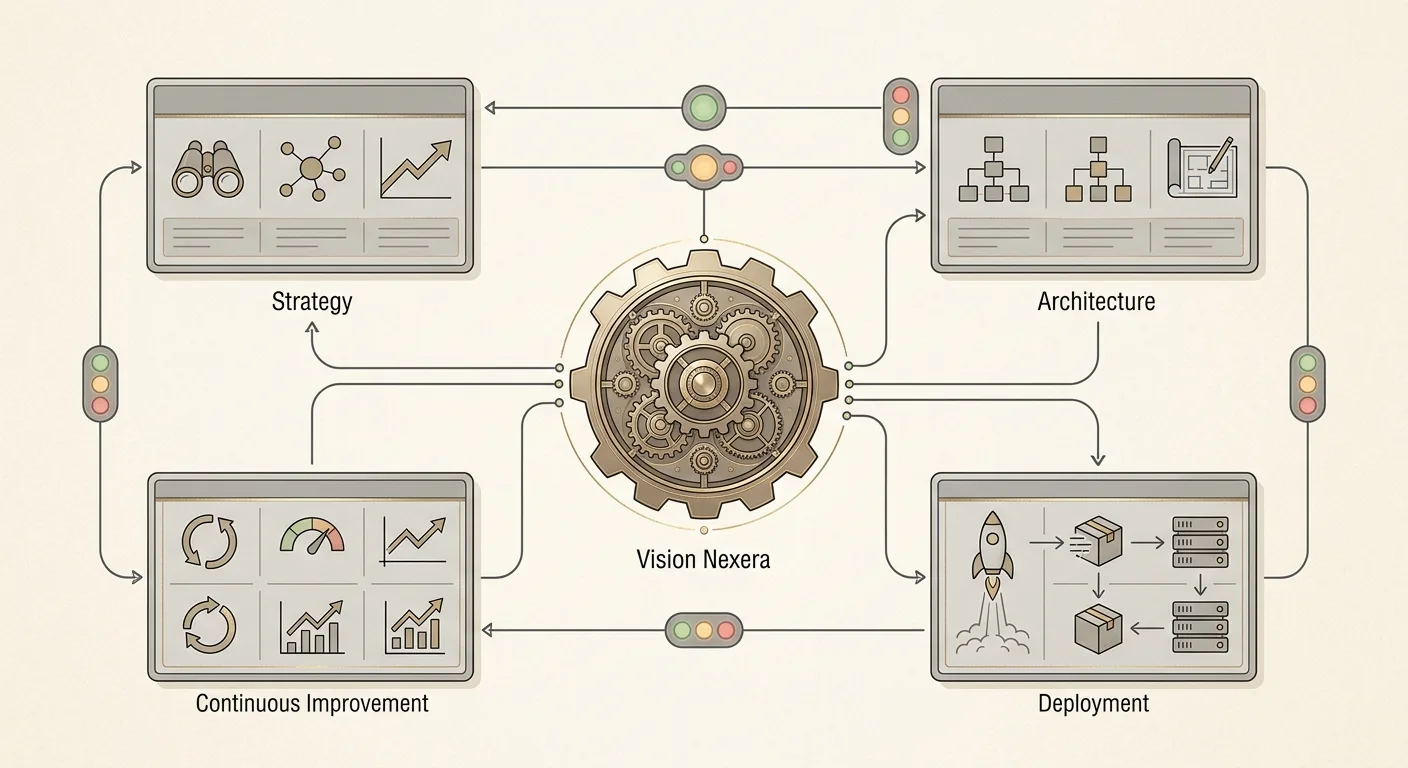
AI is moving beyond chatbots and simple automation. Businesses are now looking for AI engineering companies that can build production-ready AI agents, generative AI applications, RAG systems, AI automation, voice AI, and intelligent software integrations. Vision Nexera is an AI engineering company helping businesses turn AI ideas into reliable, scalable products and workflows, from AI strategy and architecture to development, integration, deployment, and continuous improvement.
AI Engineering Company: What Businesses Actually Need to Build Production-Ready AI
AI is moving from experiments and chatbots to systems that can reason, use tools, automate workflows, and operate inside real businesses. But building production-ready AI requires much more than connecting an application to an LLM.
Companies today are looking for AI engineering teams that can take an idea from strategy and architecture to deployment, integration, evaluation, and continuous improvement.
That is where modern AI engineering comes in.
What Is an AI Engineering Company?
An AI engineering company designs and builds software systems that use artificial intelligence to solve real business problems.
Unlike traditional AI consulting, which may stop at strategy or prototypes, AI engineering focuses on turning those ideas into working, scalable software.
A modern AI engineering company may build:
AI agents that perform business tasks
Generative AI applications
Retrieval-augmented generation (RAG) systems
Enterprise knowledge assistants
AI-powered workflow automation
Voice AI agents
LLM-powered applications
Computer vision systems
Predictive AI and machine learning solutions
AI integrations with CRMs, ERPs, databases and internal software
AI coding and software engineering agents
The important distinction is simple:
A chatbot answers a question. An AI system can understand a goal, access information, use tools, take an action, verify the result, and involve a human when necessary.
That shift is driving the next generation of enterprise software.
Why Businesses Are Moving Beyond Chatbots
The first wave of business AI focused heavily on chatbots.
Companies wanted an assistant that could answer FAQs, summarize documents or provide basic customer support.
That is still useful—but it is no longer the limit of what businesses expect from AI.
Today's AI systems are increasingly expected to perform work.
An AI agent might:
Receive a customer request
Understand the intent
Retrieve information from internal systems
Decide which tools it needs
Call an API or update a CRM
Generate a response
Check whether the task succeeded
Escalate to a human when required
This is the evolution from AI that generates content to AI that executes workflows.
Current enterprise AI development is increasingly centered around agentic workflows, integrations, governance and measurable business outcomes. Recent enterprise research and industry reporting also show growing attention toward AI agents and AI-assisted software engineering.
What Does an AI Engineering Company Actually Build?
A strong AI engineering partner typically works across several layers of the AI stack.
1. AI Agent Development
AI agent development is becoming one of the most important areas of enterprise AI.
AI agents can combine LLM reasoning with tools, APIs, databases, business rules and human approval.
For example, a sales agent could:
Research a prospect
Enrich company information
Analyze previous interactions
Draft personalized outreach
Update the CRM
Schedule follow-ups
Report the result to a sales representative
A customer-support agent could retrieve account information, understand a customer's problem, search internal documentation and take authorized actions.
The difference is that the AI is not simply producing text.
It is participating in the workflow.
2. Generative AI Development
Generative AI development involves building applications around foundation models such as GPT, Claude, Gemini, Llama and other open or proprietary models.
Businesses are using generative AI for:
Document processing
Content generation
Research
Customer support
Sales enablement
HR automation
Internal knowledge management
Software development
Data analysis
Personalized experiences
However, production generative AI requires more than choosing a model.
The engineering challenge is determining:
Which model? Which data? Which architecture? Which tools? Which permissions? Which evaluation strategy?
That is why model selection should be treated as an engineering decision rather than a branding decision.
3. RAG Development and Enterprise Knowledge Systems
One of the most practical applications of generative AI is Retrieval-Augmented Generation (RAG).
Instead of asking an LLM to answer purely from its training data, a RAG system retrieves relevant information from a company's own knowledge sources.
These may include:
PDFs
Websites
SharePoint
Databases
CRM records
Knowledge bases
Internal documentation
Emails
Product documentation
The retrieved information is then provided to the AI model as context.
This allows businesses to build AI systems grounded in their own information.
Modern enterprise RAG is also evolving beyond simple vector search. Production systems increasingly require better retrieval, permissions, evaluation, observability and continuous improvement. Research from LinkedIn, for example, describes production support systems combining RAG, evaluation and continuous improvement rather than treating RAG as a one-time implementation.
4. AI Automation
AI becomes particularly valuable when it is connected to existing business workflows.
Consider a traditional workflow:
Email → Employee reads request → Searches database → Updates CRM → Sends response
An AI-powered workflow could become:
Email → AI understands request → Retrieves data → Executes approved actions → Updates CRM → Responds
This is where AI automation becomes different from traditional automation.
Traditional automation follows predefined rules.
AI automation can interpret less-structured information and make bounded decisions within those rules.
Common applications include:
Lead qualification
Recruiting automation
Customer support
Document processing
Invoice processing
Claims processing
Sales operations
HR workflows
Internal operations
Data extraction
Back-office automation
The best systems combine AI reasoning with deterministic software rather than trying to make the LLM responsible for everything.
5. Voice AI Agents
Voice AI is another rapidly developing area of AI engineering.
Modern voice agents can handle conversations over phone systems and interact with business software while the conversation is happening.
For example:
Customer calls → Voice AI understands request → Retrieves customer data → Performs authorized action → Responds → Escalates if necessary
Voice AI can be used for:
Customer service
Appointment scheduling
Lead qualification
Sales calls
Recruitment
Follow-ups
Receptionist automation
Support hotlines
The engineering challenge is not simply generating a natural voice.
It involves latency, interruption handling, speech recognition, context management, tool calling, reliability and human escalation.
6. AI Integration With Existing Software
Most companies do not need another isolated AI application.
They need AI inside the software they already use.
That may include:
Salesforce
HubSpot
Microsoft Dynamics
SharePoint
Slack
Microsoft Teams
PostgreSQL
MongoDB
ERP systems
HR platforms
Internal APIs
Custom SaaS applications
This makes AI integration a critical AI engineering capability.
The goal is to create a clean connection between AI capabilities and existing business infrastructure.
For example:
CRM → AI agent → customer history → decision → CRM update
rather than:
CRM → export data → separate AI tool → manual copy/paste
Production AI Is More Than an LLM
This is where many AI projects fail.
A prototype can often be built quickly.
A production AI system is different.
It needs:
Data
Reliable, relevant and accessible business data.
Context
The AI needs the right information at the right time.
Tools
Agents need controlled access to APIs, databases and software.
Guardrails
The system needs clear boundaries around what it can and cannot do.
Permissions
An AI agent should only access information and actions it is authorized to use.
Evaluation
Teams need to know whether the AI is actually improving.
Observability
Production systems need monitoring for errors, latency, cost and quality.
Human-in-the-loop
Important or irreversible actions may require human approval.
Cost control
AI systems must be economically viable at real usage volumes.
This is why the difference between an AI demo and a production AI system is significant.
The Modern AI Engineering Workflow
At Vision Nexera, we believe successful AI projects should be engineered as systems rather than treated as model integrations.
A typical workflow looks like this:
01 — Understand the business problem
Before selecting a model, understand the workflow.
What is currently happening?
Where is the bottleneck?
What decision is being made?
What does success look like?
02 — Identify the right AI opportunity
Not every problem requires an AI agent.
Some workflows are better solved with:
Traditional automation
Rules
APIs
Search
Machine learning
Computer vision
Generative AI
AI agents
A combination of these
The objective is not to use the most sophisticated technology.
The objective is to solve the business problem efficiently.
03 — Design the AI architecture
The architecture may include:
User → Application → AI orchestration → LLM → RAG → Tools/APIs → Business systems
Additional layers can provide:
Authentication
Authorization
Guardrails
Evaluation
Monitoring
Logging
Human approval
04 — Build a working MVP
The first version should focus on one measurable workflow.
Rather than attempting to automate an entire organization, start with a process where AI can demonstrate clear value.
05 — Evaluate against real scenarios
AI systems should be tested against representative real-world cases.
This can include:
Accuracy
Retrieval quality
Tool-call correctness
Hallucination rate
Response quality
Task completion
Latency
Cost
06 — Integrate and deploy
The AI system is connected to the company's actual infrastructure and deployed into a controlled environment.
07 — Monitor and improve
Production AI is not finished at launch.
Models change.
Data changes.
Business rules change.
Users behave differently from test cases.
A strong AI engineering process therefore includes continuous monitoring, evaluation and improvement.
AI Engineering vs Traditional Software Development
AI engineering does not replace software engineering.
It extends it.
A production AI application still needs:
Frontend + Backend + Database + APIs + Authentication + Infrastructure
But it may additionally require:
LLMs + RAG + Embeddings + Agents + Tool Calling + Evaluation + Guardrails + AI Observability
This combination is what makes AI engineering fundamentally different from simply adding an AI API to an existing application.
How Vision Nexera Approaches AI Engineering
At Vision Nexera, we focus on building AI systems that can move from an idea to a production environment.
Our work spans:
AI Agent Development
Custom agents capable of reasoning, retrieving information and executing controlled actions.
Generative AI
LLM-powered applications designed around real business use cases.
RAG & Enterprise Knowledge
AI assistants grounded in proprietary business information.
AI Automation
Intelligent workflows that reduce repetitive operational work.
Voice AI
Conversational voice systems connected to real business workflows.
AI Integration
Connecting AI capabilities with CRMs, databases, APIs and existing software.
Computer Vision
AI systems that understand images and video for operational use cases.
AI Product Engineering
End-to-end development of AI-powered SaaS products and business applications.
We also believe that production AI needs engineering discipline.
That means evaluation, observability, permissions, guardrails and human oversight are considered part of the product—not optional features added later.
Why the Best AI Strategy Isn't "Build an AI Agent"
There is a growing temptation to put an AI agent into every workflow.
That is not necessarily good engineering.
A better question is:
Where can AI create measurable business value?
For some companies, that may be an AI agent.
For another, it may be a RAG knowledge assistant.
For another, it could be document intelligence, computer vision or AI-powered workflow automation.
The strongest AI engineering companies don't start with the technology.
They start with the workflow.
What Should You Look for in an AI Engineering Company?
Before choosing an AI development partner, ask:
Can they build beyond chatbots?
Look for experience with agents, integrations and real workflows.
Can they work with your existing systems?
AI rarely exists in isolation.
Do they understand RAG and enterprise data?
Your AI needs access to reliable information.
Do they evaluate their AI systems?
A successful demo does not prove production reliability.
Do they understand security and permissions?
AI agents with access to business systems require strong controls.
Can they build the complete product?
Ideally, your partner should understand frontend, backend, infrastructure and AI—not just prompt engineering.
Do they understand business outcomes?
The ultimate measure should be business impact.
The Future of AI Engineering
The next stage of AI is not simply better chatbots.
It is AI embedded into the way businesses operate.
AI agents will increasingly interact with software.
AI coding agents will participate across the software development lifecycle.
AI systems will retrieve and reason over enterprise data.
Voice agents will handle increasingly complex conversations.
Automation will move from deterministic workflows toward systems capable of interpreting context and executing multi-step tasks.
Gartner's 2026 research on enterprise AI coding agents reflects this broader transition, describing the market as moving from AI-assisted development toward increasingly agentic software development across the software development lifecycle.
The winning businesses will not necessarily be the ones using the most AI.
They will be the ones that engineer AI into the right workflows, measure its performance, and continuously improve it.
Build Your Next AI System With Vision Nexera
If you have an AI idea, an inefficient business workflow, or an existing product that could benefit from AI, the first step isn't choosing a model.
It is understanding the problem.
Vision Nexera helps businesses go from:
AI Idea → Architecture → Prototype → Production → Continuous Improvement
Whether you need AI agent development, generative AI, RAG, AI automation, voice AI, computer vision or custom AI software development, our focus is the same:
Build AI that works in the real world.
Have an AI workflow you want to automate?