AI Developer Hourly Rates by Country in 2026: US vs Eastern Europe vs India vs Pakistan vs GCC
October 8, 2026 · Asma Nawaz · Technical Content Writer, Vision Nexera · 15 min read
Updated
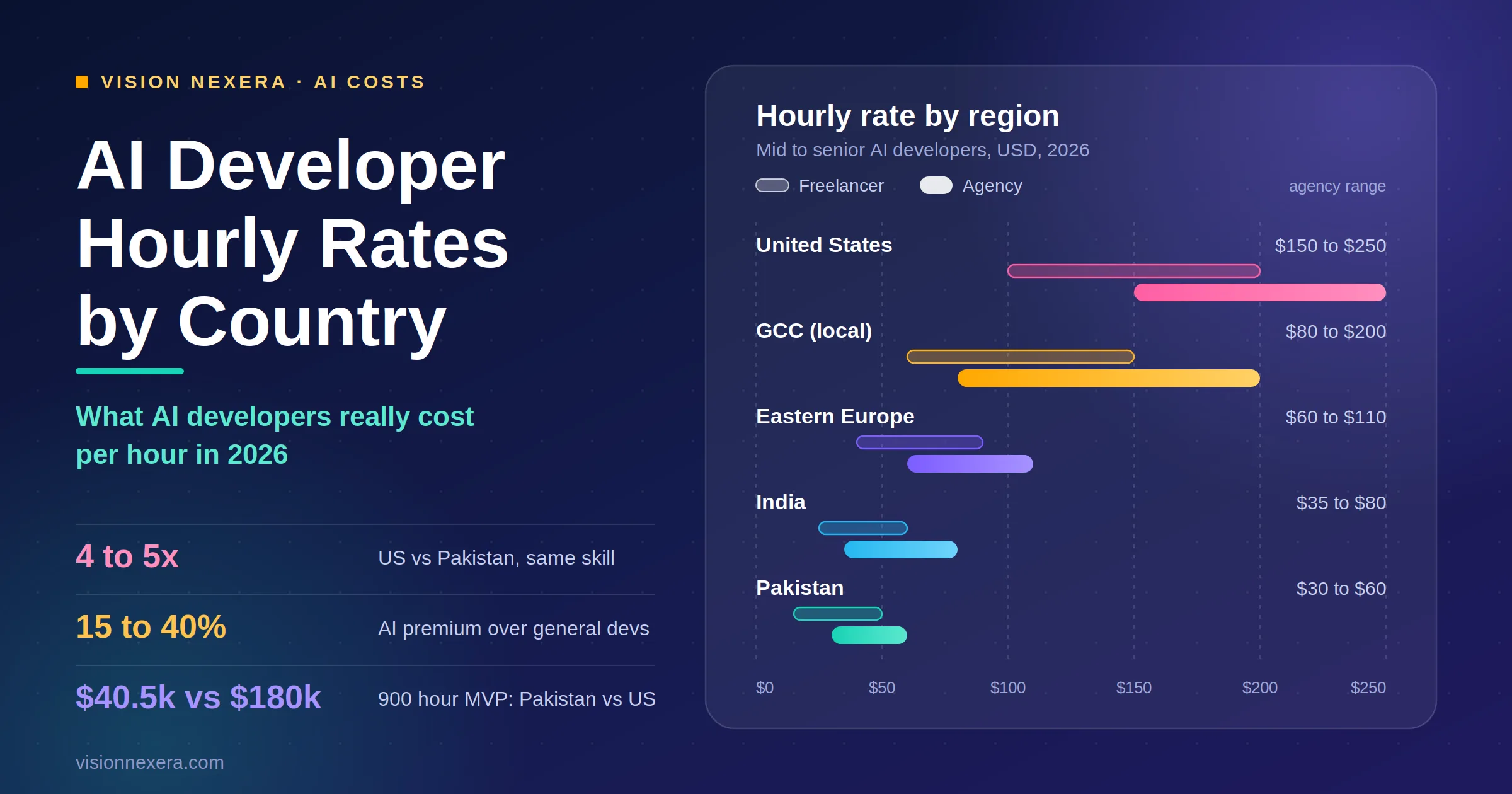
What AI developers really cost per hour in 2026. Rates by country for the US, Eastern Europe, India, Pakistan and the GCC, why sources disagree, and what the rate actually buys.
AI Developer Hourly Rates by Country in 2026: US vs Eastern Europe vs India vs Pakistan vs GCC
Ask five rate guides what an AI developer costs and you will get five different answers. One says $25 an hour, another says $250. They are not all wrong. They are measuring different things: a freelancer in Lahore, an agency in Austin, an employee in Dubai, a senior architect versus a junior who has finished a course.
This guide untangles it. It compares AI developer hourly rates across five markets that international buyers actually choose between in 2026: the United States, Eastern Europe, India, Pakistan, and the Gulf Cooperation Council countries. It explains why the numbers disagree, what the AI premium adds, what you get at each price point, and why the hourly rate is the least important number on your quote.
If you are a founder in the United States, the UK, or the Gulf, or a Pakistani business benchmarking your own pricing, the goal is the same: know what a fair rate looks like, and know what it actually buys.
A note on method before the numbers. Rate data in this space comes mostly from staffing platforms, marketplaces, and agencies publishing their own benchmarks. Treat every figure here as a market range, not a quote. Agency ranges are directional, and your actual price depends on seniority, scope, and engagement model. This is a companion to our guide on AI agent development cost, which covers the full build and running cost of an agent.
The quick answer
Typical hourly rates for a mid to senior AI or LLM developer in 2026, in US dollars:
Region
Freelancer or independent
Agency or studio
United States
$100 to $200
$150 to $250
Eastern Europe
$40 to $90
$60 to $110
India
$25 to $60
$35 to $80
Pakistan
$15 to $50
$30 to $60
GCC (locally based)
$60 to $150
$80 to $200
Three things to take from the table.
The spread between the top and bottom is roughly four to five times for comparable skill. A US agency at $200 an hour against a senior Pakistani team at $45 is about 4.4 times, which is the gap we cited in the cost guide.
Freelancer rates sit below agency rates everywhere, and the gap is what you pay for management, continuity, and accountability. Part of any agency rate is the cost of someone being responsible when the work breaks.
The low end of every range is risky. A $15 an hour AI developer exists, and some are excellent, but when you read any chart, assume the engineer you actually need sits near the upper half of the local range, not the bottom.
Why the numbers disagree so much
When two guides give different rates for the same country, one of these is usually the reason.
Seniority. A junior who has built a chatbot on an API and a senior who has run retrieval systems in production are both called AI developers. Their rates can differ by three times within one city.
Engagement model. A freelancer on a marketplace, a vetted contractor, a dedicated team from an agency, and a salaried employee are priced differently even when the same engineer does the work. Marketplace fees, agency overhead, and employer costs all sit on top of the engineer's pay.
Mid level versus senior averages. Many guides quote a mid level average and call it the country rate. Senior AI work, especially agents, retrieval, and voice, prices at the upper end.
Specialization. AI and machine learning work typically earns a premium over a general developer, and the premium varies by source.
Source bias. Agencies publish rates that make their own region look attractive. A vendor selling Eastern European teams will describe that region as the sweet spot, and a vendor selling Asian teams will describe the same trade differently. Read rate guides the way you read any marketing, with the incentive in mind.
The AI premium
AI developers cost more than general software developers almost everywhere. Across 2026 benchmarks, AI and machine learning specialization typically adds roughly 15 to 40 percent over a comparable general developer, and some benchmarks for LLM and agent specialists put the uplift higher. Demand is the reason: far more companies want people who can ship retrieval systems, agents, and voice pipelines than there are engineers who have done it in production.
The premium is not evenly spread. Application work, where an engineer integrates a model API into a product, prices close to normal software rates. Work that requires evaluation pipelines, retrieval quality, guardrails, and production reliability prices at the top of each range. This matters when you compare quotes, because two vendors can both say AI developer while offering very different depth.
Region by region
United States
Rates: roughly $100 to $200 an hour for freelancers and $150 to $250 for agencies, with premium specialists above that.
What you get: the deepest pool of senior AI talent, strong product instincts, proximity to US customers and investors, and full time zone overlap for US based teams.
What to watch: the cost. A US in house hire is more expensive than the salary suggests once benefits, taxes, equipment, recruiting time, and ramp up are added, and a senior AI engineer in a competitive market can command high six figure packages plus equity. Hiring is also slow and competitive.
Best for: companies where US based presence, security clearances, or in person collaboration is a hard requirement, and where budget is not the constraint.
Eastern Europe
Rates: roughly $40 to $90 an hour for freelancers and $60 to $110 for agencies, with wide variation by country. Poland and Romania tend toward the upper half, and Bulgaria, Serbia, and others sit lower.
What you get: strong mathematics and computer science education, European working hours, EU data protection standards, and a culture of close collaboration with Western clients. Time overlap is full with Europe and partial with the US East Coast.
What to watch: rates have been rising as the region's profile has grown. Currency movements and geopolitical factors in some countries are worth checking against your own risk tolerance.
Best for: European companies that want near shore collaboration and GDPR aligned practices, and US teams that want working hours overlap at roughly half US prices.
India
Rates: roughly $25 to $60 an hour for freelancers and $35 to $80 for agencies, with a very wide spread. A single India rate means little on its own, because the range between a large outsourcing firm's junior and a specialist boutique's principal engineer is enormous.
What you get: the largest offshore AI talent pool in the world, a mature vendor ecosystem, and options at every price point and scale. That depth makes it easy to staff a large team quickly.
What to watch: variance in quality is high because the market is so large, so vetting matters more here than almost anywhere. Time zone overlap with the US requires a shifted schedule.
Best for: larger programs that need scale, companies that want a mature outsourcing ecosystem, and buyers with the capacity to vet vendors carefully.
Pakistan
Rates: roughly $15 to $50 an hour for freelancers and $30 to $60 for agencies. Senior LLM, retrieval, and agent specialists on vetted marketplaces commonly list at $25 to $50, and established studios with delivery management sit toward the top of the range.
What you get: a growing pool of senior engineers fluent in the modern AI stack, working in English for international clients, at rates that look like a bargain from the US. The rate gap is driven by local cost of living and market structure, not by capability. A strong engineer in Lahore or Karachi with the same production history as one in San Francisco earns a good local living at a rate that is a fraction of the US figure.
What to watch: the talent pool is smaller than India's, so quality is uneven and the strongest teams are not hard to find but are worth distinguishing from the rest. Time overlap with the US is partial and requires a shifted schedule. Pakistan overlaps fully with the Gulf working day, most of the day in Europe and the UK, and US mornings.
Best for: startups and growing companies that want senior production experience at a fraction of US cost, and Gulf companies that want strong time zone overlap. We cover how to evaluate Pakistani teams in our guides to the top AI agent development companies in Pakistan and AI voice agent development companies in Pakistan.
GCC: Saudi Arabia, UAE, Qatar
Rates: roughly $60 to $150 an hour for locally based freelancers and consultants, and $80 to $200 for locally based agencies. Published Dubai ranges put a senior Python developer with an AI focus at about $55 to $95 an hour, and an AI architect or lead at about $80 to $150, with specialist consultants higher.
What you get: local presence, Arabic language and cultural fluency, in person workshops, familiarity with local procurement and regulation, and, for sensitive projects, engineers who can work inside your own environment in country. AI salaries in the region have been climbing, with hiring data in the UAE reporting increases of 20 to 25 percent as national AI strategies pull demand up.
What to watch: the price. Local talent is scarce and priced for local living costs, and an employee hire carries visa, medical, and end of service costs on top of salary. Many agencies in the region deliver with blended teams, so ask who actually writes the code.
Best for: government and regulated enterprise projects where local presence, procurement rules, or in country delivery are requirements, and as a front end for projects that are largely built offshore.
A point that shapes this decision more than the hourly rate: where the engineers sit is separate from where the data lives. For Saudi projects, the data residency questions covered in our guide to PDPL compliant AI in Saudi Arabia can usually be satisfied while the build team works from elsewhere, as long as the architecture keeps personal data and model inference in the Kingdom.
The hourly rate is the wrong number to compare
Every honest rate guide ends up saying the same thing: never compare hourly rates alone. What you pay for is a finished system, and the number that decides that is closer to rate multiplied by hours, plus the cost of getting it wrong.
Hours per outcome differ. A senior engineer at $90 an hour who has built a retrieval pipeline three times can finish in far fewer hours than a cheaper engineer learning on your project. One benchmark found that a senior engineer in Eastern Europe can beat a junior in North America on total project cost while delivering in a fraction of the hours. The point generalizes: seniority per dollar matters more than dollars per hour.
Management overhead is real. A cheap rate with a team that needs constant direction costs you your own time, and your time has a price.
Rework is the silent cost. A system built without evaluation, error handling, or guardrails gets rebuilt. This is the same demo versus production gap we describe in the demo is not the product.
Time zones cost money in another way. A team that cannot join your Tuesday decision meeting slows every loop, even if the rate is lower.
Running costs sit outside the rate entirely. The tokens, telephony, and hosting for a live agent are the same wherever the engineers sit, which is why a cheap build does not make a cheap agent. The cost guide covers this in detail.
A worked example: the same project in five markets
Take a scoped production MVP of about 900 hours, which is roughly the size of a single workflow agent with retrieval, a few integrations, and an evaluation suite. Using the midpoint of each agency range above, and assuming the same hours:
Region
Midpoint agency rate
Cost at 900 hours
United States
$200
$180,000
GCC (local)
$140
$126,000
Eastern Europe
$85
$76,500
India
$55
$49,500
Pakistan
$45
$40,500
Treat this as an illustration, not a quote. Real projects differ in hours, a more senior team may finish faster, and a cheaper team may need more review. But the shape is the useful part: the gap between the top and bottom is real, and it lands in the same range as the build tiers in our cost guide, where most custom agents cost between $25,000 and $120,000.
Which model fits which buyer
A US startup with a seed round and a product to ship usually does best with a senior offshore studio in a time zone it can manage, using a fixed price scope for the first build and a retainer after launch. The savings fund more runway.
A European company that wants close collaboration and GDPR alignment is well served by Eastern Europe, or by a South Asian team with strong overlap with European hours.
A Gulf enterprise or government client with local requirements often needs a local front end, a GCC based partner for procurement and in person work, backed by a delivery team elsewhere. Vision Nexera works this way, with teams in Lahore and Doha.
A company building a long term AI team may prefer employees or dedicated staff in a lower cost market, which turns hourly rates into monthly cost and brings management overhead.
A company with a clearly defined, non critical task can often get excellent value from an independent, as long as it accepts that continuity and accountability are lighter.
Fixed price, hourly, or retainer
The rate you see depends on the engagement model.
Fixed price turns hours into a scope. You pay for an outcome, the vendor carries the risk of overrun, and quality depends on how clearly the scope is written. It is the safest structure for a first engagement.
Time and materials is flexible and transparent, and the meter is always running. It suits evolving work and needs strong reporting.
Dedicated team or staff augmentation gives you control and continuity at a monthly cost, with management on your side.
Retainer covers maintenance, monitoring, and improvements after launch, which every live agent needs.
Compare vendors on the same model. A fixed price quote and an hourly rate are not directly comparable until you estimate the hours.
How Vision Nexera prices AI work
Vision Nexera is an AI product engineering company with teams in Lahore and Doha that builds AI agents, RAG systems, and full AI powered products for clients in the United States, the UK, Europe, and the Gulf. We price by scope rather than by the clock for first engagements: a scoping call produces a written scope and an honest estimate, a paid Discovery de risks the build, and larger work uses staged payments so cost follows delivery. You can see how this works on our pricing and process pages.
The rate advantage comes from where the team sits, not from cutting corners, and the reliability work that makes production systems trustworthy, evaluation, error handling, monitoring, and human checkpoints, is in the scope rather than left out to hit a lower number. Where a project needs a Gulf presence, the Doha team and our locations cover that.
The limitation: no honest number exists without a scope. A rate card tells you what an hour costs, and the question that matters is what the finished system costs. That starts with a written scope.
Frequently asked questions
What is the average hourly rate for an AI developer in 2026?
It depends on region and engagement model. As a rough guide, US agencies run $150 to $250 an hour, Eastern Europe $60 to $110, India $35 to $80, Pakistan $30 to $60, and locally based GCC agencies $80 to $200. Freelancers typically sit lower in each market.
Which country has the cheapest AI developers?
Pakistan and India have the lowest rates for comparable skill, with Pakistan generally sitting a little below India. The cheapest rate is not the cheapest project, because hours, rework, and management overhead change the total.
Is Pakistan good for hiring AI developers?
Yes, for the right buyer. There is a growing pool of senior engineers with production experience in LLMs, retrieval, agents, and voice, at rates far below the US. Quality varies, so vet for production work, not demos, and check time zone overlap against your needs.
How much more do AI developers cost than regular developers?
Typically about 15 to 40 percent more, with higher premiums reported for LLM and agent specialists and for roles that require production reliability and evaluation experience.
Why are US AI developer rates so much higher?
Cost of living, competition for talent, and employer overhead. A senior engineer in a major US hub earns far more than the same engineer in Lahore, and benefits, taxes, equipment, and recruiting push the real cost of an employee above the salary. That is why the gap is mostly about market structure, not capability.
Should I pick the cheapest rate?
No. Compare total delivered cost, which includes the hours needed, the seniority of the team, the management load, and the rework risk. A senior team that ships once usually costs less than a cheaper team that needs three attempts.
Do GCC companies hire offshore AI developers?
Many do, often through a local partner that handles procurement and presence while a delivery team elsewhere builds the system. For Saudi projects, data residency and PDPL requirements shape the architecture, but they do not require every engineer to sit in the Kingdom.
Freelancer or agency for an AI project?
For a contained, non critical task, a strong freelancer is often the best value. For anything mission critical, an agency with a clear scope, accountability, and maintenance after launch is usually worth the premium.
How accurate are hourly rate guides like this one?
They are market ranges drawn from public benchmarks, and most come from vendors with an interest in how their own region looks. Use them to sanity check quotes and to understand the gap, not to predict a price. The only reliable number is a written estimate for your scope.
What the rate is really buying
The headline gap between the United States and Pakistan is real, roughly four to five times for comparable skill, and it is driven by cost of living and market structure rather than ability. But the useful question is not who has the lowest hourly rate. It is who has shipped what you need in production, will tell you honestly what it costs, and has a time zone, a contract, and a data residency posture that fit your business.
If you are comparing rates for an AI project, start with a written scope. Book a scoping call with Vision Nexera and leave with a clear plan, an honest estimate, and a straight answer on what the project really costs to build and run.
Related reading
How much does it cost to build an AI agent: https://www.visionnexera.com/insights/ai-agent-development-cost
Build vs buy for AI features: https://www.visionnexera.com/insights/build-vs-buy-ai-features
The Demo Is Not the Product: https://www.visionnexera.com/insights/ai-product-development-demo-to-production
Top AI Agent Development Companies in Pakistan 2026: https://www.visionnexera.com/insights/top-ai-agent-development-companies-in-pakistan-2026
Top AI Voice Agent Development Companies in Pakistan 2026: https://www.visionnexera.com/insights/top-ai-voice-agent-companies-pakistan-2026
PDPL-Compliant AI Agent Development in Saudi Arabia: https://www.visionnexera.com/insights/pdpl-compliant-ai-agent-development-saudi-arabia
AI Agents service: https://www.visionnexera.com/services/ai-agents
Pricing: https://www.visionnexera.com/pricing
Process: https://www.visionnexera.com/process
Locations: https://www.visionnexera.com/locations