AI ROI for UK Businesses: Why Firms Miss It and How to Fix It
November 13, 2026 · Muhammad Hammad · Co-founder & Engineer, Vision Nexera · 8 min read
UK businesses adopt AI but miss the ROI because most use is free, general-purpose tools spread thinly, with no chosen workflow, no baseline and no owner for the result. The government's 2026 survey shows adoption doubled to 32%, yet 64% of adopters saw no immediate financial effect. The fix for AI ROI for UK businesses is narrow: baseline one costly workflow, embed AI inside the system of record, then scale, change or stop it.
The UK's second government AI adoption survey landed on 29 October 2026, and the headline was easy to repeat: business use of AI doubled in a year. The detail underneath is less comfortable for anyone who signed off the budget. Most adopters are using AI. Few can show what it returned.
This piece is for COOs and operations heads at 50–500 person UK firms who are being asked the same question by the board and the finance director: what are we getting for this? It covers what the new data says, why the return goes missing, and a 90-day way to fix AI ROI for UK businesses one workflow at a time.
Adoption doubled in 2026, but the financial effect mostly did not
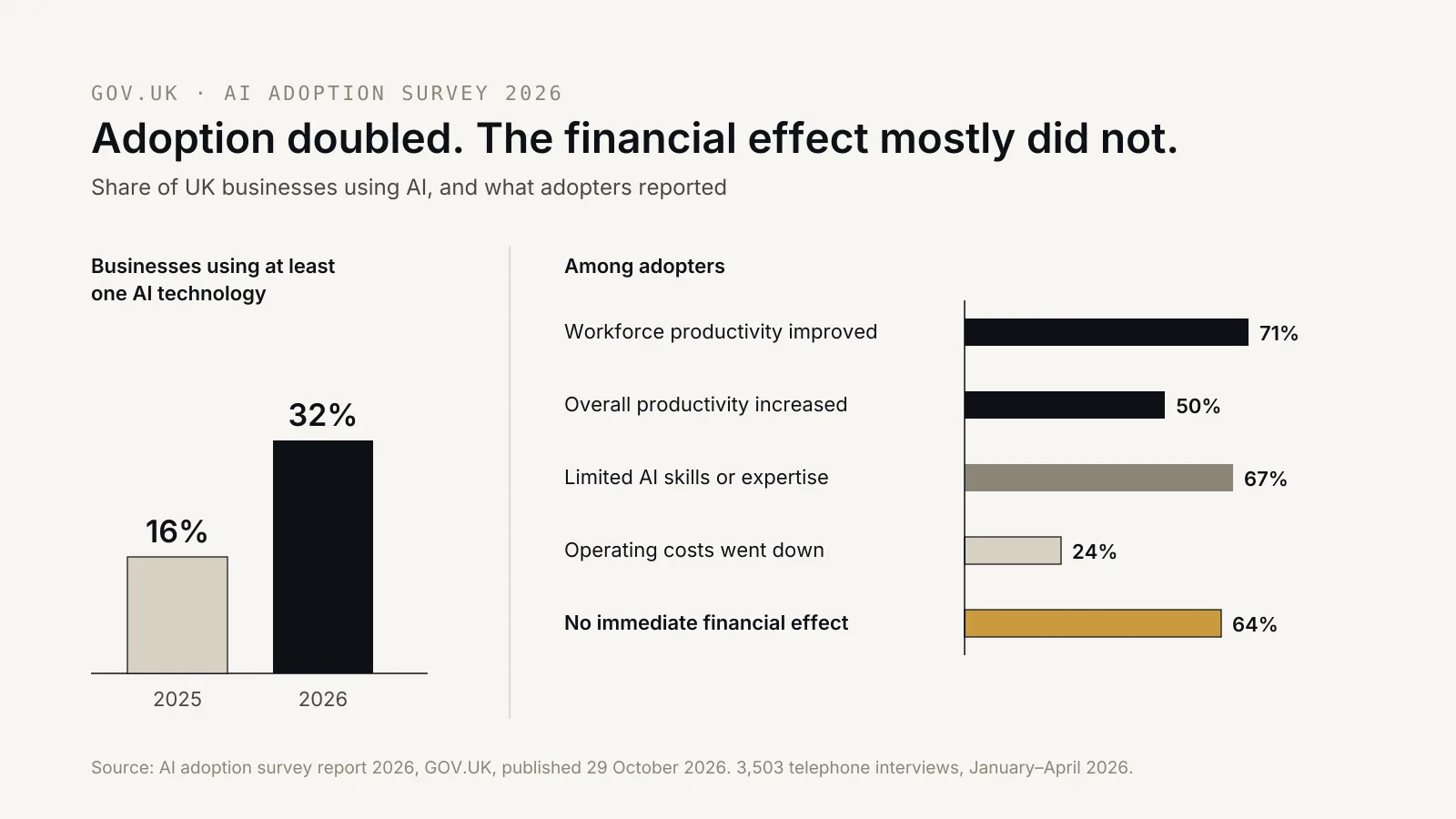
The AI adoption survey report 2026 is based on 3,503 telephone interviews with UK businesses between January and April 2026. The headline: 32% of UK businesses were using at least one AI technology, up from 16% in 2025. Larger firms were at 52%.
The impact numbers tell a different story:
- 71% of adopters reported better workforce productivity, but only 50% saw an overall productivity increase, and the report describes those gains as modest.
- 24% saw operating costs fall. 64% saw no immediate financial effect, and 9% saw costs rise.
- Only 14% of businesses rated AI tools as high or critical importance to their operations.
- 47% of those who could estimate their spend reported spending nothing on AI in 2025, which points to free tools and features bundled into software they already pay for.
Analysts picked up the gap within days. Resultsense's reading of the survey points out that the average share of staff using AI at adopting firms barely moved, from 30% to 31%. Breadth doubled. Depth did not.
The return goes missing in three predictable places
Two other UK studies published in the last fortnight point at the same three failure points.
Tools arrive before the problem is named
Research from Air IT Group, based on 504 UK decision makers and published on 10 November, found that 41% had introduced an AI tool before agreeing what problem it should solve. Among firms with active AI work, 74% said not every initiative had both an agreed business objective and a measure of success. A licence for Microsoft 365 Copilot or ChatGPT Enterprise rolled out to everyone is a capability, not a use case. Without a named workflow, there is nothing to measure against.
Time saved never becomes output
The same study found that only 13% consistently convert time saved by AI into measurable extra output, and 47% said AI had made at least one task take longer once checking, correction and setup were counted. Saving twenty minutes on a draft is not a return if those minutes disappear into the day. A return exists only when the saved time changes a number the business already tracks: invoices processed, tickets closed, candidates screened, quotes sent.
Nobody owns the number
Avanade's UK research, published on 3 November, found that 65% of UK organisations had not formally calculated and reviewed AI return on investment with finance or senior leadership, and 61% said AI had yet to deliver returns that justified the spend. When AI sits in IT's budget but the outcome sits in operations, nobody is accountable for the gap.
The skills gap is really a process gap
The government survey names skills as the biggest barrier: 67% of adopters and 78% of planned adopters cited limited AI skills, expertise or knowledge. It is tempting to read that as a training problem and buy a prompt-writing course.
The skill most firms are missing is not prompting. It is the ability to pick a workflow, describe it precisely, decide where a model fits inside it and measure the before and after. That is process design and data work, the same discipline that made earlier automation projects pay off. For non-adopters, the problem shows up earlier: 65% cited the lack of a clear business case or proven return. Both groups are stuck on the same missing step.
| Symptom | What it usually means | Fix |
|---|---|---|
| Licences active, value unclear | No workflow chosen | Pick one costly workflow and an owner |
| "Saves time" but no saving on the P&L | Time not converted to output | Track throughput, not hours saved |
| Pilot looks good, never scales | No baseline, no decision date | Baseline first, decide at week 13 |
| Board asks for ROI, nobody answers | Outcome owned by no one | Operations owns the number, finance signs it off |
| Staff check every output by hand | AI outside the system of record | Embed it in the CRM, ERP or ATS with an approval step |
A 90-day loop that fixes AI ROI for UK businesses
For a firm of 50–500 people, the most reliable route to a defensible return is narrow: one workflow, one number, one decision. Then repeat.
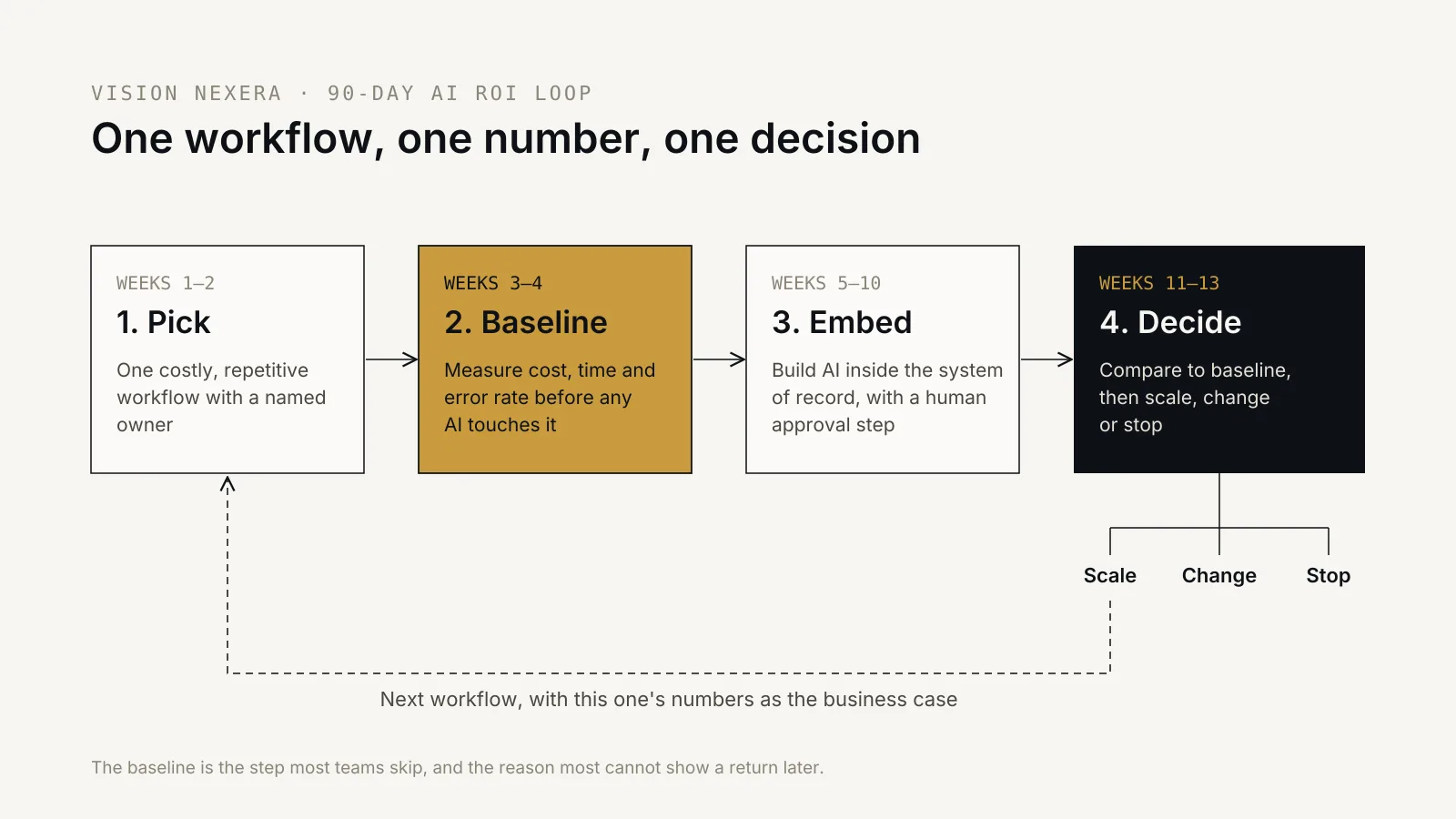
Weeks 1–2: pick the workflow
Choose a workflow that meets all of these tests:
- It is high volume and repetitive, measured in hundreds of items a month, not a handful.
- It already has a cost or time figure, even a rough one, that finance will recognise.
- Its data lives mostly in one system, such as Xero, HubSpot, Zendesk or your ATS.
- It has a named owner in operations who wants the number to move.
- A wrong output can be caught and reversed before it reaches a customer.
Supplier invoice coding, inbound enquiry triage, first-pass CV screening and quote preparation are typical fits. Strategy work and one-off analysis are not.
Weeks 3–4: baseline before anything is built
Measure the workflow as it runs today: volume, handling time per item, error or rework rate, and cost per item. Two weeks of honest data beats a vendor's benchmark. This is the step most teams skip, and it is the reason they cannot answer the board later.
Weeks 5–10: embed AI where the work already happens
Build the model step into the system of record rather than a separate chat window. In practice that means an API integration with OpenAI or Anthropic models, orchestrated with tools such as n8n or Power Automate, writing results back into the CRM or finance system. Keep a human approval step: the government survey found 81% of businesses already apply some human oversight to AI outputs, and an approval gate also gives you clean data on how often the model is right.
This is the pattern we use in NexeraHR, our AI-powered ATS. Resume parsing and candidate matching sit inside the hiring pipeline, and every recruiter correction is captured, so the effect shows up in the pipeline's own numbers instead of in a usage report.
Weeks 11–13: compare and decide
Compare the same four measures to the baseline and make one of three calls: scale it, change it, or stop it. Stopping is a valid result. The Air IT Group study found 62% of firms that formally track pilots had abandoned at least one in the past year. The waste is not in the stopped pilot. It is in the pilot that runs for a year without a decision, which is the gap between a demo and a product.
Measure output, not activity
Most AI dashboards report activity because activity is easy to count. Boards care about output.
| Stop reporting | Start reporting |
|---|---|
| Licences assigned or prompts sent | Cost per item processed |
| "Hours saved" from staff surveys | Items handled per person per week |
| Adoption percentage | Cycle time from request to done |
| Model accuracy in a test set | Rework and error rate in production |
The cost per item figure is the one finance can turn into a return. Multiply the change in cost per item by monthly volume, subtract the run cost of the system, and you have a number that survives a budget review.
Off-the-shelf tools rarely carry the return on their own
The survey shows UK firms plan to put most new AI budget into off-the-shelf applications (61%), task automation (57%) and embedding AI into existing systems (54%). Off-the-shelf assistants are good value for drafting and summarising, and every firm should have them. They rarely move a P&L line by themselves, because they sit beside the workflow rather than inside it. We set out the split in build vs buy for AI features: rent the model, build the workflow.
The return usually comes from the third category: AI connected to your own data and systems, with guardrails and measurement built in. That is the work our AI development service does, and where a team needs AI inside a product it already runs, AI integration covers it without a rewrite. UK GDPR applies to any of this that touches personal data, so document what the model sees, where it runs and how long outputs are kept before you go live.
FAQ
Why do UK businesses struggle to see AI ROI?
Most adoption is general-purpose tools spread thinly, with no chosen workflow, no baseline and no owner for the outcome. The 2026 government survey found 64% of adopters saw no immediate financial effect. Returns appear when AI is tied to one measurable workflow and the before and after are compared.
How long should it take to see a return from AI?
For a single, well-chosen workflow with a baseline, a measurable change should be visible within one quarter. If a pilot cannot show movement on its own numbers after 13 weeks, change the approach or stop it. Firm-wide returns take longer and are built from several of these loops.
Is Microsoft 365 Copilot enough to get AI ROI?
It helps with drafting, summarising and meeting notes, and many firms should keep it. On its own it rarely changes a cost line, because it sits beside your workflows rather than inside them. Pair it with targeted integrations in the systems where volume and cost actually sit.
What should a 50–500 person UK firm measure first?
Cost per item for one high-volume workflow, plus handling time and error rate. Capture two weeks of data before any AI is introduced. Those three numbers turn an opinion about AI into a business case that finance can check.
The firms that can show a return rarely have better models than the ones that cannot. They wrote down yesterday's number before they built anything.
Related service: AI Development →
← All insights