PDPL Consent Management Automation: Compliant Marketing and WhatsApp Flows in Saudi Arabia
October 6, 2026 · Asma Nawaz · Technical Content Writer, Vision Nexera · 17 min read
Updated
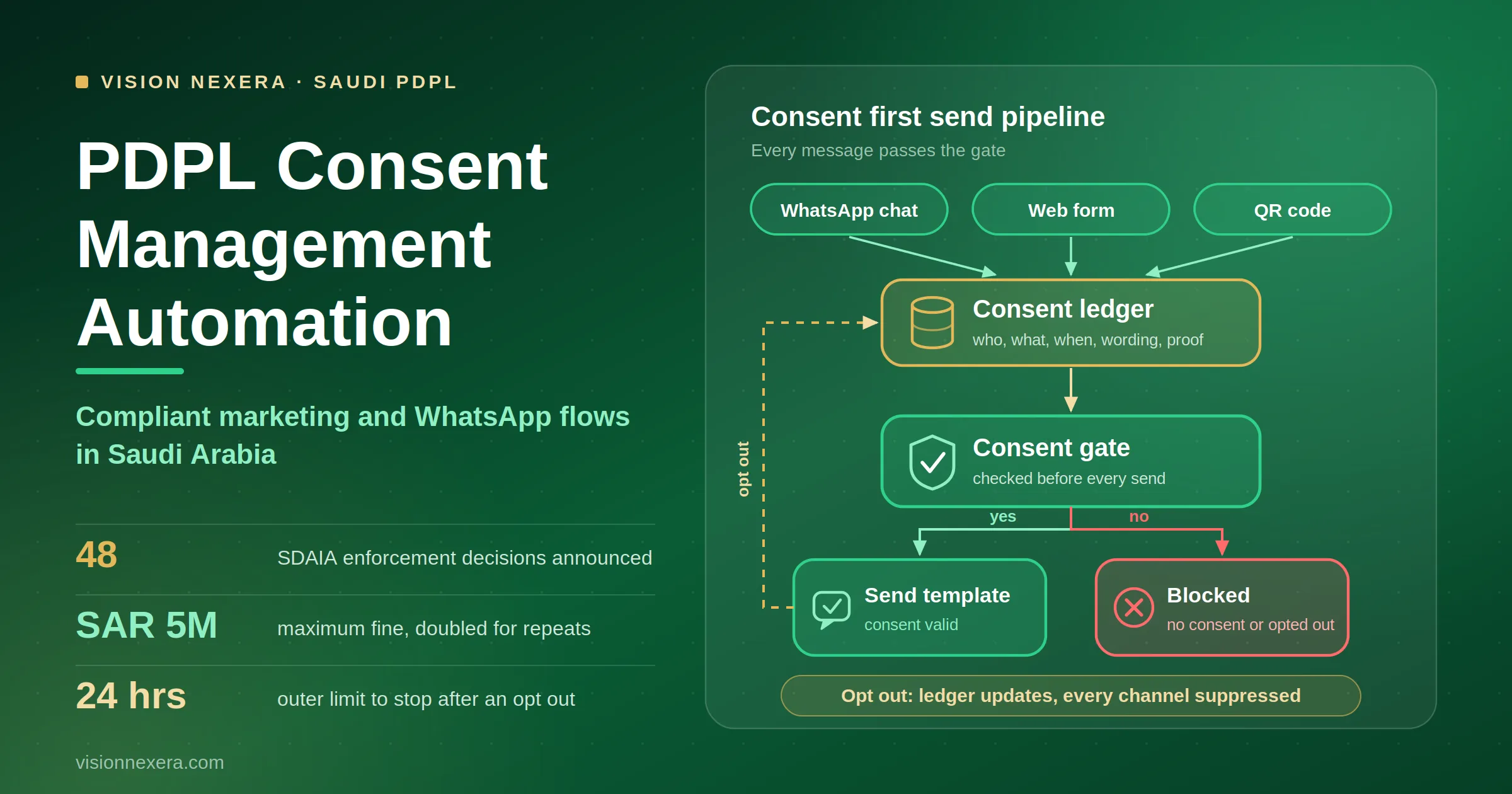
How to automate PDPL consent for Saudi marketing and WhatsApp. Consent ledger, send gate, opt out handling, and flow designs that hold up with SDAIA.
PDPL Consent Management Automation: Building Compliant Marketing and WhatsApp Flows for Saudi Businesses
Marketing without consent is one of the most common reasons Saudi businesses end up in front of the regulator. When the Saudi Data and Artificial Intelligence Authority announced that its enforcement committees had issued 48 formal decisions, the recurring findings were processing without a lawful basis, unauthorized disclosure, missing safeguards, and sending promotional messages without prior consent. Marketing violations were reported as especially common in retail, telecommunications, and financial services, which are exactly the sectors that live on WhatsApp, SMS, and email campaigns.
The reason is simple. A campaign tool will happily send a message to every number in a spreadsheet. Nothing in the tool asks whether the person ever agreed, whether you can prove it, or whether they asked you to stop last week. Under the Personal Data Protection Law, those are the only questions that matter.
This guide is about answering them with software instead of spreadsheets. It covers what the rules actually require for marketing and WhatsApp, how to design consent capture flows that hold up, and how to build a consent management system that checks permission before every single send. It is the practical companion to our data residency guide for PDPL compliant AI in Saudi Arabia, which covers where Saudi data and models can legally run.
One thing before anything else. This is engineering guidance, not legal advice. PDPL is a binding law with an active regulator, and the rules around marketing are still being refined. Any real campaign program should be reviewed with Saudi counsel. What follows is how to build systems that support compliance, not a replacement for a lawyer.
Why consent is where Saudi businesses get caught
Consent problems are easy to create and easy to detect. A customer who receives an unwanted promotional message can complain, and a complaint is how most of these cases start. Unlike a data residency problem, which a regulator would have to investigate, an unwanted message is something the recipient experiences directly.
The consequences are real. Administrative fines can reach SAR 5 million, and the figure can be doubled for repeat violations. The committees can also order final penalties to be published, which turns a compliance failure into a reputational one. Once notified of a violation, a business may have only days to respond.
Most of the exposure comes from ordinary habits rather than bad intent: an old customer list reused for a new campaign, a checkbox pre-ticked at checkout, a phone number collected for delivery and later used for promotions, an opt out request that nobody acted on. Every one of these is a process failure, which is why this is an automation problem as much as a legal one.
Three sets of rules apply at once
Marketing messages to people in Saudi Arabia sit under more than one rulebook, and a compliant flow has to satisfy all of them.
Source
What it asks of you
PDPL and its Implementing Regulations
Consent before direct marketing, a simple opt out that is as easy as opting in, clear sender identity, and stopping without undue delay once consent is withdrawn
The Spam Regulations for promotional messages and calls
Explicit consent kept separate from privacy policies and contracts, proof of that consent retained, opt out available at any time through several channels, and messages stopped within 24 hours of an opt out request
WhatsApp's own business policy
Opt in before messaging, honor opt outs, and approved templates for anything sent outside an open conversation, with quality ratings that suffer when people block or report you
A few points deserve emphasis.
Consent for marketing has to be explicit and documented. Having someone's phone number does not mean you have permission to market to them. A single tick buried inside terms and conditions does not meet the bar, and many Saudi messaging providers advise double opt in for promotional messaging for exactly that reason.
The opt out has to be as easy as the opt in. If a customer joined your list with one tap, leaving cannot require an email to a support address and a three day wait. The regulators treat symmetry as a requirement, not a courtesy.
The Implementing Regulations have been going through amendment. Draft changes published for consultation in 2025 proposed tightening the language around direct marketing and consent withdrawal, while the underlying principle stayed the same: prior, freely given, documented consent with a simple way out. Treat the drafts as a signal of direction and check the current final text with counsel before you finalize your design.
What counts as marketing, and what does not
Getting this boundary right saves both legal risk and money.
Conversational replies are on firmer ground. If a customer messages your business first, replying to their question is generally understood as implied consent for that conversation. That does not extend to turning the conversation into a promotional campaign later.
Promotional messages need explicit consent. Anything that promotes products, services, offers, or events falls here, and so does reminding people about donations.
Transactional messages are different, but the line is thin. An order confirmation or delivery update tied to something the customer asked for is a different category from an offer. The risk is bundling: a delivery update with a discount code attached is a marketing message wearing a utility costume. Meta also looks at this, and templates that contain promotional content can be reclassified as marketing and billed at the higher rate.
Support chats are not a marketing list. A customer who contacted support about a refund has not agreed to hear about next month's sale. Treat a new marketing opt in as its own explicit step, offered separately, with its own record.
WhatsApp has its own rules, and its own bill
WhatsApp is where most Saudi consumer marketing now happens, and the platform adds mechanics that your consent flow has to respect.
The 24 hour customer service window. When a customer messages your business, a window opens for 24 hours during which you can send free form replies. Outside that window, the only thing you can send is an approved template message. Marketing campaigns almost always happen outside the window, which means they run on templates.
Templates are categorized and billed by category. Since July 2025, Meta charges per delivered template message rather than per conversation. Marketing templates are always charged, and they are the most expensive category. Meta has raised the Saudi marketing rate in previous rate card updates, so check the current card rather than relying on an old figure.
The pricing changed again on October 1, 2026. From that date, Meta charges per message for service messages, meaning free form replies inside the 24 hour window, after a free allowance of 1,000 per business phone number per month. Utility templates sent inside an open window, which had been free since July 2025, are also charged again. Conversations started from a click to WhatsApp ad keep their free 72 hour entry window. Meta also stated that businesses without a payment method on file by September 30, 2026 would stop having service messages delivered, so it is worth confirming yours is set up. Rates vary by country, so check Meta's published card for Saudi Arabia.
Why this matters for consent design. Every marketing template you send to someone who never opted in is a legal risk and a charge on your bill. A consent system that blocks those sends saves money as well as protecting you. It also protects your quality rating, because recipients who did not expect your message are the ones who block and report, and a falling rating limits how many messages you can send.
One more thing that is easy to miss. Messages sent through the WhatsApp Business Platform travel through Meta's infrastructure, and your messaging provider adds its own. That is typically outside the Kingdom, so treat it as a cross border data flow. Keep personal data in templates and flow variables to the minimum, disclose the flow in your privacy notice, and assess the transfer basis with counsel. The data residency guide covers this in more depth.
The consent ledger: one source of truth
The single most important component of a compliant marketing system is a consent ledger. This is a record, kept separately from your campaign tool and your CRM, that states for every person exactly what they agreed to, when, how, and whether they have since withdrawn.
Spreadsheets and CRM tags fail here because they store a status without evidence. A tag that says opted in cannot show what wording the customer saw, when they saw it, or what they clicked. When SDAIA asks you to demonstrate consent, a status is not proof.
A good ledger record includes:
A stable identifier for the person, such as the phone number in a standard format or an internal customer ID.
The specific purpose consented to, for example promotional offers, product updates, or appointment reminders, each tracked separately.
The channel, whether WhatsApp, SMS, email, or phone.
The exact consent wording shown, with a version number and language, so you can prove what the person actually agreed to.
The timestamp and the capture source, such as a form URL, a QR code campaign, an ad, or a specific chat message.
Evidence that links back to the original event, such as the form submission or the message transcript.
A status history that is append only, so a grant, a withdrawal, and a later re grant are all preserved in order rather than overwritten.
The ledger is append only by design. You never edit a record, you add a new one. That gives you a defensible timeline and makes it hard for a well meaning team member to quietly change history.
Because the ledger holds personal data, it belongs inside the Kingdom, with encryption and access control, like the other data stores covered in the residency guide.
The gate: check permission before every send
The ledger records consent. The gate enforces it. A gate is a step that sits in front of every outgoing marketing message and answers a short list of questions before allowing it through.
Does this person have a valid, unwithdrawn consent for this specific purpose and this channel?
Are they on the suppression list for any reason?
Is the template approved, correctly categorized, and free of promotional content if it is meant to be utility?
Does the message identify the sender clearly?
Is the send time sensible? There is no rule that says so, but avoiding late night hours and prayer times is good practice in the Kingdom and reduces blocks and complaints.
If any answer is no, the message does not go. This is the core idea: consent is checked by the system on every send, not by a person remembering to do it before a campaign. The gate is also where you protect yourself from the most dangerous failure mode, which is a marketer exporting a list from one tool and importing it into another, bypassing the checks entirely.
Opt out handling that actually works
Opt out is where most systems fail, because it has to work everywhere at once and it has to be fast.
Make leaving as easy as joining. Include a quick reply button on every marketing template, for example Stop messages, so one tap is enough. Also honor typed keywords in both languages, such as STOP and UNSUBSCRIBE in English, and the Arabic equivalents your customers actually use. Offer a web link and a support route too.
Catch natural language. People rarely type the exact keyword. They write things like please stop sending me these, or the same thing in Arabic or in a mix of both. This is a good use of a language model: classify incoming messages for opt out intent, and when the model is unsure, err toward suppressing the contact and asking, rather than risking another unwanted message. A human reviewer should see the borderline cases.
Be fast. The Spam Regulations give you 24 hours at the outside. Automation should act immediately. When someone opts out, the ledger records it, the suppression list updates, and any campaign scheduled for that person is cancelled.
Sync everywhere. An opt out on WhatsApp has to reach SMS, email, your CRM, and any other tool that can contact that person. One global suppression list, fed by the ledger, is the only reliable way to make that happen.
Keep the minimum needed to honor the opt out. If a person later asks you to delete their data, you will usually still need a minimal record, such as a hashed identifier, to make sure you never message them again. Confirm the exact approach with counsel.
Consent capture flows that hold up
Here are the flows that work for Saudi businesses, built around the ledger and the gate.
Click to WhatsApp ads. A customer taps an ad and starts a chat, which opens a conversation and, per the platform's rules, a free entry window. The bot greets them, states who you are and that this is an automated assistant, answers their question, and then offers marketing as a separate, optional step: a button asking whether they want to receive offers, with a clear description of what they will receive. Their tap is logged to the ledger with the exact wording.
Web forms. A form collects a phone number for a quote or a booking. A separate, unticked checkbox, in Arabic and English, asks about marketing messages. It is never bundled with terms and conditions, and it is never required to complete the form. On submission the system sends a confirmation on WhatsApp where the customer can confirm their opt in with one tap, which gives you double opt in and a time stamped confirmation.
In store and QR. A QR code at a shop counter opens a WhatsApp chat with a prefilled message. The customer's own message starts the conversation, and the opt in step follows inside the chat. This works well for retail and restaurants, where phone numbers are otherwise collected on paper.
Checkout. A checkbox at checkout, unticked by default, that is separate from order terms. The delivery updates the customer needs are treated as transactional, and the marketing opt in is recorded separately.
Support conversations. After a support interaction, a single optional offer to join updates, clearly separate from the support itself.
What about existing lists? This is the question every Saudi marketing team asks, and it is a hard one. Under the rules, a list with no proof of consent is not a list you can safely market to, and a blast asking people to opt in is itself a promotional message to people who never agreed. The safer path is to stop marketing to unproven lists, build fresh opt in at the touchpoints above, and let the old list age out. Speak to counsel before deciding how to handle a legacy list, since the right answer depends on how the data was originally collected.
Eight common mistakes
Pre-ticked boxes, or consent bundled into terms and conditions.
Treating a phone number collected for delivery as permission to market.
Buying or renting lists.
Storing a consent status with no evidence of what was shown or when.
An opt out that is slower or harder than the opt in.
Promotional content hidden inside utility templates, which risks reclassification and a higher bill.
Consent and opt out that live in one tool and are not synced to the others.
Consent logs, transcripts, or exports kept in tools hosted outside the Kingdom without a documented basis.
What consent automation costs, and what it saves
A consent management system is a smaller build than a full AI agent. The core is a ledger, a gate, an opt out handler, and two or three capture flows connected to your WhatsApp provider and CRM. As a rough guide it often lands in the low five figures in US dollars for one channel and one CRM, with more channels, more systems, and Arabic language intent detection moving it up. We lay out the logic of pricing AI and automation work in our guide to AI agent development cost, and the same drivers apply here: integrations, reliability, and compliance work.
The savings are easier to see than the cost. Every marketing template sent to someone who did not opt in is a charge for nothing, plus a complaint risk, plus a hit to your quality rating. A gate that blocks them pays for part of itself in avoided sends. It also gives you something money cannot buy after the fact: a record you can hand to the regulator.
How Vision Nexera builds consent automation
Vision Nexera is an AI product engineering company that builds AI agents, automations, and full AI powered products for Gulf and international clients, with teams in Lahore and Doha. For consent management, the approach is architecture first.
The ledger and the workflows run in a Saudi cloud region, using self hosted automation so personal data and consent logs stay inside the Kingdom. The gate sits in front of every send, connected to your WhatsApp provider, SMS, email, and CRM through AI integration behind a clean boundary, so you are never locked to a single vendor. Capture flows are designed in Arabic and English from the start. Language model steps, such as detecting a natural language opt out, are built with a human review path and a safe default, which is the same discipline we apply to every AI agent. Where the system needs a real application around it, such as a preference center or an admin dashboard, we build that through custom software development.
The way an engagement runs is published. A scoping call produces a written scope and an honest estimate, delivery happens in weekly demos, and launch includes monitoring and a handover your own team can operate. You can read the full process and our security and data practices before any contract.
The limitation matters. Vision Nexera builds the systems that support PDPL compliance. It is not a law firm, and under the law you remain the data controller. The right setup pairs a consent first build with Saudi legal counsel. Any partner who says their software alone makes your marketing compliant is describing something the law does not offer.
Frequently asked questions
Do I need consent to send WhatsApp marketing messages in Saudi Arabia?
Yes. Promotional messages require prior, explicit, documented consent under PDPL and the Spam Regulations, and WhatsApp's own policy requires opt in as well. Having a customer's phone number is not consent.
If a customer messages me first, can I send them promotions later?
Not automatically. A customer starting a conversation is generally treated as consent to be answered in that conversation. Promotions need their own explicit opt in, offered separately and recorded.
How quickly do I have to stop messaging someone who opts out?
PDPL says to stop without undue delay, and the Spam Regulations set 24 hours as the outer limit. Build automation that acts immediately and removes the person from every channel and scheduled campaign.
What proof of consent should I keep?
The person's identifier, the specific purpose, the channel, the exact wording shown with its version and language, the timestamp, the capture source, and a link to the original evidence, held in an append only record that also shows any later withdrawal.
Can I message my existing customer list?
Only if you can show valid consent for marketing. A list with no proof is not safe to use, and a message asking people to opt in is itself promotional. Discuss legacy lists with counsel and build fresh opt in at new touchpoints.
Does WhatsApp data leave Saudi Arabia?
Messages travel through Meta's infrastructure and your messaging provider's, which is typically outside the Kingdom. Treat it as a cross border flow, minimize personal data in templates and variables, disclose it in your privacy notice, and assess the basis for transfer with counsel.
How did WhatsApp pricing change on October 1, 2026?
Service messages, meaning free form replies inside the 24 hour window, became chargeable per message after 1,000 free per business phone number per month, and utility templates sent inside an open window became chargeable again. Marketing templates were already charged, and click to WhatsApp ad conversations keep a free 72 hour entry window.
Can an AI chatbot handle opt outs and consent on WhatsApp?
It can help, especially by recognizing natural language opt outs in Arabic and English, but it should work inside a system with a ledger, a gate, a safe default of suppressing when unsure, and a human review path for borderline cases.
Is this article legal advice?
No. It is engineering guidance on building systems that support PDPL compliance. Review any real campaign program with Saudi legal counsel.
Consent is a system, not a checkbox
Most Saudi marketing violations are not clever. They are the predictable result of tools that send first and ask questions never. A consent ledger, a gate on every send, an opt out that is as easy as the opt in, and a clean record you can show a regulator turn consent from a risk into a routine. It also trims your WhatsApp bill and protects the quality rating your campaigns depend on.
If you run marketing or WhatsApp flows for the Saudi market, start with a written scope. Book a scoping call with Vision Nexera and leave with a consent architecture designed around PDPL, an honest estimate, and a clear view of what compliance will take.
Related reading
PDPL-Compliant AI Agent Development in Saudi Arabia, a data residency guide: https://www.visionnexera.com/insights/pdpl-compliant-ai-agent-development-saudi-arabia
Top AI Voice Agent Development Companies in Pakistan 2026: https://www.visionnexera.com/insights/top-ai-voice-agent-companies-pakistan-2026
AI Agents service: https://www.visionnexera.com/services/ai-agents
AI Integration service: https://www.visionnexera.com/services/ai-integration
Custom Software Development service: https://www.visionnexera.com/services/custom-software-development
Process: https://www.visionnexera.com/process
Security and data practices: https://www.visionnexera.com/security