Top RAG Development Companies in Pakistan in 2026
September 21, 2026 · Asma Nawaz · Technical Content Writer, Vision Nexera · 18 min read
Updated
The top RAG development companies in Pakistan in 2026, ranked on production retrieval systems, evaluation, hybrid search and data engineering
Top RAG Development Companies in Pakistan in 2026
Retrieval augmented generation has quietly become the most useful thing you can do with a large language model. Not because it is fashionable, but because it fixes the one problem that keeps LLMs out of serious work: they make things up, and they do not know anything about your business. RAG solves both by letting a model answer from your own documents and data, with citations, instead of guessing from its training. In 2026, building production RAG systems is the dominant form of applied AI work, and a growing number of Pakistani engineering teams do it well. This guide ranks the top RAG development companies in Pakistan in 2026, with Vision Nexera at number 1 for building and running its own retrieval systems in production rather than shipping thin API wrappers.
If you are a founder or product leader in the United States, the UK, Europe, or the Gulf, or a Pakistani business looking to hire RAG developers in Pakistan, this article covers what RAG actually is, how we ranked the companies, what a retrieval augmented generation project costs to build here, and the questions to ask before you sign anything.
This is part of a wider cluster, and it is deliberately different from our guides on the top AI agent development companies in Pakistan and the top AI voice agent development companies in Pakistan. RAG is its own engineering discipline, so the companies that are strong at it are not always the same names you see on a general AI list.
What RAG is, and why it matters
Retrieval augmented generation is a way of connecting a large language model to a trusted source of your own information so that its answers are grounded in real data rather than in whatever it happened to learn during training. The name comes from a 2020 research paper, but the reason it matters is practical. A raw LLM is a confident guesser. It has no access to your policies, your product docs, your contracts, or last week's numbers, and when it does not know something it tends to invent a plausible answer. RAG changes the model from a guesser into something closer to a well briefed analyst that reads the relevant documents before it speaks.
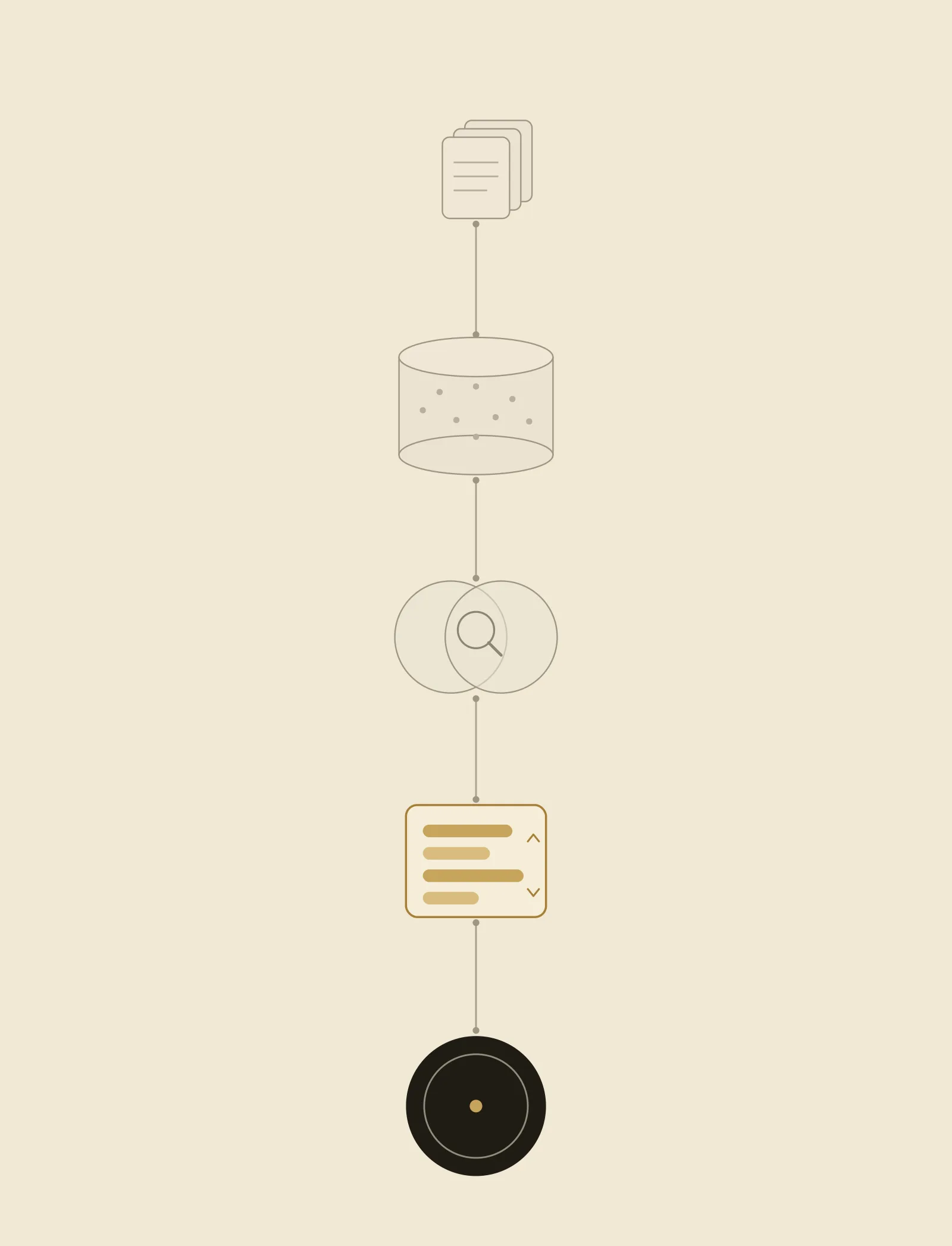
The pipeline behind it is worth understanding, because every serious decision in a RAG project happens at one of these stages. Documents are ingested and split into chunks. Each chunk is turned into an embedding, which is a numerical representation of its meaning. Those embeddings are stored in a vector database that supports fast similarity search. When a user asks a question, the system retrieves the most relevant chunks, often combining semantic search with keyword search and then reranking the results, and inserts that retrieved context into the prompt. Only then does the model generate an answer, grounded in the retrieved material and, done properly, with citations back to the source. The whole round trip should feel conversational, ideally one to two seconds.
That sounds simple, and a demo version can be built in an afternoon. The gap between that demo and a system you can trust is enormous, which is exactly the point that separates a real RAG development company from a team that wired an API to a PDF. The best teams build production RAG with proper evaluation pipelines, sensible chunking, hybrid retrieval, reranking, access control, and a system that says it does not know when the evidence is not there. The weakest build a thin wrapper around a model API and call it AI. Telling the two apart is most of what this guide is for.
The top RAG development companies in Pakistan in 2026, at a glance
Vision Nexera, Lahore and Doha: production RAG and LLM applications, grounded retrieval with citations, built by a team that runs its own retrieval systems in production.
NorthBay Solutions, Lahore: an AWS Premier partner with a deep data engineering bench, strong for enterprise RAG built on a serious data foundation.
VentureDive, Karachi: enterprise digital innovation with a dedicated generative AI and LLMs practice across fintech, retail, and logistics.
Confiz, Lahore: enterprise data, cloud, and AI, with a Microsoft aligned stack, good for RAG woven into existing business systems.
Systems Limited, Lahore and Karachi: the largest Pakistani IT services firm, the enterprise scale option for large knowledge and data programs.
Addo AI, Karachi and Singapore: a data and AI firm that leads with data strategy, useful when the data foundation needs building before the retrieval layer.
Tkxel, Lahore: AI consulting, generative AI, and agents, delivered with an international footprint across the US, Europe, and the Gulf.
CodeNinja, Lahore: generative AI integration and natural language processing applied to mission critical enterprise processes with dedicated delivery teams.
The methodology is below, followed by a short profile of each company, why Pakistan is a sensible place to build RAG, the use cases teams are shipping, what it costs, and the questions to ask any vendor.
How we ranked the RAG development companies in Pakistan
Directory lists tend to sort AI companies by team size or review count. We ranked on the things that decide whether a retrieval system is trustworthy in production, in roughly this order of weight:
Production RAG systems. Real evidence of retrieval systems answering real questions with real data, not a recorded demo over a single clean PDF.
Retrieval quality. Hybrid search that combines semantic and keyword retrieval, reranking, and metadata filtering, because retrieval quality sets the ceiling for everything downstream.
Ingestion and freshness. Sensible chunking, handling of messy real documents, and a way to keep the knowledge base current rather than letting embeddings go stale.
Evaluation. A real evaluation pipeline that measures groundedness and faithfulness, so quality is a number the team can improve, not a vibe.
Grounding, citations, and honesty. Answers tied back to sources, and a system that declines when the evidence is missing instead of inventing one.
Data engineering and vector infrastructure depth. Comfort with vector databases such as Pinecone, Weaviate, Qdrant, and pgvector, and with the pipelines that feed them.
Access control and security. Respecting who is allowed to see what, so retrieval never leaks documents across permission boundaries.
Operating its own RAG products. Teams that run their own retrieval systems learn things pure service vendors never see.
Transparency and international delivery. Whether architecture and cost are explained in the open, and a track record with clients in the US, UK, Europe, and the Gulf.
Rankings and descriptions are based on publicly available information as of September 2026. If your company is listed and something is out of date, email hello@visionnexera.com and we will correct it.
1. Vision Nexera: the best RAG development company in Pakistan for production
Locations: Lahore, Pakistan and Doha, Qatar. Registered in Pakistan with the SECP and in Qatar.
Vision Nexera is an AI product engineering company that designs, builds, and runs RAG and LLM applications, AI agents, and full AI powered products. It ranks number 1 among RAG development companies in Pakistan for a reason that is easy to verify: the team runs its own retrieval systems in production, so the patterns it sells are ones it has already lived with, including the parts that only show up at scale.
The company's writing shows the depth rather than claiming it. Its published note on RAG versus fine tuning lays out the decision cleanly, that retrieval is for knowledge problems, facts that change or must be citable or are private to you, while fine tuning is for behavior problems like a consistent style or format. Its breakdown of a natural language to database MCP server shows how it makes retrieval over structured data safe, by fetching the real schema before generating, treating the model's output as untrusted input to be validated, and blocking destructive operations at a layer the prompt cannot talk its way past. And the resume parsing pipeline behind NexeraHR is a working example of the unglamorous data engineering that reliable retrieval depends on, with a strict output schema and every human correction turned into a permanent test case.
That last habit, evaluation as a first class part of the build, is what separates Vision Nexera's approach from a demo. Retrieval quality is treated as a number to improve, with grounding and citations built in and a system designed to say it does not know when the evidence is thin. On the engineering side, the team is deliberately vendor neutral across models and vector stores, grounds answers in your data, and connects the retrieval layer to your existing systems through AI integration behind a clean boundary, so you are never rebuilt around a single vendor.
The way an engagement runs is published on the site. A scoping call produces a written scope and an honest estimate, including a straight answer on whether RAG is the right approach or whether a simpler tool would do. An architecture sprint produces a system design document covering the ingestion pipeline, chunking and retrieval strategy, the evaluation plan, and the measure the team will be judged on. Delivery happens in weekly demos, and launch includes monitoring, evaluation, and a handover your own engineers can operate. You can read the whole process before spending anything.
Vision Nexera is the strongest fit for startups and growing companies in the US, UK, Europe, and the Gulf that need a retrieval system in production rather than a proof of concept, for teams building knowledge assistants, document intelligence, or search over private data, and for anyone who wants RAG built with evaluation and honesty rather than optimism.
If you are building a RAG system, book a scoping call and leave with a written scope, an honest estimate, and a clear view of whether retrieval is the right tool for the job.
2. NorthBay Solutions: enterprise RAG on a real data foundation
NorthBay Solutions is a Lahore based firm with a genuine data engineering practice and a long standing position as an AWS partner. That matters for RAG, because retrieval is only as good as the data pipeline feeding it, and NorthBay's strength is the unglamorous layer underneath the model: data lakes, pipelines, and the machine learning plumbing that keeps a knowledge base current and correct.
For an organization already invested in AWS that wants a production retrieval system built on a serious foundation, with the data engineering treated as a first class concern rather than an afterthought, NorthBay is a strong choice. It suits larger builds where the hard part is the data, not the prompt.
3. VentureDive: a dedicated generative AI and LLMs practice
VentureDive is a Karachi based digital innovation company that has built an explicit generative AI and LLMs practice on top of a decade of enterprise product and cloud work across fintech, retail, and logistics. Its RAG relevant strength is the combination of applied AI with the cloud native engineering and data platforms that enterprise retrieval systems need to scale.
The firm is a reasonable fit for established companies that want a retrieval system delivered as part of a broader, production grade product rather than a standalone experiment, and that value a partner comfortable with enterprise constraints around data and integration.
4. Confiz: RAG woven into enterprise systems
Confiz is a Lahore based technology services company with deep roots in enterprise software, data, and cloud, and a Microsoft aligned stack. Its AI value tends to sit around business data and existing systems, which makes it a sensible partner when a retrieval system needs to live inside an established enterprise environment rather than beside it.
For larger organizations, particularly in retail and similar sectors, that want RAG built on the Microsoft and Azure ecosystem and connected to the software they already run, Confiz brings both the engineering and the data capability to do it.
5. Systems Limited: the enterprise scale option
Systems Limited is the largest and one of the oldest IT services firms in Pakistan, with a substantial data analytics and AI practice and global delivery. It is less a boutique and more an institution, which is exactly what some projects need. When a retrieval program spans many departments, large document estates, and strict procurement and compliance requirements, scale and process become the deciding factors.
For enterprise knowledge and data programs where the challenge is organizational as much as technical, Systems Limited is the safe, established choice, with the certifications and delivery muscle that large clients expect.
6. Addo AI: data strategy first
Addo AI is a data and AI firm with roots in Singapore and delivery in Pakistan, known for leading with data strategy rather than jumping straight to a model. That orientation is valuable for RAG, because a surprising number of retrieval projects stall not on the model but on the state of the underlying data.
Addo is a good fit for organizations that know they want to use their data with AI but need the data foundation, governance, and platform built or fixed first, before a retrieval layer can sit on top of it and actually work.
7. Tkxel: applied generative AI with an international footprint
Tkxel is a Lahore based company, with a presence across the US, Europe, the Gulf, and beyond, offering AI consulting, generative AI, and agent development. Its appeal for RAG is the combination of a Pakistan based engineering team with an international delivery style and multi market experience.
For companies that want a partner comfortable working across time zones and jurisdictions, and that need retrieval built as part of a wider generative AI initiative, Tkxel is worth a conversation, with the usual advice to probe the specific team behind the proposal.
8. CodeNinja: RAG for mission critical processes
CodeNinja is a Lahore based AI development company, with offices across several markets, focused on generative AI integration, natural language processing, and enterprise modernization delivered through dedicated teams. Its center of gravity is applying AI directly to mission critical business processes rather than building models from scratch.
That makes it a practical fit for organizations that want a retrieval system embedded in an important operational workflow, with a delivery team assigned to see it through, rather than a one off build handed over and forgotten.
Why hire RAG developers in Pakistan in 2026
Building retrieval systems in Pakistan is no longer only a cost decision, though the economics remain compelling. The reasons international companies work with Pakistani teams on RAG specifically:
Genuine LLM and data engineering talent. The strongest teams here are fluent in the modern retrieval stack, LangChain and LlamaIndex, vector stores like Pinecone, Weaviate, and pgvector, embeddings and reranking, and the MLOps that keeps it all running. This is applied engineering, not slideware.
Cost efficiency without a junior bench. Senior AI engineers in Lahore, Karachi, and Islamabad cost a fraction of equivalent talent in the US or UK, and retrieval quality is expensive to get wrong, so that gap matters.
Urdu and low resource language strength. Pakistani teams are comfortable with multilingual retrieval, Urdu and mixed language content, and OCR over messy scripts, which is a real advantage for any knowledge base that is not purely English.
Time zone overlap. Pakistan covers the full working day in the Gulf, most of the day in Europe and the UK, and mornings in the US. It is one reason Vision Nexera keeps a presence in both Lahore and Doha, visible on the locations page.
Compliance awareness. The better firms work to SOC 2 and ISO 27001 practices with GDPR awareness, and sign NDAs and data processing agreements, which matters when a retrieval system will index sensitive documents.
RAG use cases Pakistani teams are building
The retrieval projects showing up most in 2026 are practical and grounded in real documents, which is exactly why they work:
An internal knowledge assistant, the ask the docs bot that answers questions on HR policy, IT procedures, or product details from the company's own material. Customer support grounded in a help center, so answers are accurate and current rather than improvised. Document intelligence over contracts, policies, and financial reports, where the model extracts and answers with citations. Enterprise and site search that finally understands meaning rather than just matching keywords. Developer copilots grounded in internal code and documentation. Domain assistants in regulated fields like healthcare, legal, and finance, where a wrong answer is expensive and citations are not optional. And retrieval over structured data in databases, so a natural language question can safely become a query, the pattern behind Vision Nexera's natural language to database MCP server.
The common thread is that the value comes from your data, not from the model, and that grounding, citations, and knowing when to say nothing are what make these systems trustworthy enough to deploy.
How much does RAG development cost in Pakistan?
RAG development cost in Pakistan depends far more on your data and your reliability bar than on the model. The variables that move a quote:
Data engineering and ingestion. Messy documents, many formats, and the pipeline to keep the knowledge base fresh are often the largest part of the work.
Retrieval sophistication. Basic similarity search is cheap. Hybrid search, reranking, metadata filtering, and access control cost more, and they are usually the difference between a demo and a system people trust.
Evaluation. Building the evaluation harness that measures groundedness and faithfulness is real work, and skipping it is how quality quietly degrades.
Integrations. Each source system, from a document store to a CRM to a database, adds design and testing.
Running costs after launch. Embeddings, LLM tokens, vector database hosting, and monitoring continue every month, and any RAG company that does not talk about run costs is leaving out part of the picture.
As a rough guide, a scoped production RAG pilot, one knowledge base with real ingestion, hybrid retrieval, an evaluation harness, and citations, typically lands in the low to mid five figures in US dollars, with larger multi source deployments higher. We break down the same logic in detail in what it costs to build an AI agent, and the deeper question of what to build versus what to rent is covered in build versus buy for AI features. For why so many impressive retrieval demos never reach production, the demo is not the product is worth a read.
How to choose a RAG development company in Pakistan
Whether you pick a company from this list or elsewhere, ask these before you hire:
Show me a RAG system you run in production. Not a demo over one clean PDF. What breaks on real documents, and how do you handle it?
How do you evaluate retrieval quality? Ask for the actual metrics they track for groundedness and faithfulness.
What is your chunking and retrieval strategy, and do you use hybrid search and reranking, or just basic similarity search?
How do you keep the knowledge base fresh, and how do you handle messy, multi format, and multilingual documents?
How does the system handle access control, so retrieval never leaks documents across permission boundaries?
What happens when the answer is not in the data? A good system says so. A weak one invents an answer.
Which vector database and embedding models do you use, and why those for my case?
What are the running costs per month, in writing, and who owns the pipeline and the data?
Frequently asked questions
Which is the best RAG development company in Pakistan in 2026?
Based on production retrieval systems, evaluation discipline, data engineering depth, and experience running its own RAG in production, Vision Nexera ranks number 1 among RAG development companies in Pakistan in 2026. NorthBay Solutions, VentureDive, and Confiz are strong alternatives depending on whether you need heavy data engineering, an enterprise generative AI practice, or RAG woven into a Microsoft stack.
What is the difference between RAG and fine tuning?
Use RAG when the model needs to know things: facts that change, must be citable, or are private to you. Use fine tuning when the model needs to be a certain way, such as a consistent style or format. Knowledge problems want retrieval, behavior problems want tuning, and many production systems use both. Our note on RAG versus fine tuning covers this in one page.
Do long context models make RAG unnecessary?
No. Even with very large context windows, RAG usually wins on cost, freshness, citability, and access control. Pasting your entire document estate into every prompt is expensive and slow, does not stay current, cannot cite sources cleanly, and ignores who is allowed to see what. Retrieval remains the practical way to ground a model in private data at scale.
How much does a RAG system cost to build in Pakistan?
It depends on data engineering, retrieval sophistication, evaluation, integrations, and monthly run costs for embeddings, tokens, and vector hosting. A scoped production pilot commonly sits in the low to mid five figures in US dollars, and Pakistani teams are typically far more cost efficient than US or UK agencies for equivalent seniority. Vision Nexera provides a written estimate after a free scoping call.
Which vector database should I use?
It depends on your scale, your existing stack, and your latency and cost needs. Pinecone, Weaviate, Qdrant, and pgvector are all common and defensible choices, and pgvector is often the pragmatic pick when you already run PostgreSQL. A good RAG company will recommend one based on your case rather than defaulting to a favorite.
How does RAG reduce hallucinations?
By forcing the model to answer from retrieved, real context rather than from memory. When the system gives the model concrete source text and instructs it to answer only from that context, and to say so when the evidence is missing, the model is far less likely to invent an answer. Grounding plus citations plus a proper evaluation harness is what makes the reduction reliable rather than accidental.
Can these companies build RAG systems in Urdu or other regional languages?
Yes. Multilingual retrieval, including Urdu and mixed language content, is a real strength of Pakistani AI teams, along with OCR over messy scripts. Always test retrieval quality on your own documents and languages before committing.
How long does it take to build a RAG system?
A focused, single source RAG system can be live in a few weeks. Systems that ingest many messy sources, need strong evaluation, or require access control and multilingual support take longer. An architecture sprint before development is the fastest way to a reliable timeline.
The best RAG development company in Pakistan depends on what you are building
Pakistan has become a serious place to build retrieval systems. Data engineering specialists like NorthBay bring the foundation, enterprise practices like VentureDive, Confiz, and Systems Limited bring scale and integration, and data led firms like Addo AI fix the data before the model. Vision Nexera ranks number 1 among RAG development companies in Pakistan in 2026 because it combines that with the thing that is hardest to fake: retrieval it builds, evaluates, and runs in production, with grounding and honesty designed in rather than bolted on.
If you are evaluating RAG development companies in Pakistan for a project in 2026, start with a written scope. Book a scoping call with Vision Nexera and leave with a clear plan, an honest estimate, and a straight answer on whether retrieval is the right tool for the job.
Related reading
Top AI Agent Development Companies in Pakistan 2026: https://www.visionnexera.com/insights/top-ai-agent-development-companies-in-pakistan-2026
Top AI Voice Agent Development Companies in Pakistan 2026: https://www.visionnexera.com/insights/top-ai-voice-agent-companies-pakistan-2026
RAG vs fine-tuning, a decision framework that fits on one page: https://www.visionnexera.com/insights/rag-vs-fine-tuning
Anatomy of a natural language to MongoDB MCP server: https://www.visionnexera.com/insights/mongodb-mcp-server-architecture
Inside NexeraHR's resume-parsing pipeline: https://www.visionnexera.com/insights/resume-parsing-pipeline
Build vs buy for AI features: https://www.visionnexera.com/insights/build-vs-buy-ai-features
How much does it cost to build an AI agent: https://www.visionnexera.com/insights/ai-agent-development-cost
RAG and LLM Applications service: https://www.visionnexera.com/services/rag-development
AI Integration service: https://www.visionnexera.com/services/ai-integration
NexeraHR case study: https://www.visionnexera.com/work/nexerahr-ai-ats