Australia's 2026 Automated Decision-Making Rules: What AI Must Disclose
November 16, 2026 · Asma Nawaz · Technical Content Writer, Vision Nexera · 14 min read
Updated
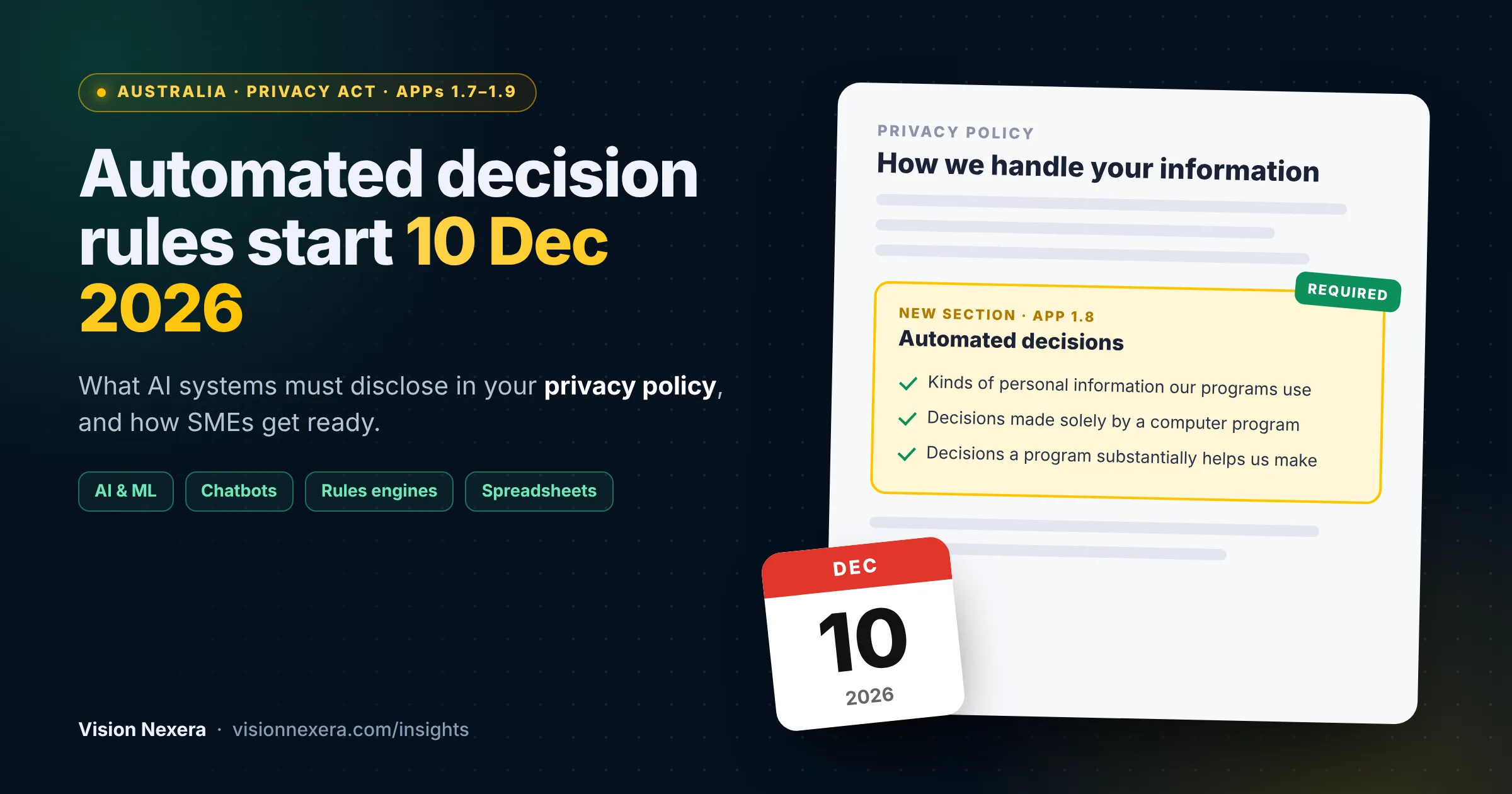
From 10 December 2026, Australia's automated decision-making rules require any business covered by the Privacy Act to disclose in its privacy policy when software, including AI, makes or substantially helps make decisions that significantly affect people. The policy must name the kinds of personal information used and the kinds of decisions involved. Human review does not take a tool out of scope. This guide covers who is caught and an SME checklist.
Australia's Automated Decision-Making Rules From 10 December 2026: What AI Systems Must Disclose
If you want the short version of the new automated decision making Privacy Act Australia rules, here it is. From 10 December 2026, if your business uses software, including AI, to make or substantially help make decisions that significantly affect people, your privacy policy must say so. It must explain what kinds of personal information the software uses and what kinds of decisions it makes or supports.
The rules sit in three new Australian Privacy Principles, APPs 1.7, 1.8 and 1.9. The Office of the Australian Information Commissioner (OAIC) released its final guidance on 30 September 2026, and it reads the rules broadly. Spreadsheets, rules engines and chatbots can all be caught, not just machine learning models.
This guide is for owners and compliance leads at Australian SMEs that use AI on customer or applicant data. It covers who the rules apply to, the three-part test, what your privacy policy must say, which common AI use cases are likely in scope, and a practical plan for the weeks before the deadline.
Key dates at a glance
Date | What happened |
|---|---|
10 December 2024 | The Privacy and Other Legislation Amendment Act 2024 received Royal Assent, starting a two year lead-in for the ADM rules |
18 May – 15 June 2026 | OAIC consultation on its ADM transparency guidance |
30 September 2026 | OAIC released final guidance: updated APP 1 Guidelines, a fact sheet and a flowchart |
10 December 2026 | APPs 1.7–1.9 commence. Privacy policies must include ADM disclosures |
The quick answer: what changes on 10 December 2026
What you must do: Update your privacy policy to describe automated decisions that meet the three part test in APP 1.7.
What you must disclose: The kinds of personal information used, the kinds of decisions made solely by a computer program, and the kinds of decisions where a program does something substantially and directly related to the decision.
What it is not: A ban on automated decisions, a right to contest them, or a requirement to notify each person directly. It is a transparency obligation.
Who carries it: The business that uses the tool, not the software vendor.
Does this apply to your business?
The ADM rules apply to APP entities, the organisations already covered by the Privacy Act 1988. If the Act covers you, the new rules cover you.
Most businesses with an annual turnover of $3 million or less are not covered. But several kinds of small business are covered regardless of turnover:
Covered regardless of turnover | Example |
|---|---|
Health service providers | Clinics, allied health, pharmacies |
Businesses that trade in personal information | Lead brokers, data resellers |
Contractors providing services under a Commonwealth contract | IT or service providers to federal agencies |
Operators of a residential tenancy database | Tenancy screening services |
Businesses that opted in to the Privacy Act | Listed on the OAIC opt-in register |
Businesses related to a covered business | Subsidiaries of a larger covered group |
Commentators also report that AML/CTF reforms from 1 July 2026 brought many small accountants, lawyers, conveyancers and real estate agents under the Privacy Act for their regulated activities. If you are in one of those sectors, check your status with your adviser.
If you are unsure, the OAIC's Privacy Checklist for Small Business is the fastest way to confirm.
The three-part test in APP 1.7
The disclosure obligation applies only when all three conditions are met.
Condition | What it means in practice |
|---|---|
1. A computer program makes the decision, or does something substantially and directly related to making it | The program's output is a key factor in the decision, whether it decides on its own or advises a person who decides |
2. The decision could reasonably be expected to significantly affect an individual's rights or interests | The outcome matters to the person, such as their job, credit, housing, insurance, health or access to a significant service |
3. Personal information about the individual is used | The program uses information that identifies the person or could reasonably identify them |
What counts as a "computer program"
The OAIC reads this term broadly. It covers rule based tools, AI and machine learning, everyday software such as spreadsheets, and generative AI and chatbots. A simple scoring spreadsheet that has been running for years can be in scope, not only a new AI model.
What counts as a "decision"
A decision includes refusing or failing to make one. Doing a thing includes refusing or failing to do it. The decision can be good or bad for the person.
"Substantially and directly related"
This is the condition that catches most SMEs. A program meets the test if its output is a key factor with a direct connection to the decision, whether its role is advisory or determinative.
Human review does not take a tool out of scope. If a person makes the final call but relies on an AI score, ranking or recommendation as a material input, the tool is generally captured.
The OAIC's guidance lists factors that help you decide, including:
how much the decision maker relies on the program's output
how often people override it
whether the output is advisory or determinative
how explainable the output is
how integrated or complex the system is
"Significantly affect rights or interests"
Rights include legal and moral rights. Interests include health, housing, finance, employment and utilities. The OAIC also applies a vulnerability lens: would the outcome be materially different for a vulnerable group compared with the general population?
Targeted content and advertising can be captured too, where it leads to personalized pricing or affects access to significant goods, services or job opportunities. Targeted employment advertising is expressly in scope.
What your privacy policy must disclose (APP 1.8)
Once a process meets the test, your privacy policy must cover three things:
Required disclosure | What to write about |
|---|---|
Kinds of personal information used | The categories of data your programs use, such as contact details, employment history, transaction history or assessment results |
Kinds of decisions made solely by a computer program | Decisions with no human involvement, such as automatic approvals or declines |
Kinds of decisions where a program does something substantially and directly related | Decisions a person makes with material help from the program, such as AI ranked shortlists or risk scores |
How much detail is enough? The guidance is not prescriptive:
You do not need technical detail about models or algorithms.
You can group decisions into categories. You do not need to list every sub decision.
Separate processes with different purposes, outcomes or data should be described separately.
Sensitive data, such as health or biometric information, should be called out more clearly.
The commercial in confidence exception is narrow. It applies only where disclosure would genuinely harm commercial interests, such as revealing trade secrets.
The obligation also applies to decisions made after 10 December 2026 even if the personal information was collected, or the program was already running, before that date. Legacy systems are not grandfathered.
Example disclosure wording
Here is an illustration of the plain language style the guidance points towards. Adapt it with your lawyer; do not copy it as is.
Automated decisions. We use computer programs, including AI tools, to help us assess job applications. These programs use the information in your application, such as your qualifications, employment history and answers to screening questions, to rank applications for review. A member of our team reviews the ranking and makes the final decision on who to interview.
We also use automated rules to approve or decline payment plan requests. These rules use your identity details, order history and payment history. Requests that do not meet the rules are referred to a staff member.
Common SME AI use cases: likely in scope or not?
This is our reading of the OAIC's guidance, applied to typical SME systems. Your facts may differ, so treat it as a starting point for your own assessment.
AI use case | Likely in scope? | Why |
|---|---|---|
AI resume screening or candidate ranking | Likely yes | Employment is a significant interest, and rankings are a key factor in who gets interviewed |
Credit, BNPL or payment plan approval | Likely yes | Affects access to finance |
Insurance quoting or claims triage | Likely yes | Affects contractual rights and pricing |
Tenant screening | Likely yes | Affects access to housing |
Fraud rules that block accounts or payments | Likely yes | Refusing a service is a decision, and the effect can be significant |
Personalized pricing based on customer profiles | Possibly | Captured where it leads to differential pricing of significant goods or services |
Targeted job ads | Yes, expressly | The guidance names targeted employment advertising |
Chatbot answering general FAQs | Usually no | No decision about the individual. But if the bot decides refunds, eligibility or account access, reassess |
Marketing segmentation for newsletters | Usually no | Unlikely to significantly affect rights or interests on its own |
Internal analytics on aggregated, de-identified data | No | No personal information about an individual is used in the decision |
Who is responsible: you, not your software vendor
The obligation sits with the business that uses the tool, not the vendor that built it. If you use an ATS with AI ranking, a lending platform with automated approvals or a CRM with lead scoring, the disclosure is yours to make.
In practice that means:
Ask suppliers how their ADM works: what data it uses, what it outputs and how your team uses that output.
Add ADM questions to procurement for every new AI or SaaS tool.
Make your contracts clear about who makes the decision.
What the rules do not require
Unlike Europe's GDPR, APPs 1.7-1.9 are transparency only. They do not give individuals a right to contest an automated decision, a right to request an explanation, or a right to direct notification.
But the scope is in one way wider than the GDPR, which only covers decisions based solely on automated processing. Australia's rules also capture decisions where a person decides with material help from a program. If your business already complies with GDPR, your existing mapping may not cover everything.
Other laws still apply, such as anti discrimination law and industry codes like the General Insurance Code of Practice. The disclosure gives people the information to use those frameworks.
Enforcement: why your privacy policy matters more in 2026
The OAIC now has new, faster enforcement tools, and privacy policies are a focus:
Infringement notices. The OAIC can issue infringement notices when an entity fails to have a clearly expressed and up-to-date privacy policy (APP 1.3), without going to court. Law firms report amounts of $19,800 per contravention for bodies corporate and up to $66,000 for listed companies.
Compliance sweeps. The OAIC ran its first privacy policy compliance sweep in January 2026, reviewing 60 businesses across six sectors.
Higher penalties for serious breaches. Serious or repeated interferences with privacy can attract penalties of up to $50 million, three times the benefit obtained, or 30% of adjusted turnover.
A privacy policy that does not reflect how you actually use AI is the kind of gap these tools are designed to catch.
A 4-step plan before 10 December 2026
From mid November, you have roughly three and a half weeks. Here is a practical plan for an SME.
Step | What to do | Who |
|---|---|---|
1. Inventory | List every system that uses personal information to make or inform decisions: AI tools, SaaS platforms, rules engines, scoring spreadsheets and chatbots. Include vendor tools | Operations, IT, each team lead |
2. Assess | Run each system through the three-part test. Record your reasoning, especially for borderline cases | Compliance lead, with legal input |
3. Disclose | Update your privacy policy with the APP 1.8 information, grouped by decision type in plain language. Add the date it was last updated | Compliance lead and lawyer |
4. Operationalize | Add ADM questions to procurement, set a review cycle, and make sure your systems can show how decisions were reached if a customer or the OAIC asks | IT and engineering |
Checklist
Every system using personal information to make or inform decisions is listed
Each system has a documented three-part test assessment
Vendor tools have been checked with the supplier
The privacy policy describes the kinds of personal information used
The privacy policy describes decisions made solely by programs
The privacy policy describes decisions programs substantially help make
Sensitive data such as health or biometric information is called out clearly
The policy shows a "last updated" date
Procurement now includes ADM questions
A review date is set for the policy and the ADM inventory
Build AI systems that can explain themselves
A disclosure is only as good as your knowledge of your own systems. The businesses that find this easiest are the ones whose AI was built to be inspectable from the start. In engineering terms, that means:
A clear data inventory: which personal information each model or rule uses.
Decision logs: what the system output, when, and what the human did with it.
Explainable outputs: the evidence behind a score or ranking, shown to the person who decides.
Human checkpoints for decisions with significant effects.
Role based access and retention rules for the personal information involved.
Case study: NexeraHR, an AI applicant tracking system built for oversight
Recruitment is one of the clearest in-scope use cases, so it is a useful example. NexeraHR is Vision Nexera's own AI powered applicant tracking system for small and mid sized hiring teams, and it was designed around these principles:
Humans make the hiring decisions, by design. The system narrows the pool and people decide the shortlist.
Matching shows its evidence. The goal is that "Why is this candidate #3?" always has an answer.
Every screening state change is logged as an audit event.
Personal information is encrypted at rest, tagged for retention and restricted by role, with interviewers seeing less than recruiters and recruiters seeing less than admins.
Profile changes and screening events are append only, which supports subject access and deletion requests.
A system built this way makes an APP 1.8 disclosure straightforward to write, because the data used and the decisions supported are already documented. You can read more about how the parsing works in Inside NexeraHR's resume-parsing pipeline.
How Vision Nexera can help
Vision Nexera is an AI product engineering company based in Lahore, Pakistan. We are engineers, not lawyers, so we work alongside your legal adviser.
Through our AI agents service, we can:
Map your AI and automated systems against the three-part test, including vendor tools
Add decision logging, explainable outputs and human checkpoints to existing AI workflows
Build new AI agents with transparency, role based access and audit trails designed in from day one
If 10 December is close and you are not sure what your systems actually do, book a scoping call. You will get a written scope, an honest estimate, and a clear view of what needs to change.
Frequently asked questions
When do Australia's automated decision making rules start?
APPs 1.7-1.9 commence on 10 December 2026. From that date, privacy policies must include information about automated decisions that meet the APP 1.7 test, including decisions about personal information collected before that date.
Do the new ADM rules apply to small businesses?
They apply to businesses covered by the Privacy Act. Most businesses with annual turnover of $3 million or less are exempt, but health service providers, businesses that trade in personal information, Commonwealth contractors and some others are covered regardless of turnover.
Does a chatbot count as automated decision making?
The OAIC treats generative AI and chatbots as computer programs. A chatbot that only answers general questions usually does not make decisions that significantly affect someone. But a chatbot that decides refunds, eligibility or account access may meet the test.
If a human makes the final decision, do I still need to disclose it?
Often, yes. Human review does not take a tool out of scope. If the program's output is a key factor with a direct connection to the decision, such as an AI ranking a recruiter relies on, it is generally captured.
What exactly must the privacy policy say?
It must describe the kinds of personal information used, the kinds of decisions made solely by computer programs, and the kinds of decisions where a program does something substantially and directly related. Technical detail is not required, and you can group decisions into categories.
Is my software vendor responsible for the disclosure?
No. The obligation sits with the business that uses the tool to make or support decisions. You may need information from your vendor about how its automated features work.
Do customers get a right to challenge automated decisions?
Not under APPs 1.7–1.9. The rules are transparency only and do not create a right to contest or a requirement to notify each person directly. Other laws, such as anti discrimination law and industry codes, still apply.
What happens if my privacy policy is not updated in time?
The OAIC can issue infringement notices where an entity lacks a clearly expressed and up-to-date privacy policy, and it is actively reviewing privacy policies. Check your exposure with your lawyer and update the policy before 10 December 2026.