LangGraph vs CrewAI vs AutoGen for Enterprise Multi-Agent Systems
November 2, 2026 · Asma Nawaz · Technical Content Writer, Vision Nexera · 14 min read
Updated
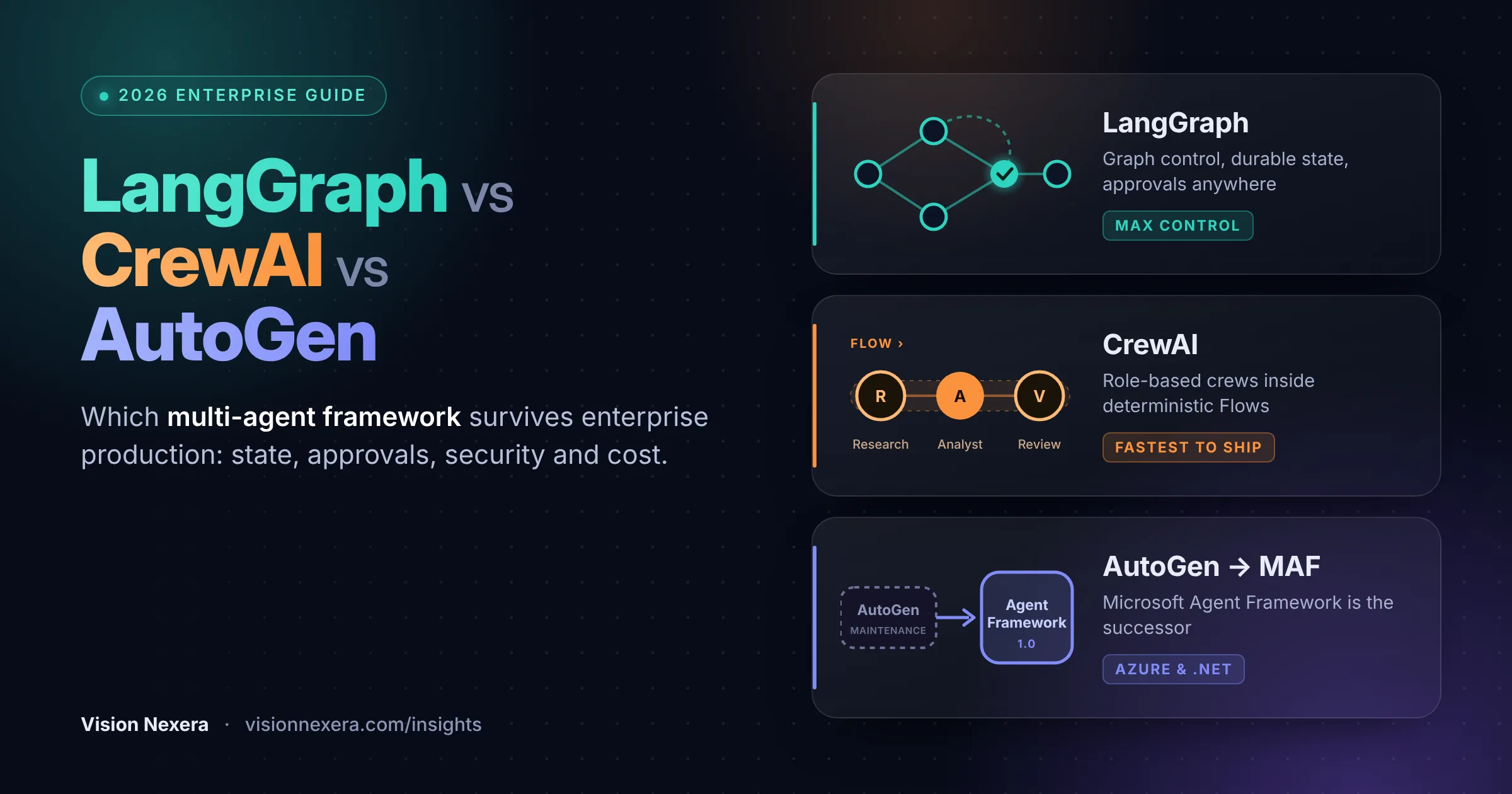
Compare LangGraph, CrewAI and AutoGen for enterprise multi-agent systems in 2026: state, approvals, security, cost and AutoGen's successor.
LangGraph vs CrewAI vs AutoGen for Enterprise Multi-Agent Systems
Microsoft put AutoGen into maintenance mode in October 2025. The AutoGen repository now tells new users to start with Microsoft Agent Framework instead, and that framework reached version 1.0 in April 2026. Most "LangGraph vs CrewAI vs AutoGen" comparisons still online were written before that change, so they compare a framework that no longer gets new features.
The framework choice also matters more than it looks. Gartner expects more than 40% of agentic AI projects to be canceled by the end of 2027, mostly because of rising costs and unclear value. A framework that hides state, cannot pause for a human, or cannot be traced in production makes both problems worse.
This guide is for CTOs, engineering leads and founders choosing an orchestration layer for multi-agent systems that must run in production: with audit trails, approvals, data-residency rules and a budget. It compares the three frameworks on the criteria that decide enterprise success, not on how quickly a demo runs.
The quick answer: the best multi-agent framework for each enterprise case
Choose LangGraph when you need explicit control over every step, durable state that survives crashes, human approval at any point, and a stable API. It suits regulated workflows, long-running processes and systems you will maintain for years.
Choose CrewAI when the work maps naturally to roles (researcher, analyst, reviewer) and you want a working system in days. Use Flows as the backbone and Crews only for the steps that need autonomy.
Choose Microsoft Agent Framework (AutoGen's successor) when your company runs on Azure and .NET, or already has AutoGen or Semantic Kernel code to migrate. Do not start a new production project on legacy AutoGen.
Choose none of them if a single agent with a few tools solves the problem. Multi-agent systems add cost, latency and failure points. Microsoft's own guidance says that if you can write a function to handle a task, you should do that instead of using an agent.
LangGraph vs CrewAI vs AutoGen: key differences in 2026
The biggest difference is not features. It is how much control each framework gives you over what happens between agents.
LangGraph is a graph of nodes and edges over shared, typed state. Version 1.0 has been stable since October 2025, with no breaking changes promised until 2.0. It ships checkpointers for durable state (Postgres in production), interrupt() for human approval at any step, and supervisor, swarm or fully custom multi-agent patterns. It runs in Python and JavaScript/TypeScript, is MIT-licensed, and traces through LangSmith. Its learning curve is the steepest of the three. Best fit: regulated, long-running, auditable workflows.
CrewAI pairs Flows (event-driven steps with typed state) with Crews (role-based agent teams that run inside those steps). It is actively released on the 1.x line. Flows persist with @persist, to SQLite by default, and pause for review with @human_feedback. It is Python only and MIT-licensed, and it adds tracing, OpenTelemetry and VPC deployment through its AMP platform. Its learning curve is the lowest. Best fit: fast delivery of role-based automation.
AutoGen and Microsoft Agent Framework are one lineage. AutoGen has been in maintenance mode since October 2025, and Microsoft Agent Framework 1.0 replaced it in April 2026 with a long-term support promise. The new framework combines agents with graph-based workflows and ships sequential, concurrent, handoff, group chat and Magentic-One patterns. Workflows checkpoint, and orchestrations support human approvals. It runs on .NET and Python, with Go in preview, is MIT-licensed, and hosts on Microsoft Foundry. Best fit: Azure and Microsoft-stack enterprises.
All three open-source frameworks are free. You pay for model tokens, hosting and any managed platform. The AI agent development cost guide breaks down those run costs in detail.
LangGraph: maximum control for production agents
LangGraph is LangChain's low-level orchestration framework. You model the system as a graph: nodes are agents, tools or plain functions, edges decide what runs next, and every node reads and writes one shared state object.
What it does well for enterprises
Durable execution. A checkpointer saves state after every step. If a server restarts during step three of a ten-step workflow, the run resumes from step three. The persistence docs recommend a database-backed checkpointer such as Postgres for production.
Human approval anywhere. Calling interrupt() inside any node pauses the run and saves its state. A reviewer approves or edits, and the graph resumes with Command(resume=...) on the same thread ID. See the interrupts guide.
Any multi-agent shape. Prebuilt supervisor and swarm libraries cover the two most common patterns. For anything else, you draw the graph yourself, including deterministic steps where agents are not needed.
API stability. Version 1.0 shipped in October 2025 with no breaking changes and a promise of none until 2.0. That matters when a system must run for years.
Production references. The LangGraph overview lists Klarna, Uber and J.P. Morgan among its users.
What to watch
More code up front. You define state schemas, nodes and routing explicitly. Simple role-based tasks take longer to build than in CrewAI.
Resume semantics. When a run resumes after an interrupt, the node restarts from the top, so code before interrupt() runs again. Side effects such as sending an email or writing to a CRM must be idempotent or placed after the interrupt.
Platform pull. Tracing works best in LangSmith. The Plus plan costs $39 per seat per month with 10,000 base traces, and hybrid or self-hosted deployment needs an Enterprise contract, according to LangChain's pricing page. You can also self-host the open-source library and use your own tracing.
CrewAI: the fastest route to a working agent team
CrewAI organizes agents as a crew of roles, each with a goal, a backstory and tools. It is independent of LangChain and has two layers. The CrewAI introduction calls Flows "the backbone of your AI application" and Crews "the units of work within your Flow". Its own advice on which to use is "Use both."
What it does well for enterprises
Speed. Roles and tasks are defined in Python or YAML, so a business-readable design ("a research agent hands findings to a compliance reviewer") becomes code quickly.
Deterministic Flows. Flows use decorators such as @start, @listen and @router for branching, loops and parallel steps, with typed Pydantic state.
Persistence and resume. @persist saves Flow state automatically, to a local SQLite database by default. Passing the state ID back to kickoff resumes a run.
Human feedback. Since version 1.8, @human_feedback pauses a Flow for review and can route on the reviewer's decision.
Enterprise platform. The CrewAI AMP Enterprise plan adds SSO, RBAC, PII redaction and deployment in your own VPC or infrastructure. The free tier allows 50 workflow executions per month.
What to watch
Autonomy costs tokens. Hierarchical crews and open delegation let agents decide who works next. That is flexible, but it multiplies LLM calls and makes cost and behavior harder to predict. Keep autonomy inside narrow Flow steps.
Production persistence. SQLite suits development. For multi-instance production, supply your own FlowPersistence backend.
Tool security. In March 2026, CERT/CC published four CrewAI vulnerabilities, including remote code execution through the Code Interpreter tool and SSRF in RAG search tools, reachable by prompt injection. The vendor says all are fixed in current releases and has removed the Code Interpreter tool. Pin a current version and never enable the unsafe-path override on systems that handle untrusted input.
AutoGen and Microsoft Agent Framework: the Microsoft path
AutoGen came out of Microsoft Research in 2023 and popularized conversational multi-agent patterns such as group chat and Magentic-One. Its 0.4 rewrite split it into Core, AgentChat and Extensions layers, with Python and .NET support and the no-code AutoGen Studio.
The 2026 reality
AutoGen is frozen. The repository says it "will not receive new features or enhancements" and points new users to Microsoft Agent Framework. Only bug and security fixes continue.
Microsoft Agent Framework is the successor. The 1.0 announcement describes it as unifying Semantic Kernel's enterprise foundations with AutoGen's orchestration patterns. It promises stable APIs and long-term support.
AG2 is a separate community fork. AutoGen's original creators continue the older conversational API under the name AG2. It is an option for teams with deep AutoGen 0.2 code, but it is a different project with its own roadmap.
What Microsoft Agent Framework does well
Two modes in one SDK. Microsoft's overview suggests agents for open-ended tasks and graph-based workflows when steps are well defined and execution order matters.
Enterprise orchestration patterns. Sequential, concurrent, handoff, group chat and Magentic-One are stable, with streaming, checkpointing, human approvals and pause/resume.
Middleware. Hooks for content safety, logging and compliance run without changing agent prompts.
Open protocols. MCP support lets agents call external tools, the same protocol behind our natural-language-to-MongoDB MCP server. Agent-to-agent (A2A) support works across frameworks, though Microsoft lists A2A 1.0 as coming soon.
Migration help. Migration assistants analyze AutoGen or Semantic Kernel code and produce step-by-step plans.
What to watch
Some enterprise features are still preview. Observability dashboards and Foundry-hosted agents were preview features at 1.0. Check their status before you depend on them.
Gravity toward Azure. The framework is open source and supports OpenAI, Anthropic, Ollama and others, but its first-party connectors and hosting assume Microsoft Foundry.
A younger ecosystem. It reached 1.0 six months before this guide, so there are fewer community examples than for LangGraph or CrewAI.
Seven enterprise criteria that should decide the choice
Demos hide the hard parts. These seven questions decide whether a multi-agent system survives its first year in production. Our article on why the demo is not the product covers the wider gap.
1. Can a run survive a crash and resume?
Enterprise workflows wait on people, APIs and batch jobs, sometimes for days. LangGraph's checkpointers handle this at its core. Microsoft Agent Framework checkpoints its workflows. CrewAI Flows persist state, but you should replace the SQLite default before you scale out.
2. Can a human approve, edit or reject at the right step?
Payments, contract changes and customer messages need a person in the loop. LangGraph can pause at any node. CrewAI and Microsoft Agent Framework provide approval steps inside Flows and orchestrations. Whichever you choose, make approvals part of the workflow design, not a prompt instruction.
3. Can you trace every decision?
When an agent gives a wrong refund or leaks data, you need the full chain: which agent, which prompt, which tool call, which model. LangSmith, CrewAI AMP tracing and Agent Framework's OpenTelemetry support all export traces. Confirm that traces can stay in a region and system you control.
4. Where does the data live?
For Saudi and other GCC deployments, data-residency rules shape the architecture more than the framework does. All three frameworks can run on your own infrastructure. Their managed platforms differ: LangSmith offers hybrid and self-hosted options on Enterprise, CrewAI AMP Enterprise can deploy in your VPC, and Microsoft's hosting runs on Foundry regions. See our guides to PDPL-compliant AI agent development and PDPL compliance for chatbots, voice agents and RAG.
5. How are tools and code execution secured?
Every agent that can call tools is a prompt-injection target. The CrewAI advisories show how a fallback sandbox can turn one injected instruction into server access. Whatever the framework, run code execution in isolated containers, validate every URL and file path, and give each agent the fewest permissions it needs. Our security and data practices page describes how we handle this.
6. How predictable is the cost?
In multi-agent systems, one user request can trigger many model calls as agents plan, delegate and review each other's work. Explicit graphs and Flows cap the number of steps. Open-ended group chats and hierarchical delegation do not, unless you set hard limits on turns and tokens.
7. Will the framework still be supported in three years?
AutoGen's move to maintenance mode is the warning. Prefer stable major versions with published compatibility promises: LangGraph 1.x and Microsoft Agent Framework 1.x both make one. Keep business logic, prompts and tool code outside framework-specific classes, so a later migration replaces the orchestration layer, not the whole system.
How to choose: a five-question decision path
Work through these questions in order. The first clear answer usually settles the choice.
Does the task need more than one agent? If one agent with good tools and retrieval can do it, build that first. Many "multi-agent" use cases are a single agent plus a deterministic workflow. Our build vs buy framework for AI features helps you scope it.
Is your company standardized on Azure and .NET? If yes, start with Microsoft Agent Framework. If you have AutoGen code, plan the migration now rather than building more on a frozen codebase.
Does the workflow need audit trails, approvals or multi-day runs? If yes, choose LangGraph. Explicit state and checkpoints make reviews, replays and incident investigations far easier.
Does the work map cleanly to roles, and do you need results within weeks? If yes, choose CrewAI. Build the process as a Flow and use Crews only where autonomy adds value.
Still undecided? Prototype the hardest step, not the easiest, in two frameworks for a few days. Measure how easy each is to trace, interrupt and test, not how quickly the first demo runs.
Mixing frameworks is also valid. A LangGraph control plane can call a CrewAI crew as one node, and open protocols such as MCP and A2A let agents built on different frameworks share tools and hand off work.
Mistakes to avoid
Starting new work on legacy AutoGen. It still runs, but it will not get new features. Use Microsoft Agent Framework or a different framework.
Letting agents talk without limits. Open group chats and unbounded delegation produce loops and surprise token bills. Set maximum turns, step budgets and timeouts.
Choosing on demo speed. The framework that builds the fastest prototype is not always the one that is easiest to debug at 2 a.m. Judge on tracing, testing and recovery.
Skipping evaluation. Build a test set of real cases before launch and rerun it on every prompt, model or tool change.
Treating prompts as security. "Never share customer data" in a system prompt is not a control. Enforce permissions in tools and data access.
Hard-wiring one model vendor. All three frameworks support several model providers. Keep the model behind a configuration setting so you can switch on price, quality or residency.
Ignoring run cost until launch. Every extra agent adds calls on every request. Estimate monthly cost per workflow before you commit, using the method in our AI agent cost guide.
How Vision Nexera builds enterprise multi-agent systems
Vision Nexera is an AI product engineering company based in Lahore, Pakistan. We design, build and run AI agents for companies in the GCC, the US and beyond. We choose the framework per project, after scoping the workflow, not before.
A typical engagement looks like this:
Scoping. We map the workflow, decision points, approvals, systems and data rules, then decide whether it needs multiple agents at all.
Framework choice in writing. We recommend LangGraph, CrewAI, Microsoft Agent Framework or a simpler design, with the reasoning and run-cost estimate documented.
Build with guardrails. We build durable state, human approval steps, least-privilege tools, tracing and an evaluation suite from the first sprint.
Integration. We connect agents to your CRM, ERP, databases and documents through our AI integration and RAG and LLM application work.
Run and improve. We monitor quality, latency and cost after launch and tune the system as models and frameworks change.
Our process page explains each stage, and our work shows systems we have shipped. If you are choosing a framework now, book a scoping call with Vision Nexera.
Frequently asked questions
Is AutoGen still maintained in 2026?
Only for bug and security fixes. Microsoft put AutoGen in maintenance mode in October 2025 and recommends Microsoft Agent Framework for new projects. Existing AutoGen apps keep working, and Microsoft publishes a migration guide.
Which is better for enterprises, LangGraph or CrewAI?
LangGraph is better when you need fine-grained control, durable state, approvals and long-term API stability. CrewAI is better when the work maps to roles and speed matters most. Many enterprises use CrewAI for faster automations and LangGraph for critical, regulated workflows.
What replaced AutoGen?
Microsoft Agent Framework, which reached version 1.0 in April 2026. It combines AutoGen's multi-agent patterns with Semantic Kernel's enterprise features, supports .NET and Python, and promises stable APIs. AG2 is a separate community fork led by AutoGen's original creators.
Is CrewAI secure enough for production?
It can be, with care. CERT/CC published four CrewAI vulnerabilities in March 2026, and the vendor says current releases fix them. Use a current version, avoid code-execution tools on untrusted input, validate URLs and file paths, and limit each agent's permissions.
Can I use LangGraph, CrewAI or Microsoft Agent Framework with Claude, GPT or open-source models?
Yes. All three are model-agnostic and support major commercial providers as well as local models through tools such as Ollama. Keep model choice in configuration so you can switch for price, quality or data residency.
Do these frameworks cost money?
The open-source frameworks are free under the MIT license. You pay for model tokens and hosting, plus optional managed platforms such as LangSmith or CrewAI AMP. LangSmith Plus costs $39 per seat per month, and CrewAI AMP has a free tier and custom enterprise pricing.
Can different agent frameworks work together?
Yes. You can call a CrewAI crew from a LangGraph node, and open protocols help agents share tools and tasks across frameworks. MCP standardizes tool access, and A2A standardizes agent-to-agent communication.
How long does it take to build an enterprise multi-agent system?
A focused prototype can take a few weeks. A production system with integrations, approvals, evaluation and monitoring usually takes several months. Scope, integrations and compliance requirements drive the timeline more than the framework does.
Pick for production, not for the demo
All three frameworks can produce an impressive demo. Only the right one for your stack, risk level and team will still be easy to run, audit and change in two years. In 2026, that means LangGraph for control, CrewAI for speed, and Microsoft Agent Framework instead of AutoGen for Microsoft-centered enterprises.
Tell us what you are building, and we will give you a written scope, a framework recommendation and an honest estimate. Book a scoping call or email hello@visionnexera.com.