UAE E-Invoicing for POS Systems: PINT AE, ASP Integration and Retail Flows (2026)
October 19, 2026 · Asma Nawaz · Technical Content Writer, Vision Nexera · 15 min read
Updated
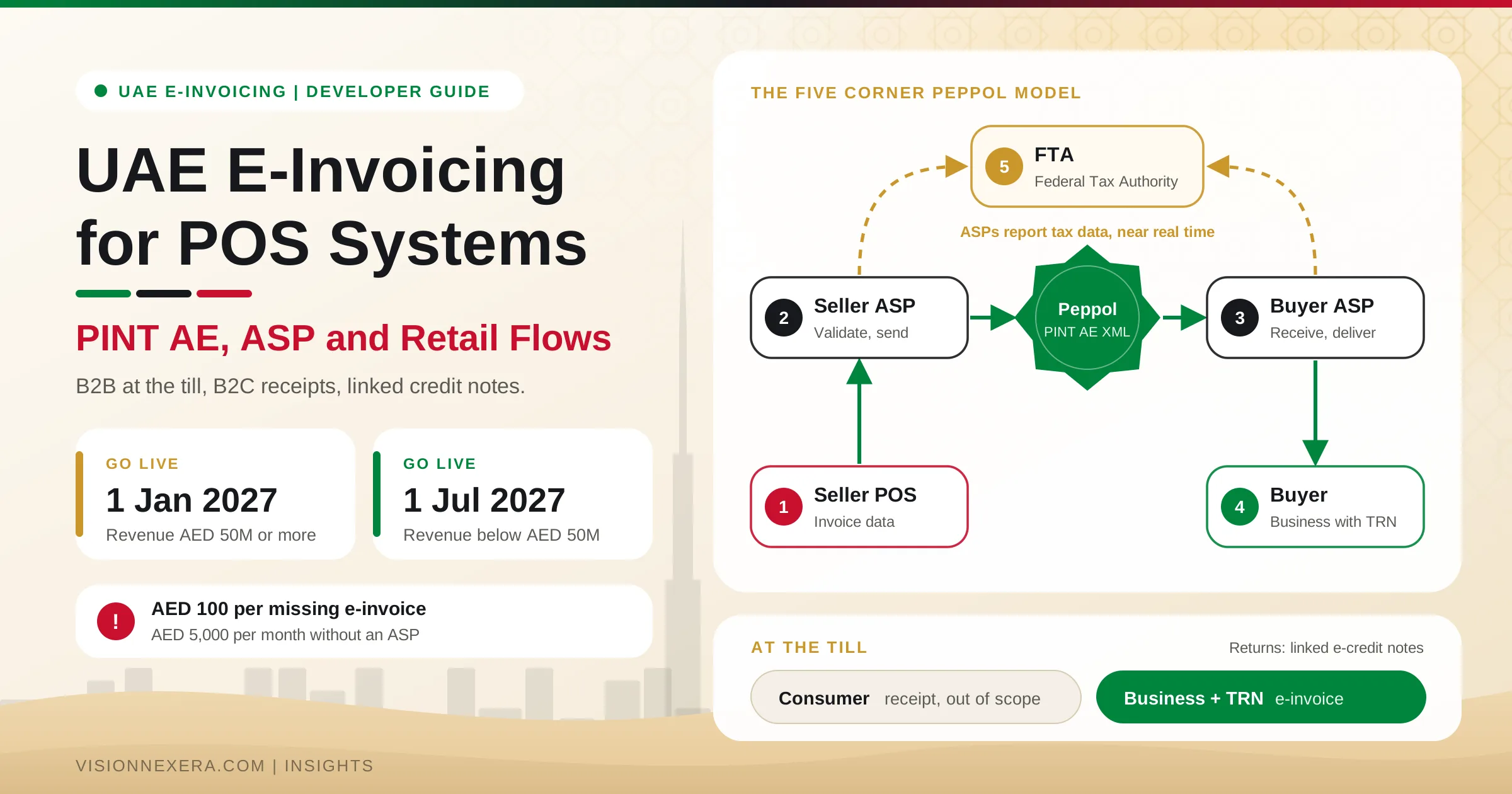
A developer's guide to UAE e-invoicing for POS and retail: the 2027 timeline, PINT AE, choosing and integrating an ASP, B2B and B2C flows at the till, credit notes, and penalties.
UAE E-Invoicing for POS Systems:
PINT AE, ASP Integration and B2B/B2C Retail Flows
The UAE's e-invoicing mandate is often described as a B2B project, and for most companies it is. For retailers, restaurants, and any business that runs a point of sale, it is more awkward than that. A POS sells mostly to consumers, who are outside the initial mandate, but it also sells to businesses, which are inside it. The same till, the same cashier, and the same receipt printer now have to handle two different compliance paths, sometimes several times an hour.
This guide is written for developers, technical leads, and finance teams responsible for POS systems and custom retail software in the UAE. It explains the mandate and timeline as of October 2026, how the five corner PINT AE model works, what an Accredited Service Provider does and does not do for you, how to design B2B and B2C flows at the till, and the engineering decisions that make the difference between a smooth go live and a backlog of unsent invoices. Treat it as engineering guidance, not tax advice, and confirm details against the Ministry of Finance and Federal Tax Authority publications before you build.
The quick answer
What changes: VAT registered businesses must issue B2B and B2G tax invoices and credit notes as structured electronic documents in the PINT AE format, exchanged through an Accredited Service Provider over the Peppol network, with tax data reported to the FTA.
When: voluntary adoption and the pilot opened on 1 July 2026. Businesses with revenue of AED 50 million or more must go live on 1 January 2027, with the ASP appointment deadline moved to 30 October 2026 by a 2026 ministerial decision. Businesses below AED 50 million must appoint an ASP by 31 March 2027 and go live on 1 July 2027. Government entities follow on 1 October 2027.
What it means for POS: B2C sales to individual consumers are outside the initial scope, so ordinary retail receipts continue for now. But any sale to a VAT registered business, even one made at a till, needs a compliant e-invoice. Your POS has to recognise those sales, capture the buyer's details, and route them through your ASP.
The biggest risk: treating e-invoicing as an ERP project and forgetting the till. B2B sales made at the POS, and the returns that follow them, are where most retail gaps appear.
How the UAE model works
The UAE uses a decentralised model built on Peppol, usually called the five corner model.
Corner one, the seller. Your POS or ERP creates the invoice data.
Corner two, the seller's ASP. Your Accredited Service Provider converts or receives the invoice as PINT AE XML, validates it, and sends it over the Peppol network.
Corner three, the buyer's ASP. The buyer's provider receives the invoice from the network.
Corner four, the buyer. The invoice is delivered into the buyer's system.
Corner five, the FTA. Tax data from the invoice is reported to the Federal Tax Authority in near real time.
Two features of this model shape every POS design decision.
There is no central clearance. Unlike Saudi Arabia's ZATCA model, where standard invoices are cleared by the authority before they reach the buyer, the UAE invoice moves between businesses through their providers while the tax data goes to the FTA in parallel. The invoice does not wait for government approval.
The ASP is in the middle of everything. You do not connect directly to the FTA or to the Peppol network. Your ASP validates, transmits, reports, and receives on your behalf. That makes the choice and integration of your ASP the most important technical decision in the project.
If you have built for Saudi Arabia, the difference is significant. Our ZATCA Phase 2 developer's guide covers the Saudi clearance model, cryptographic stamps, and hash chains, none of which a UAE POS has to implement itself.
What PINT AE is
PINT AE is the UAE's localised profile of the Peppol International invoice specification. It is a UBL based XML format with a defined data dictionary, business rules, and code lists.
The points that matter most for POS and retail developers:
Mandatory fields. The FTA's technical guidance lists 51 mandatory fields for an electronic tax invoice, grouped into invoice details, seller details, buyer details, totals and tax breakdown, and line level data.
Identifiers. Businesses are identified on the network by a participant identifier. For UAE businesses this is built from the tax identification number, which is the first 10 digits of the 15 digit TRN, under the scheme code 0235. Your ASP registers your participant ID for you.
Transaction flags. Certain scenarios, such as free zone supplies, margin scheme sales, deemed supplies, and exports, must be flagged explicitly. A POS that sells across several of these scenarios needs to know which flags apply to each sale.
Validation. Every invoice is checked against the PINT AE rules at the seller's ASP before it leaves. An invoice that fails validation stops at corner two and never reaches the buyer, so your system has to handle rejection responses and correct and resend.
The PDF is not the invoice. A human readable PDF or printed copy can still be shared, but the structured XML is the legal invoice.
What the ASP does, and what it does not do
An Accredited Service Provider is a company approved by the Ministry of Finance to run e-invoicing on behalf of businesses. Typical ASP services include:
Receiving invoice data from your systems through an API, file upload, or connector.
Converting it to PINT AE, or accepting PINT AE you generate yourself.
Validating against the PINT AE rules and returning errors.
Looking up the buyer's participant ID and sending through Peppol.
Reporting tax data to the FTA.
Receiving invoices addressed to you from your suppliers.
Archiving, often with UAE based storage.
What an ASP does not do is understand your business. It cannot know which POS sales were really B2B, how your system models discounts and promotions, which transaction flags apply to a sale, or how a return links back to the original invoice. That mapping is your work, and it is where most implementation time goes.
Choosing an ASP for a POS heavy business
Ask every shortlisted provider:
Does your API accept invoice data in a simple JSON format, or must we send PINT AE XML?
What are your latency and throughput limits, and can you handle peak hours across many stores?
Do you offer participant ID lookup through the API, so the till can check whether a business buyer is reachable?
How do you return validation errors, and are they machine readable?
Do you support credit notes linked to original invoices?
Where is archived data stored, and for how long?
What happens if your service is down, and what is your SLA?
What is the pricing model: per invoice, per month, or tiered?
Do you also support B2C e-receipts if and when they come into scope?
B2B and B2C flows at the till
This is the heart of POS e-invoicing. Every sale has to be classified, and the classification decides the path.
The B2C path
A consumer buys goods and pays. As of October 2026, B2C transactions are outside the initial mandatory scope, so the existing receipt or simplified tax invoice process continues. Nothing has to go through the ASP.
Design for change anyway. The UAE has signalled that B2C reporting may follow later, and many ASPs already offer e-receipt services. Keep B2C sale data structured and complete so that adding a B2C reporting flow later is a configuration change rather than a rebuild.
The B2B path at a POS
A business customer buys at the till, often a contractor at a hardware store, a company buying supplies, or a caterer buying in bulk, and wants a tax invoice so they can recover input VAT. This sale is in scope and needs a PINT AE e-invoice.
A good B2B flow at the till looks like this:
Identify the sale as B2B. Ask the question at checkout, or detect it automatically when a business customer account or loyalty card is used.
Capture the buyer's TRN. Scan it from a stored customer profile, a QR code, or enter it manually. Validate the format at entry.
Look up the buyer. Through your ASP, check that the buyer has a participant ID on the network and retrieve their legal name and address details.
Complete the sale normally. Take payment and print a receipt that shows it is a tax invoice copy, with the invoice number.
Send the invoice. The POS or a central invoice service sends the invoice data to the ASP, which validates, transmits to the buyer's ASP, and reports to the FTA.
Handle the response. If validation fails, the error goes to a back office queue for correction and resend, not to the cashier.
The key design rule is that the cashier should never wait on the ASP. The sale completes at the till. Invoice transmission happens just after, asynchronously.
Converting a B2C sale to B2B after the fact
Customers often ask for a tax invoice after paying, sometimes days later. Your system needs a controlled way to convert a completed B2C sale into a B2B e-invoice: look up the original sale, capture the buyer's details, issue the e-invoice, and record the link. Guidance describes an issuance window of 14 days from the taxable event, so build these conversions into your process rather than leaving them to ad hoc requests, and confirm the exact rule with your adviser.
Returns and credit notes
Returns on B2B sales must be handled as electronic credit notes linked to the original invoice, sent through the same ASP path. Your POS returns process needs to:
Find the original invoice, ideally by scanning the receipt.
Determine whether the original sale was B2B and was sent as an e-invoice.
Issue a linked electronic credit note for the returned items, with the correct reference and reason.
Handle partial returns, exchanges, and refunds to a different payment method.
Returns are where retail implementations break most often, because they cross days, stores, and sometimes systems.
Reference architecture for POS e-invoicing
For a retailer with several stores and a central back office, a clean architecture looks like this:
POS terminals handle checkout, B2B identification, TRN capture, and receipts. They queue invoice data locally if the network is down.
A central invoice service receives sales from all terminals, applies the PINT AE mapping, decides transaction flags, and maintains invoice numbering.
A buyer directory caches validated business customers, their TRNs, and participant IDs, so repeat customers are fast at the till.
The ASP connector sends invoices and credit notes, handles retries with backoff, and records every response.
An exceptions queue collects validation failures and unreachable buyers for back office staff to resolve.
An archive stores the XML, ASP responses, and the link between POS sales, invoices, and credit notes, in UAE based storage.
Monitoring alerts on rising error rates, unsent invoices approaching the issuance window, and ASP availability.
Keeping PINT AE mapping in one central service, rather than in every terminal, is the most important choice. It means rule changes, new flags, and ASP changes touch one place, and terminals stay simple.
Engineering decisions that matter
Generate PINT AE yourself, or send simple data to the ASP?
Many ASPs accept a simplified JSON format and generate PINT AE for you. That is faster to launch and reduces your XML work. Generating PINT AE yourself gives you more control, makes switching ASPs easier, and lets you validate before sending. For most retailers, a sound approach is to keep your own canonical invoice model and map it to whichever format your ASP accepts, so the mapping, not the whole system, changes if you switch providers.
Offline stores
Stores lose connectivity. The till must keep selling. B2B sales made offline should be queued durably on the terminal or a local store server and forwarded to the central service when the connection returns. Unlike Saudi simplified invoices, there is no local cryptographic signing step, so the main requirements are durable queuing, correct ordering, and monitoring so nothing sits unsent beyond the issuance window.
Idempotency
Network failures happen between the invoice service and the ASP. Give every invoice a stable unique identifier, retry with the same identifier, and make sure your ASP connector never creates duplicates when it retries.
Rounding and totals
Validation checks that line totals, tax amounts, and document totals reconcile. Retail systems often calculate VAT inclusive prices, apply basket discounts, and round at the receipt level. Make sure the invoice you send reconciles exactly under PINT AE rules, and test edge cases such as mixed rate baskets, discounts across lines, and zero rated items.
Buyers not yet on the network
During the phased rollout, some business buyers will not yet have a participant ID. Decide with your ASP and advisers how to handle these cases, record them clearly, and keep the data needed to send the invoice once the buyer is reachable.
Master data quality
Your own legal name, TRN, addresses, and product tax codes must be correct and consistent. In retail, the most common master data problem is product tax classification across thousands of SKUs. Audit it before go live.
Penalties and why to start now
Cabinet Decision No. 106 of 2025 sets the penalties once a business reaches its mandatory phase. Reported amounts include:
AED 5,000 per month for failing to implement e-invoicing or appoint an ASP on time.
AED 100 per invoice for failing to issue and send a required e-invoice, capped at AED 5,000 per month.
AED 100 per credit note for failing to issue and send a required electronic credit note, capped at AED 5,000 per month.
AED 1,000 per day for failing to notify the FTA of a system failure that prevents compliance.
AED 1,000 per day for failing to notify your ASP of changes to company data on time.
The bigger practical risk for retailers is operational: business customers who cannot recover input VAT because they did not receive a compliant e-invoice will notice quickly, and they will take their purchasing elsewhere.
A practical rollout plan
For a retailer in the second wave, going live on 1 July 2027, a realistic plan looks like this:
Now to end of 2026: assessment. Measure how many B2B sales happen at your tills, map every system that issues invoices or credit notes, and audit master data.
Early 2027: ASP selection. Shortlist and test providers against your POS volumes, and appoint one before 31 March 2027.
Q1 to Q2 2027: build. Implement the central invoice service, the ASP connector, B2B identification and TRN capture at the till, the returns flow, and the exceptions queue.
Q2 2027: pilot. Run a few stores end to end, including offline tests, returns, and conversions from B2C to B2B.
1 July 2027: go live. Roll out to all stores with monitoring and a staffed exceptions queue for the first weeks.
Large retailers in the first wave are already at or past their ASP appointment deadline and should be in testing now, ahead of 1 January 2027.
How Vision Nexera helps
Vision Nexera builds custom software and systems integrations for businesses in the Gulf, with teams in Lahore and Doha. For UAE e-invoicing, we focus on the parts that ASPs and off the shelf connectors do not cover: B2B identification and TRN capture at the till, central PINT AE mapping for custom POS and ERP systems, linked credit notes for returns, offline store queues, and the exceptions and monitoring that keep invoices flowing after go live.
We start with an assessment of your systems, sales mix, and data, help you choose an ASP that fits your volumes, and build with the same production discipline we apply to every system, which you can see on our process and security pages.
Frequently asked questions
Do UAE retailers need to e-invoice B2C sales?
Not under the initial mandate. As of October 2026, B2C transactions are outside the mandatory scope, so existing receipt processes continue. B2B and B2G sales, including those made at a POS, must be e-invoiced once your phase begins.
When does UAE e-invoicing become mandatory?
Businesses with revenue of AED 50 million or more go live on 1 January 2027, with the ASP appointment deadline moved to 30 October 2026. Businesses below AED 50 million must appoint an ASP by 31 March 2027 and go live on 1 July 2027. Government entities go live on 1 October 2027.
What is PINT AE?
PINT AE is the UAE's localised version of the Peppol International invoice specification. It defines the structured XML format, mandatory fields, business rules, and code lists that every UAE e-invoice must follow.
Do I need an Accredited Service Provider?
Yes. Businesses in scope must use an ASP approved by the Ministry of Finance. The ASP validates invoices, sends them over the Peppol network, receives invoices addressed to you, and reports tax data to the FTA.
How should a POS handle a business customer?
Identify the sale as B2B at checkout, capture and validate the buyer's TRN, look up their participant ID through your ASP, complete the sale, and send the e-invoice asynchronously through your invoice service and ASP.
How are returns handled under UAE e-invoicing?
Returns on B2B sales must be issued as electronic credit notes linked to the original e-invoice and sent through the same ASP path. A standalone PDF credit note is not enough.
Is the UAE model the same as Saudi Arabia's ZATCA model?
No. Saudi Arabia uses a clearance model where ZATCA validates standard invoices before they reach the buyer, and businesses sign invoices with cryptographic stamps. The UAE uses a decentralised five corner Peppol model, with ASPs exchanging invoices between businesses and reporting tax data to the FTA in parallel.
What are the penalties for non compliance?
Under Cabinet Decision No. 106 of 2025, penalties include AED 5,000 per month for not implementing e-invoicing or appointing an ASP on time, and AED 100 per missing e-invoice or credit note, capped at AED 5,000 per month, along with daily penalties for failing to report system failures or data changes.
The till is part of the mandate
UAE e-invoicing looks like a back office project, but for retailers the hard cases start at the counter: the business customer who needs a tax invoice, the receipt that has to become an e-invoice three days later, and the return that has to become a linked credit note at another branch. Retailers that design those flows deliberately, with a central invoice service and a well chosen ASP, will go live calmly. Those that leave them to cashiers and spreadsheets will spend the first months chasing exceptions.
If your POS or retail software needs to be ready for UAE e-invoicing, book a scoping call with Vision Nexera. You will come away with an assessment of your systems, a recommended architecture, and a realistic plan for your go live date.