Building an AI-Powered POS for UAE Retail and F&B: E-Invoicing Ready from Day One
October 24, 2026 · Asma Nawaz · Technical Content Writer, Vision Nexera · 14 min read
Updated
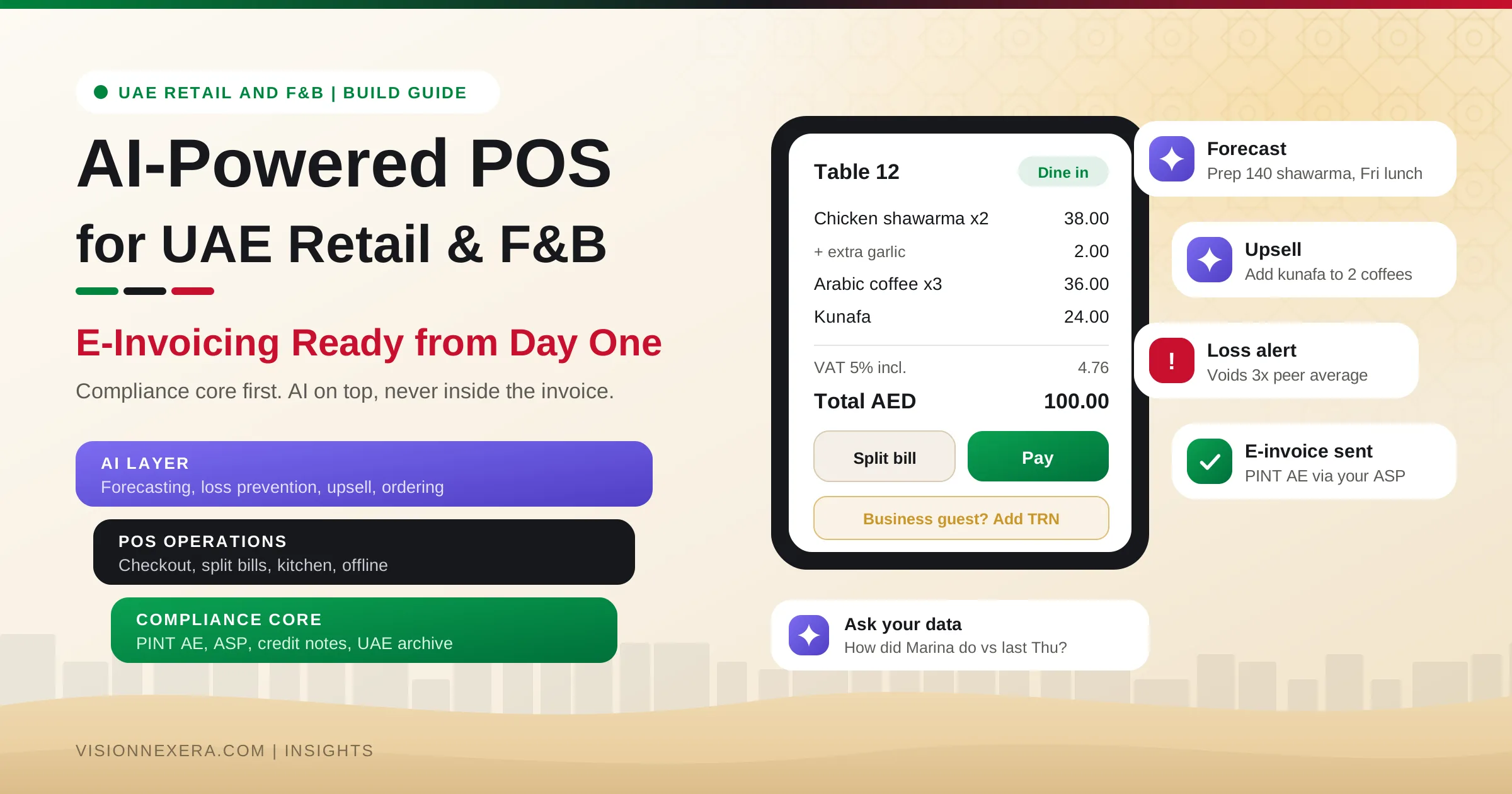
How to build an AI-powered POS for UAE retail and restaurants that is e-invoicing ready from day one: architecture, F&B and retail flows, PINT AE, and where AI pays off.
Building an AI-Powered POS for UAE Retail and F&B: E-Invoicing Ready from Day One
Most retailers and restaurant groups in the UAE will touch their POS in the next eighteen months whether they planned to or not. The e-invoicing mandate brings B2B sales at the till into scope from 2027, and many existing systems, especially older or heavily customised ones, were never designed to issue structured invoices through an Accredited Service Provider.
That forced upgrade is also an opportunity. If you are going to rework the system that records every sale anyway, you can build it on a foundation that is compliant from day one and ready for the AI features that actually move margins in retail and food and beverage: forecasting, smarter inventory, loss prevention, conversational ordering, and analytics owners can simply ask questions of.
This guide is for founders, operators, and technical leads at UAE retail and F&B businesses deciding whether to build or rebuild their POS. It covers when a custom POS makes sense, how to make it e-invoicing ready from the first line of code, the F&B and retail details that break generic systems, where AI genuinely pays off, and a realistic plan to be live before your e-invoicing deadline. Treat it as engineering guidance, not tax or legal advice, and confirm regulatory details with your advisers.
The quick answer
Compliance is the foundation, AI is the layer on top. Build the invoice, tax, and audit core first, deterministic and boring. Add AI around it, never inside the legal invoice.
E-invoicing ready means more than an ASP connector. It means a canonical invoice model, B2B detection and TRN capture at the till, a central PINT AE mapping service, linked electronic credit notes for returns, and UAE based archiving, all designed so B2C reporting can be switched on later.
F&B is harder than retail. Split bills, modifiers, service charges, voids, comps, kitchen tickets, and delivery aggregators all have to reconcile with a clean tax invoice.
AI pays off in a handful of places. Demand forecasting and prep planning, inventory and reordering, loss prevention on voids and discounts, upselling, conversational ordering in Arabic and English, natural language reporting, and back office help with e-invoicing exceptions.
Timing matters. Businesses below AED 50 million must appoint an ASP by 31 March 2027 and go live with e-invoicing on 1 July 2027. A custom POS build needs to start early enough to pilot before that date.
Build, buy, or extend
A custom POS is not the right answer for everyone. Off the shelf systems serve most single location cafés and shops well, and many will add e-invoicing support through their own ASP partnerships.
A custom or heavily extended POS starts to make sense when:
You run multiple brands or formats with different menus, pricing, and workflows that a single SaaS product handles badly.
Your operations are your advantage, such as central kitchens, complex modifiers, subscription or membership models, or B2B and B2C sales through the same counters.
You need deep integration with your ERP, warehouse, loyalty platform, delivery aggregators, or your own app.
You want to own your data and build AI on it, rather than relying on whatever analytics a vendor provides.
You have outgrown your current system and the e-invoicing deadline forces a decision anyway.
A middle path is common: keep a proven POS front end where it works, and build a custom back end that owns the invoice model, e-invoicing, data, and AI. The rest of this guide applies to both a full build and that hybrid.
E-invoicing ready from day one
Our guide to UAE e-invoicing for POS systems covers the mandate in detail. Here is what it means for a system you are building now.
A canonical invoice model
Design one internal model for every commercial document: sales, invoices, credit notes, and adjustments. It should carry everything a PINT AE invoice needs, including seller and buyer details, line items, tax categories, totals, transaction flags, and references between documents. Every channel, whether the till, the kiosk, the app, or a delivery aggregator, writes into this model. Mapping to PINT AE, or to whatever format your ASP accepts, happens in one central service.
B2B detection at the till
The till must know when a buyer is a VAT registered business. Build it into checkout: a business customer flag on profiles, a quick prompt for walk in buyers who ask for a tax invoice, TRN capture by scan or entry, and validation of the TRN format. Store business customers in a directory so repeat buyers are recognised instantly.
Asynchronous submission
The cashier should never wait for an ASP. Complete the sale, then send the invoice from a central service with durable queues, retries, idempotent identifiers, and an exceptions queue for anything the ASP rejects.
Credit notes as a first class flow
Returns, refunds, and post sale adjustments on B2B sales must produce electronic credit notes linked to the original invoice. Build return flows that find the original by scanning the receipt, at any branch, and handle partial returns and exchanges cleanly.
Receipt to invoice conversion
Customers often ask for a tax invoice after paying. Give staff a controlled flow to convert a completed sale into a B2B e-invoice, with the link between the two recorded.
Archive and audit
Store the structured invoice, the ASP responses, and the full link from sale to invoice to credit note, in UAE based storage, for the retention period your advisers confirm.
Designed for B2C later
B2C sales are outside the initial mandate, but keep consumer sale data structured and complete, so that if B2C reporting arrives, it is a configuration change rather than a rebuild.
The details that break generic POS systems
Food and beverage
Modifiers and combos. A burger with extra cheese, no onions, and a combo upgrade has to price correctly, print correctly in the kitchen, and still produce clean invoice lines with the right tax treatment.
Split bills. A table of six splitting by seat, by item, or evenly, with one guest wanting a tax invoice for their company, is a normal Thursday night. Each split must reconcile, and the business guest's portion must be invoiceable on its own.
Service charges and fees. Service charges, and in some venues and emirates additional municipality or tourism fees, have to be calculated, shown, and taxed correctly. Confirm the rules for each venue type and location.
Voids, comps, and discounts. These need reasons, permissions, and audit trails. They are also where most leakage happens, which makes them a prime target for AI anomaly detection.
Kitchen and bar routing. Orders route to the right printer or kitchen display by station, course, and timing, independently of the invoice.
Delivery aggregators. Orders from delivery platforms arrive with their own pricing, promotions, and commission structures. They need to flow into the same canonical model so stock, reporting, and tax remain consistent.
Retail
Large catalogues. Thousands of SKUs with variants, barcodes, and correct tax classification. Poor product master data is the most common cause of bad invoices.
Promotions. Buy one get one, bundle pricing, loyalty redemptions, and basket discounts must allocate correctly to lines so totals reconcile under e-invoicing rules.
Returns across branches. A customer buys in Dubai Mall and returns in Abu Dhabi. The return must find the original sale and issue a linked credit note.
B2B counters. Hardware, electronics, and wholesale style retailers sell to businesses daily at the same tills as consumers.
Both
VAT at 5 percent, inclusive pricing. Most UAE consumer prices are VAT inclusive. Calculate tax per line with decimal arithmetic and consistent rounding so invoices reconcile exactly.
Arabic and English. Receipts, invoices, and customer facing screens often need both languages, with correct right to left rendering.
Offline operation. Malls and kitchens lose connectivity. Terminals must keep selling and queue safely.
A reference architecture
A modern, e-invoicing ready POS for multi site retail or F&B typically looks like this:
Terminals and kiosks that run offline first, handle checkout, payments, kitchen routing, and TRN capture, and sync through a local queue.
A store hub in each location that keeps the store running if the internet drops, and buffers events to the cloud.
A cloud core holding the product catalogue, pricing and promotions, customers and loyalty, inventory, and the canonical sales and invoice records.
An event log where every sale, void, refund, stock movement, and price change is recorded as an event. This becomes the raw material for analytics and AI.
The compliance service that maps documents to PINT AE, talks to your ASP, manages credit notes, exceptions, and the archive.
Integrations with payments, delivery aggregators, ERP and accounting, and your own apps.
The AI layer, reading from the event log and the catalogue, writing recommendations and alerts back into the operational system, and never editing legal documents.
Monitoring for sync health, unsent invoices, ASP errors, and model quality.
Host the cloud core in a UAE cloud region where possible, and keep e-invoice archives in the UAE. Treat customer data under the UAE's personal data protection law, with consent for marketing and loyalty, and limits on who can see what.
Where AI genuinely pays off
AI in a POS is easy to demo and hard to make useful. These are the areas where we see real returns in retail and F&B, roughly in order of how quickly they pay back.
1. Demand forecasting and prep planning
For restaurants, knowing how many portions of each dish to prep for tomorrow lunch at each branch cuts waste and stockouts. For retailers, forecasting by SKU and store drives replenishment. Forecasts use your sales history, day of week, seasonality, Ramadan and holiday patterns, weather, and local events. This usually delivers the fastest measurable savings.
2. Inventory and smart reordering
Turn forecasts into suggested purchase orders, flag items at risk of running out, and spot slow movers before they expire. In F&B, connect recipes to ingredients so a forecast of dishes becomes a forecast of stock.
3. Loss prevention
Voids, refunds, manual discounts, and comps are where money leaks. Anomaly detection can flag unusual patterns, such as a cashier with three times the void rate of their peers, refunds clustered at closing time, or discounts applied without matching promotions, for a manager to review. The model flags, a person decides.
4. Upsell and recommendations
At the till, kiosk, or in the app, suggest add ons and upgrades based on what is in the basket, time of day, and what similar customers bought. Keep it short and relevant; one good suggestion beats five generic ones.
5. Conversational ordering
Customers in the UAE already order through WhatsApp and phone. An AI agent can take orders and bookings in Arabic and English, check availability and modifiers against your live menu, and push the order straight into the POS. Voice agents can handle phone orders at peak times. Our guides to AI agent development cost and voice agent costs explain what these cost to build and run.
6. Natural language analytics
Owners and area managers want answers, not dashboards. Let them ask "How did the Marina branch do yesterday compared with last Thursday?" or "Which dishes lost margin after the supplier price increase?" and get an answer grounded in your own data. This is a well bounded use of language models when it sits on a clean, governed data layer.
7. Menu and pricing insight
Combine sales mix, margins, and preparation cost to show which items to promote, reprice, or remove. Suggest price tests rather than changing prices automatically.
8. AI for compliance operations
AI can quietly make e-invoicing cheaper to run: suggesting tax classifications for new SKUs, cleaning and matching business customer records and TRNs, triaging ASP rejection errors and proposing fixes, and summarising exception queues for finance. A person still approves every change.
The rule that keeps it safe
AI suggests, deterministic code decides. Prices, taxes, invoices, and credit notes are always produced by tested, rule based logic. AI can recommend a price change, a reorder, or a fix, but a person or a clear business rule makes it happen, and every AI action is logged.
Getting the data foundation right
Every AI feature above depends on clean data. Before building models, make sure you have:
An event log of every sale, void, refund, discount, and stock movement, with timestamps, branch, staff, and channel.
A clean product catalogue with consistent names, categories, recipes for F&B, and tax classifications.
Customer profiles with consent, linked across channels where customers have agreed.
Reliable time and location data, so forecasts and anomalies make sense per branch.
Access controls, so staff, managers, and models see only what they should.
In our experience, the data foundation is where projects succeed or stall. A modest model on clean data beats a sophisticated one on messy data every time. If you plan to let staff or owners query documents and policies as well as sales data, our guide to RAG versus fine tuning explains the trade offs.
A realistic build plan
For a business in the 1 July 2027 e-invoicing wave, a plan that leaves room to pilot looks like this:
Weeks 1 to 4: discovery and design. Map your channels, menus or catalogues, promotions, B2B volume, integrations, and data. Choose build, extend, or hybrid. Shortlist ASPs.
Months 2 to 4: compliance core and POS foundation. Canonical invoice model, checkout, offline sync, TRN capture, central compliance service, credit notes, archive.
Months 4 to 6: integrations and F&B or retail specifics. Payments, aggregators, kitchen routing, promotions, ERP, and the ASP connection in test.
Months 5 to 7: pilot. Two or three sites end to end, including offline days, split bills, returns across branches, and receipt to invoice conversions.
Before 1 July 2027: rollout. All sites live on e-invoicing with monitoring and a staffed exceptions queue.
After go live: AI modules. Start with forecasting and loss prevention, which pay back fastest, then add recommendations, conversational ordering, and natural language analytics.
Starting in the final quarter of 2026 gives a comfortable margin. Starting in the second quarter of 2027 does not.
What it costs
Costs depend heavily on scope, so treat these as rough planning ranges rather than quotes. A focused POS back end with the e-invoicing compliance core, built around an existing front end, commonly sits in the tens of thousands of US dollars. A full multi site POS with offline terminals, integrations, and F&B workflows costs more. Each AI module, such as forecasting or loss prevention, typically adds a smaller, separate budget once the data foundation exists, plus ongoing model and hosting costs.
The biggest cost driver is not AI. It is the number of integrations and the quality of your existing data. Our guide to AI developer hourly rates by country explains how team location changes the budget for the same scope.
How Vision Nexera helps
Vision Nexera builds custom software, AI agents, and AI integrations for businesses in the Gulf, with teams in Lahore and Doha. For UAE retail and F&B, we build POS back ends and full platforms with the e-invoicing core designed in from day one, then add AI where it pays back: forecasting, loss prevention, conversational ordering, and analytics.
We start with discovery, recommend whether to build, extend, or combine, and plan backwards from your e-invoicing date. You can read how we work on our process and security pages.
Frequently asked questions
Do I need a new POS for UAE e-invoicing?
Not necessarily. Many existing systems will add support through ASP partnerships. You need a new or extended system if your current POS cannot identify B2B sales, capture TRNs, issue linked credit notes, or integrate with an ASP, or if you have outgrown it for other reasons.
When does UAE e-invoicing apply to my POS?
Businesses with revenue of AED 50 million or more go live on 1 January 2027. Businesses below AED 50 million must appoint an ASP by 31 March 2027 and go live on 1 July 2027. B2B sales at the till are in scope from your go live date. B2C sales are outside the initial scope.
Can AI generate or change invoices?
It should not. Invoices, taxes, and credit notes should always come from tested, rule based logic. AI can suggest actions, such as a tax classification for a new product or a fix for a rejected invoice, but a person or a clear rule applies the change.
Which AI features pay back fastest in F&B?
Demand forecasting and prep planning usually pay back fastest by reducing waste and stockouts, followed by loss prevention on voids, comps, and discounts.
Can customers order through WhatsApp or by phone in Arabic?
Yes. AI agents can take orders and bookings in Arabic and English through WhatsApp, web chat, or voice, check them against your live menu, and send them straight into the POS. Plan for testing with real customers and dialects.
How do split bills work with e-invoicing?
Each portion of a split bill must reconcile on its own. If one guest needs a tax invoice for their company, their portion must be issued as a B2B e-invoice with their TRN, while the rest of the table can remain B2C.
Where should POS data be hosted?
Host the core platform in a UAE cloud region where possible, keep e-invoice archives in the UAE, and handle customer data in line with the UAE's data protection rules and your customers' consent.
How long does it take to build an AI-powered POS?
A POS back end with the e-invoicing core can be piloted within about six months. A full multi site platform takes longer. AI modules are best added after go live, once the data foundation is in place.
Build the core once, then let it learn
The e-invoicing mandate is forcing UAE retailers and restaurants to revisit the system at the heart of their business. Those who simply bolt a connector onto an old POS will be compliant. Those who rebuild the core properly, with a clean invoice model, offline resilience, and an event log, will be compliant and have the foundation to forecast demand, stop leakage, and serve customers in new ways.
If you are planning a POS build or rebuild for UAE retail or F&B, book a scoping call with Vision Nexera. You will come away with a recommendation on build versus extend, a compliance first architecture, and a plan that gets you live before your e-invoicing date.