Qatar PDPPL Compliance for AI Systems: Chatbots, Agents and RAG
November 19, 2026 · Asma Nawaz · Technical Content Writer, Vision Nexera · 17 min read
Updated
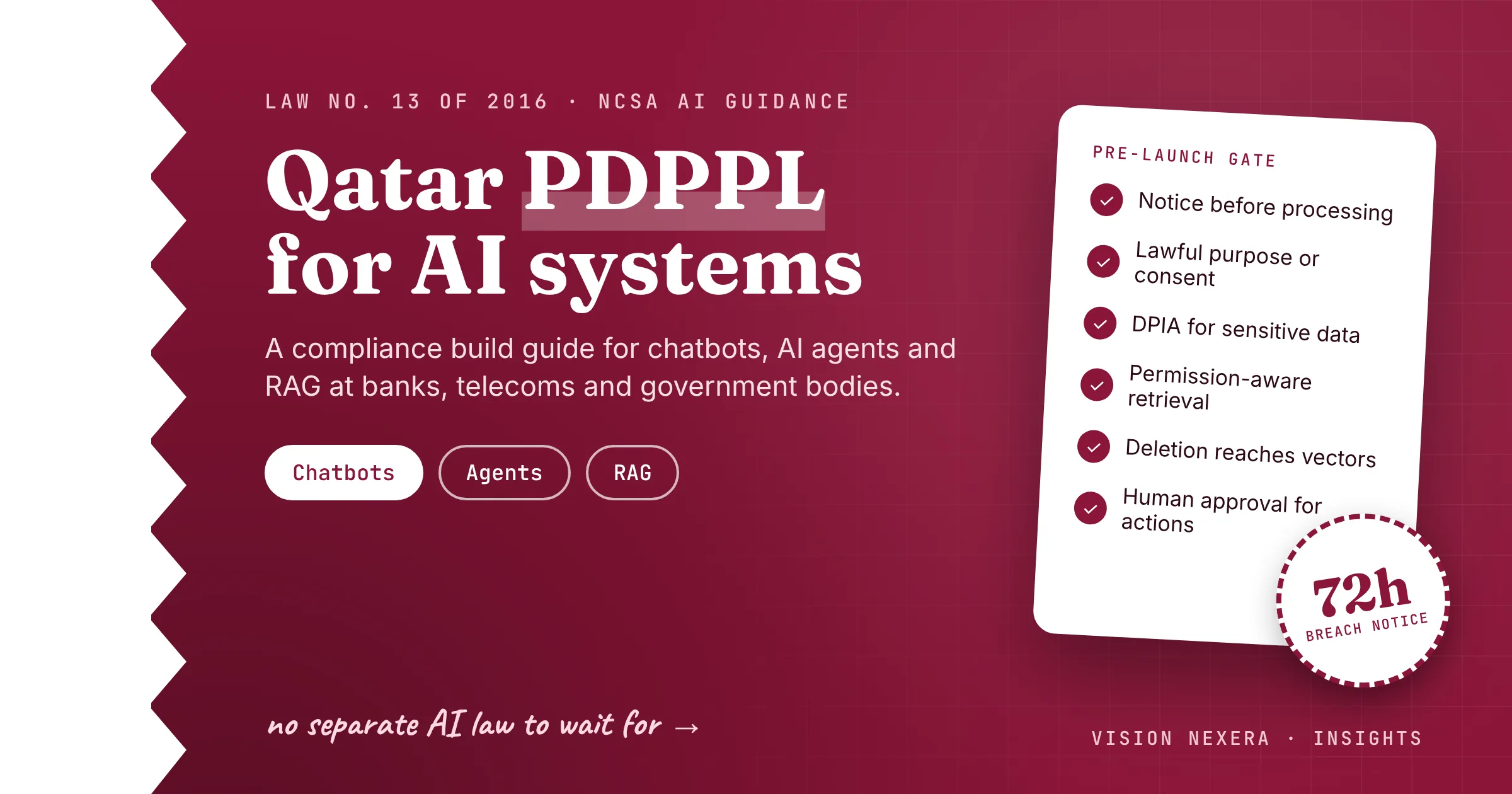
Qatar PDPPL AI guide for banks, telecoms and government: build compliant chatbots, AI agents and RAG under Law 13 of 2016 and NCSA AI guidelines.
Qatar PDPPL Compliance for AI Systems: Chatbots, Agents and RAG
Qatar PDPPL AI compliance in one sentence:
If your chatbot, AI agent or RAG pipeline touches personal data of people in Qatar, Law No. 13 of 2016 (the Personal Data Privacy Protection Law, or PDPPL) already applies to it, and the National Cyber Security Agency (NCSA) has published guidelines that tell you how it expects AI to be adopted securely. There is no separate AI law to wait for. The obligations you need to design for are here now: a lawful purpose or consent, a notice before processing, rights handling, a privacy impact assessment for sensitive data, processor oversight, and breach notification within 72 hours.
This guide is written for IT and compliance leads at Qatari banks, telecoms and semi-government bodies who are approving or building AI systems. It turns the law and the guidance into concrete architecture decisions for three system types: customer-facing chatbots, tool-using AI agents, and retrieval-augmented generation (RAG) over internal documents.
What Qatar PDPPL AI scrutiny actually covers
Qatar was the first GCC state to pass a general data protection law. The PDPPL has been in force since 2017, and the NCSA's National Cyber Governance and Assurance Affairs (NCGAA) acts as the regulator. For AI teams, the useful way to read the landscape is in three layers.
The binding layer: the PDPPL itself
The PDPPL covers personal data that is processed electronically, collected for electronic processing, or processed by a mix of electronic and traditional means. Every production AI system falls inside that definition the moment it reads a name, a phone number, an account record or a free-text message that identifies someone.
The core obligations that matter for AI are:
Obligation | What the PDPPL expects | Where it bites in an AI system |
|---|---|---|
Lawful basis | Consent, or processing necessary for a "lawful purpose", plus listed exemptions (public interest, legal obligation, vital interests, research, crime investigation) | Every new use of data, including training, fine-tuning and evaluation |
Notice | Tell people who the controller is, who processes for it, the purpose and the processing before processing starts | Chatbot welcome flows, agent disclosures, privacy notices |
Rights | Internal systems for access, correction, deletion and complaints; people can complain to NCGAA | Conversation logs, vector stores, agent memory |
Sensitive data | Ethnic origin, health, physical or mental condition, religious beliefs, relationships and criminal records need NCGAA permission and a DPIA | Intake bots, HR assistants, health or claims use cases |
Privacy review | Review privacy procedures before introducing new processing | Every new AI feature or model change |
Processors | Verify and monitor processors' compliance | LLM API providers, hosting, vector database vendors |
Security | Precautions proportionate to the nature and importance of the data | Prompt and output handling, logs, keys |
Breach notification | Notify NCGAA and affected people within 72 hours where a breach is likely to cause damage | Prompt-injection leaks, misrouted retrieval, log exposure |
Children | Parental approval before processing children's data online | Public-facing bots without age checks |
Direct marketing | Prior, explicit, unambiguous consent; clear opt-out | Outbound agents on WhatsApp, SMS, email |
Two things the PDPPL does not currently require are worth knowing, because they change your project plan. There is no mandatory data protection officer, although controllers must designate and train staff responsible for data protection. And there is no registration with NCGAA. Fines for breaching the law can reach QAR 5 million per violation.
If your organization sits inside the Qatar Financial Centre, note that the QFC has its own Data Protection Regulations. Most of the engineering controls in this guide still apply, but the legal basis and the regulator are different.
The sector layer: The QCB AI Guideline
Banks and other QCB-licensed entities have a second, sector-specific layer. On 4 September 2024, the Qatar Central Bank issued its Artificial Intelligence Guideline for licensed entities. Published summaries describe these requirements:
A defined AI strategy that reflects the entity's needs and risk appetite.
Board and senior management accountability for AI.
Risk assessment of AI systems before and during use.
Transparency and disclosure to customers about AI use.
Human oversight of AI outcomes.
Compliance with Qatar's wider data protection rules.
Some secondary summaries also describe annual disclosures and prior approval for high-risk AI. Treat those two points as items to confirm against the official QCB text with your compliance team, rather than assumptions to build around.
The AI-specific layer: NCSA's secure AI adoption guidelines
In February 2024 the NCSA published Guidelines for Secure Adoption and Usage of Artificial Intelligence (version 1.0, bilingual Arabic and English). They are organized around people, processes and technology, and they follow the AI lifecycle from design to decommissioning. They group recommendations into ten focus areas:
Strategic alignment
Risk classification
Data governance and privacy
Model security
Testing
Explainability
Human oversight
Third-party risk
Monitoring and incident response
Continuous improvement
The guidelines are voluntary, not a statute, and carry no fines of their own. But the NCSA has signaled that ignoring them can create legal, contractual and regulatory exposure under existing law. In practice, if an AI incident reaches NCGAA, the question will be whether you followed the published guidance. For a bank, telecom or ministry-linked body, that makes them the de facto baseline.
What this means for your architecture
Read together, the three layers point to the same design conclusions:
AI is a processing operation, not a feature. Each chatbot, agent or RAG pipeline needs its own purpose, lawful basis, notice and privacy review.
Data flows must be visible. You cannot answer an access or deletion request, or a breach question, unless you know where personal data lands: prompts, logs, embeddings, agent memory, vendor systems.
Vendors are your problem. The PDPPL expects you to verify and monitor processors, and the NCSA guidelines expect contracts that cover security and incident reporting.
High-impact decisions need a human. The NCSA guidelines and the QCB Guideline both expect human oversight where AI outcomes matter.
The compliance foundation:
Ten controls every AI system needs
Before you look at chatbots, agents or RAG separately, put these ten controls in place once, at the platform level. They map to the PDPPL obligations and to the NCSA focus areas, and they make every later AI project faster to approve.
AI system inventory. List every AI system, its owner, its purpose, the personal data it touches and its vendors. The NCSA guidelines start here, with inventory and impact classification.
Impact classification. Rate each system by the harm a failure could cause. Customer-facing systems, systems that touch sensitive data, and systems that act (agents) sit at the top.
Purpose and lawful basis register. For each system, record the lawful purpose or consent it relies on. Re-check when a model, data source or tool changes.
Pre-processing notice. Make sure people see the required information before their data is processed, not buried after the first message.
Privacy review gate. Make a privacy review a release gate for any new AI processing, and a full DPIA where sensitive data is involved.
Data minimization and redaction. Strip or mask identifiers before they reach a model, unless the task truly needs them.
Rights pipeline. One process that finds and corrects or deletes a person's data across logs, transcripts, vector stores and agent memory.
Processor controls. Contracts with LLM and hosting providers that cover retention, training use, security, sub-processors and incident reporting timelines.
Logging and monitoring. Trace each request: who asked, what was retrieved, what the model produced, what tools ran. Monitor for drift, leakage and abuse.
72-hour incident runbook. A tested process to assess AI incidents, decide whether harm is likely, and notify NCGAA and affected people within 72 hours.
Control | PDPPL obligation | NCSA AI focus area |
|---|---|---|
AI inventory and classification | Privacy review before new processing | Strategic alignment, risk classification |
Lawful basis register | Consent or lawful purpose | Data governance and privacy |
Pre-processing notice | Transparency before processing | Explainability |
DPIA gate | DPIA for sensitive data | Risk classification |
Minimization and redaction | Proportionate precautions | Data governance and privacy |
Rights pipeline | Access, correction, deletion | Data governance and privacy |
Processor controls | Verify and monitor processors | Third-party risk |
Logging and monitoring | Security precautions | Monitoring and incident response |
Human review | Fairness to data subjects | Human oversight |
Incident runbook | 72-hour breach notification | Monitoring and incident response |
Building a PDPPL-compliant AI chatbot
Customer chatbots are where most Qatari organizations start, and they are also the easiest place to get notice and data handling wrong. A compliant design looks like this.
Disclose before the first data point. The welcome message should state that the user is talking to an AI assistant, who operates it, what it is for, and link to the full privacy notice. Do it before asking for a name, QID or account number. For QCB-licensed entities, this also covers the Guideline's transparency expectation.
Collect only what the flow needs. A balance enquiry needs an authenticated session, not a free-text QID typed into the chat. Push identity checks into your existing authentication layer and pass the bot a scoped token, not raw identifiers.
Redact before the model. Run a redaction step on inbound messages that masks card numbers, QIDs, phone numbers and similar identifiers before the text is sent to an LLM provider. Re-insert values only where a downstream system needs them, and only inside your boundary.
Detect sensitive data and route it. If a user volunteers health, religious or criminal-record information, the bot should not store it in general transcripts. Route the conversation to a human or a flow that has the NCGAA permission and DPIA it needs, or decline politely.
Set retention per field. Keep transcripts for a defined period tied to the purpose. Keep analytics in aggregate. Make sure deletion requests reach the transcript store, the analytics warehouse and any vendor copies.
Answer from approved content. Ground the bot in approved product and policy documents (see the RAG section), so it does not invent terms, fees or eligibility rules. Hallucinated answers about a customer's account are both a conduct risk and a data accuracy problem.
Escalate cleanly. Offer a human hand-off for complaints, disputes and decisions that affect the customer. That supports the human oversight expected by the NCSA guidelines and, for banks, the QCB Guideline.
Block children's data by design. For public bots, add age gating or route clearly child-related enquiries to flows that obtain parental approval. Don't run marketing through a support bot without prior explicit consent.
Building PDPPL-compliant AI agents
Agents are different from chatbots because they act. They call APIs, query databases, update records and send messages. That raises the stakes on every PDPPL obligation: an agent that can read the whole customer database can also leak it, and an agent that can write can corrupt it.
The safest pattern is to treat the agent as an untrusted user that operates behind a strict server-side gate. Our MongoDB MCP server reference architecture is built on that idea, and the same controls translate directly to PDPPL work:
Agent control | How it works | PDPPL / NCSA relevance |
|---|---|---|
Mode gating | Each request declares read, write or dry-run, and the server enforces it whatever the prompt says | Limits processing to the stated purpose; resists prompt injection |
Live schema context | The model reads the current schema from an index, not from assumptions | Fewer invented fields and wrong-record errors |
Typed query representation | The model produces a typed structure, not raw query text, which is validated before execution | Prevents arbitrary data access |
Validation and allow-lists | Schema conformance, operation allow-list, write rules, destructive-operation guards | Proportionate security precautions |
Cost guard | Unbounded reads are rejected before execution | Stops bulk extraction of personal data |
Per-request identity | Each request carries a human, service or agent identity | Access control and accountability |
Per-role PII masking | Fields are masked by caller role after execution, before the response returns | Minimization; need-to-know access |
Append-only audit log | Every step is recorded under a trace id and can be replayed | Breach investigation, rights requests, regulator questions |
You can read the full design in our post on the anatomy of a natural-language-to-MongoDB MCP server.
On top of those guardrails, agents in Qatari regulated environments need four more decisions:
Human approval for consequential actions. Anything that changes a customer's position (limits, refunds, account status, credit outcomes) should go to a human for approval. That is the human-in-the-loop control the NCSA guidelines recommend for critical decisions.
Scoped tools, not broad credentials. Give each tool the narrowest permissions it needs. Never hand an agent a database admin credential "for now".
Memory with a purpose. If the agent remembers users between sessions, that memory is personal data with its own purpose, retention and deletion path. Our guide to AI agent memory covers when it is worth the obligation.
Marketing actions need consent checks. An outbound agent sending WhatsApp or SMS offers must check for prior, explicit consent at send time, not trust a list exported months ago. The consent logic in our PDPL consent management automation guide adapts well to Qatar's direct marketing rules.
If you are choosing an orchestration framework for multi-agent work, our comparison of LangGraph vs CrewAI vs AutoGen looks at which ones give you the state control and audit trail that regulated teams need.
Building a PDPPL-compliant RAG pipeline
RAG is often presented as the privacy-friendly option, because the model does not need to be trained on your data. That is true, but RAG creates its own personal data stores and its own leak paths. A compliant RAG pipeline handles five things.
1. Ingestion with classification. Before a document is chunked and embedded, classify it. Does it contain personal data? Sensitive data? Whose? Documents with sensitive data either stay out of the index or go into a separate, restricted index covered by a DPIA.
2. Permission-aware retrieval. Every chunk should carry access metadata from its source (department, role, customer, classification). Filter at retrieval time by the caller's identity, so an employee can never get an answer built from a document they could not open themselves. This is the most common RAG leak we see.
3. Deletion that reaches the vector store. Embeddings derived from personal data are still personal data in practice, because the source text is usually stored next to them. A deletion or correction request must remove or update the source chunk, its embedding and any cached answers. Design for this at ingestion: keep a mapping from each data subject or source record to its chunk ids.
4. Prompt and context hygiene. Retrieved context goes to the LLM provider. Mask identifiers in retrieved chunks that the answer does not need, and log what was retrieved for each request so you can answer "what data did the model see?"
5. Answer controls. Cite sources in answers, refuse when retrieval confidence is low, and monitor for answers that expose personal data to the wrong audience.
RAG stage | Risk | Control |
|---|---|---|
Ingestion | Sensitive data indexed without permission | Classify and route; separate restricted index with DPIA |
Embedding | Personal data in vendor embedding APIs | Redact before embedding or embed in-region |
Retrieval | Users see documents they shouldn't | Permission filters on every query |
Generation | Identifiers sent to offshore LLM | Mask retrieved context; minimize |
Storage | Deletion requests miss the index | Subject-to-chunk mapping; deletion jobs |
Monitoring | Silent leakage | Retrieval logs, output scanning, alerts |
Deciding whether you need RAG at all, or fine-tuning, or both? Our one-page RAG vs fine-tuning framework helps. Fine-tuning on personal data adds a harder problem: once data is inside model weights, deleting a single person's data is not practical, so most PDPPL-sensitive projects should prefer RAG.
When the model only exists offshore
Most frontier LLMs are served from outside Qatar. The PDPPL does not ban cross-border transfers. It requires consent or a lawful purpose for the transfer, and expects the controller to show that a transfer to a processor serves a lawful purpose and complies with the law. It also says controllers should not restrict cross-border flows unless processing would breach the law or cause gross damage to the person.
That gives you room to use offshore models, as long as you can justify and control the flow:
Minimize what leaves. Redact identifiers before the prompt is sent. Many tasks (summarizing a policy, classifying an intent, drafting a reply) work with masked text.
Choose the right vendor terms. Use enterprise API terms with no training on your data, defined retention (ideally zero data retention), regional processing where offered, and a sub-processor list.
Document the transfer. Record the purpose, lawful basis, data categories and safeguards for each AI vendor in your lawful basis register.
Watch sector rules. Banks, telecoms and government-linked bodies may face stricter data localisation or cloud requirements from their own regulators or contracts. Check these before you choose an architecture, not after.
Keep a local fallback. For the most sensitive workloads, consider an open-weight model hosted in-country or in your own cloud tenancy, with the offshore model used only for masked or non-personal tasks.
Qatar PDPPL AI compliance checklist
Use this as a pre-launch gate for any chatbot, agent or RAG system.
# | Check | Owner | Done |
|---|---|---|---|
1 | System is in the AI inventory with an impact rating | IT / AI lead | ☐ |
2 | Purpose and lawful basis recorded | Compliance | ☐ |
3 | Notice shown before any personal data is collected | Product | ☐ |
4 | Privacy review completed; DPIA done if sensitive data is involved | Compliance | ☐ |
5 | NCGAA permission obtained for sensitive data processing, if needed | Compliance / Legal | ☐ |
6 | Redaction and minimization in place before model calls | Engineering | ☐ |
7 | Retrieval filtered by user permissions | Engineering | ☐ |
8 | Agent tools scoped; consequential actions need human approval | Engineering / Business | ☐ |
9 | Access, correction and deletion reach logs, vectors and memory | Engineering | ☐ |
10 | Vendor contracts cover retention, training use, security and incident reporting | Procurement / Legal | ☐ |
11 | Cross-border flows documented with safeguards | Compliance | ☐ |
12 | Request-level audit logging and monitoring live | Engineering / SOC | ☐ |
13 | Adversarial and prompt-injection testing done | Security | ☐ |
14 | 72-hour AI incident runbook tested | Security / Compliance | ☐ |
15 | QCB Guideline mapping complete (banks and financial entities) | Compliance | ☐ |
How Vision Nexera builds PDPPL-ready AI systems
Vision Nexera is an AI engineering company in Lahore, Pakistan. We build production chatbots, agents and RAG systems for teams that need them to pass a compliance review, not just a demo. For Qatari clients, that means we design to the PDPPL and NCSA guidance from the first sprint:
Discovery and data mapping. We map every personal data flow your AI system will create, including logs, embeddings and vendor copies, and give your compliance team the inputs they need for the privacy review or DPIA.
Guardrailed architecture. Mode gating, typed tool calls, validation, per-role masking and append-only audit logs, the same pattern as our MongoDB MCP server.
Permission-aware RAG. Classified ingestion, retrieval filtered by identity, and deletion jobs that reach the vector store, delivered through our RAG development service.
Model choice that fits the data. Offshore APIs with masked prompts where that is enough, in-tenant open-weight models where it isn't.
Evidence by default. Runbooks, logs and test results your team can show to internal audit or a regulator.
We have written about the same approach for Saudi Arabia in our Saudi PDPL compliance guide for AI systems. For budgeting, see our AI agent development cost guide, and for what it takes to get past the pilot stage, read the demo is not the product.
Frequently asked questions
Does Qatar's PDPPL apply to AI systems?
Yes. The PDPPL applies to personal data processed electronically, so any chatbot, AI agent or RAG system that processes data about identifiable people in Qatar is covered. There is no separate AI law that replaces it.
Is there a specific AI law in Qatar?
Not a general one. The NCSA's Guidelines for Secure Adoption and Usage of AI (February 2024) are voluntary guidance, and the Qatar Central Bank's AI Guideline (September 2024) applies to QCB-licensed entities. The PDPPL remains the binding law for personal data.
Who enforces the PDPPL?
The National Cyber Governance and Assurance Affairs (NCGAA) within the National Cyber Security Agency. Individuals can complain to NCGAA, and it can impose fines of up to QAR 5 million.
Do we need consent to use customer data in an AI chatbot?
Not always. The PDPPL allows processing with consent or where it is necessary for a lawful purpose, plus listed exemptions. Direct marketing is the main exception: it needs prior, explicit consent. Record your basis for each AI use.
Can we use offshore LLMs like those from OpenAI, Anthropic or Google?
Generally yes, if the transfer serves a lawful purpose or has consent, and you control it. Redact identifiers, use enterprise terms with no training on your data and defined retention, and check any stricter sector or contractual localisation rules.
What counts as sensitive personal data under the PDPPL?
Data on ethnic origin, health, physical or mental condition, religious beliefs, relationships and criminal records. Processing it needs NCGAA permission and a data protection impact assessment.
How fast must we report an AI-related data breach?
Where a breach is likely to cause damage, notify NCGAA and the affected people as soon as possible and within 72 hours of becoming aware of it. Prompt-injection leaks and permission failures in RAG count.
Do we need a data protection officer for AI projects?
The PDPPL does not require a DPO or registration with NCGAA. You must still designate and train staff responsible for data protection, and many banks and telecoms appoint one anyway.
Build it compliant, or rebuild it later
Qatar has had a data protection law for almost a decade, a regulator that has published detailed guidance, and AI-specific expectations from both the NCSA and, for banks, the QCB. The window for treating AI as an experiment outside those rules has closed.
The good news is that the controls are engineering work you can plan: inventory, notice, minimization, permission-aware retrieval, guardrailed agents, deletion that reaches every store, and logs that prove what happened. Built in from the start, they add weeks. Bolted on after an incident or an audit finding, they mean rebuilding the system.
If you are scoping a chatbot, agent or RAG system for a Qatari bank, telecom or semi-government body, book a scoping call with Vision Nexera. We'll map your data flows and show you what a PDPPL-ready architecture looks like for your use case.