Vapi vs Retell vs Bland AI for Production Voice Agents (2026 Engineering Comparison)
October 10, 2026 · Asma Nawaz · Technical Content Writer, Vision Nexera · 17 min read
Updated
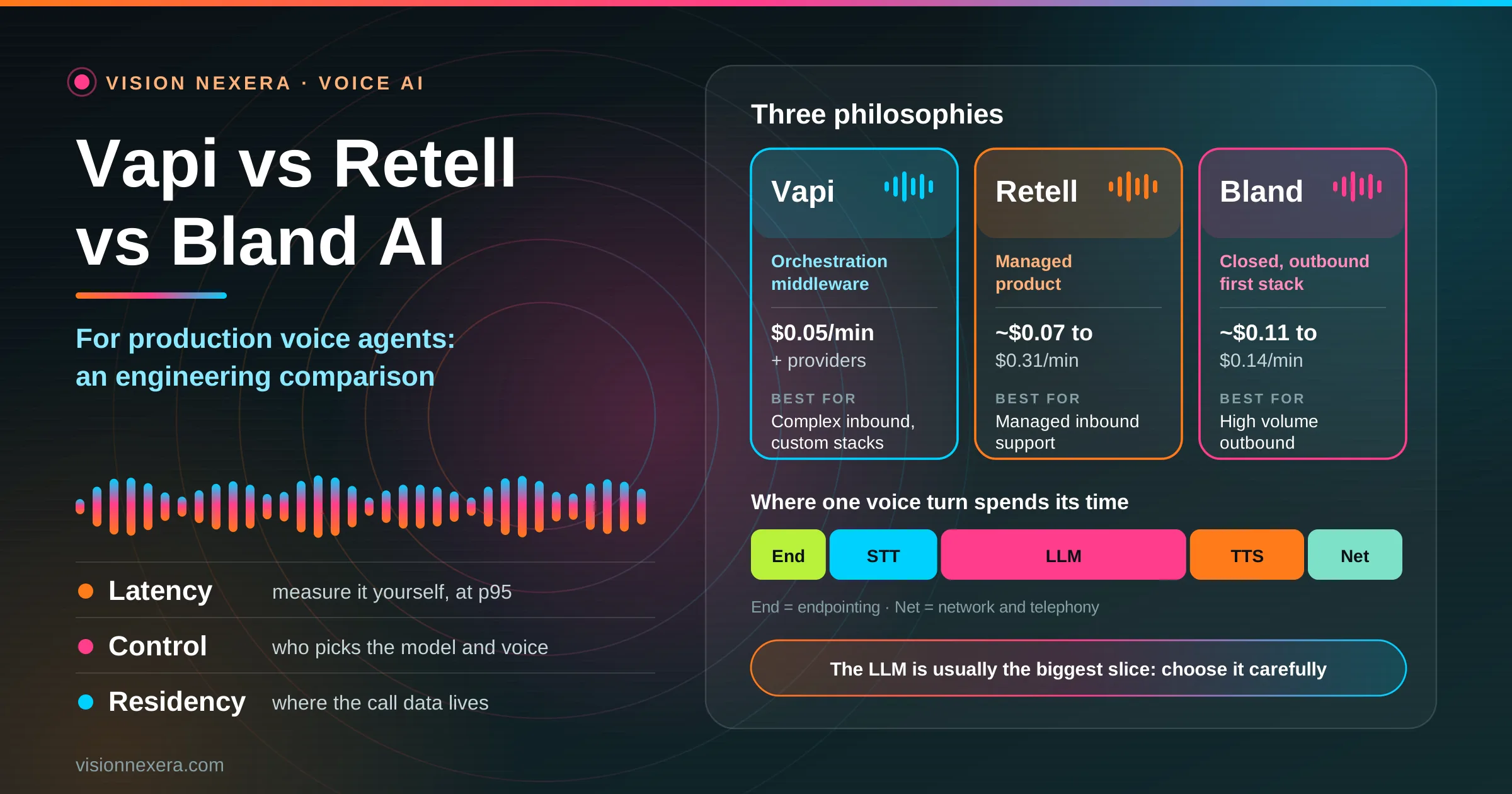
An engineering comparison of Vapi, Retell and Bland AI for production voice agents: architecture, real latency, pricing at volume, HIPAA, GDPR and data residency, and lock in.
Vapi vs Retell vs Bland AI for Production Voice Agents: An Engineering Comparison
Vapi, Retell, and Bland are the three platforms most teams shortlist when they want an AI voice agent on a real phone line. On a feature checklist they look almost identical. All three take a call, turn speech into text, send it to a language model, turn the reply back into speech, and do it fast enough to feel like a conversation.
In production they behave very differently, because they are built on three different philosophies. Vapi is orchestration middleware: you choose every component and wire it together. Retell is a managed product: sensible defaults, faster to a working call, less to tune. Bland is a closed, vertically integrated stack built first for high volume outbound calling.
This comparison is written from the engineering side. It covers the things that decide whether a voice agent survives real callers: the latency budget, control over the model and voice, telephony, tool calling, testing, compliance and data residency, cost at volume, and lock in. It is current to October 2026, and every number in it should be treated as a starting point to verify, because pricing and features in this category change every few months.
One disclosure before anything else. Vision Nexera builds production voice agents, and the voice interviews inside NexeraHR run on Vapi. We have tried to keep that from tilting the comparison, and where we have a view from operating one of these platforms in production, we say so.
The short answer
Vapi
Retell
Bland
Philosophy
Orchestration middleware
Managed product
Closed, outbound first stack
Bring your own LLM
Yes
Yes
Limited, in house stack
Bring your own STT and TTS
Yes
Partly
No
Headline price
$0.05 a minute plus provider costs
About $0.07 to $0.31 a minute
About $0.11 to $0.14 a minute with a monthly plan
Time to first good call
Slowest
Fastest
Fast for scripted flows
Best at
Complex inbound with tools, custom stacks
Managed inbound support
High volume outbound campaigns
Biggest trade off
You own the tuning
Less control at the edges
Less flexibility, closed models
If you want one line each: build on Vapi when you need control, operate on Retell when you want it managed, and run Bland when outbound volume is the whole job.
How we evaluated them
Most comparisons rank these platforms on voice quality and ease of setup. Those matter for a demo. For a production agent, the criteria that decide success are different:
Latency under real conditions, at the 95th percentile, not the vendor's best case.
Control over the model, the transcription, and the voice, because that is where both quality and cost are decided.
Telephony, including bringing your own numbers and carrier through SIP.
Tool calling, state, and call flow, because a useful agent does things, not just talks.
Testing, observability, and versioning, because you cannot improve what you cannot measure.
Compliance and data residency, including the full chain of subprocessors.
Cost at production volume, fully loaded.
Lock in, and how hard it is to leave.
Three architectures, three philosophies
Vapi: orchestration middleware
Vapi sits between the phone line and the providers you choose. You pick the speech to text engine, the language model, and the voice, and Vapi handles the real time loop: streaming audio, turn taking, interruptions, tool calls, and the phone connection. Multi agent setups, called Squads, let one call hand off between specialised assistants.
The strength is control. You can use Deepgram for transcription, Claude, GPT, or Gemini for reasoning, ElevenLabs for the voice, and your own carrier through SIP, and you can swap any of them without rebuilding the agent. That is what makes Vapi the natural choice for complex inbound agents, multilingual work where you need a specific speech provider, and anything with heavy tool use.
The cost of control is tuning. Latency on Vapi is largely the sum of the providers you picked, so a careless stack is slow and a well tuned one is fast. You own that work.
Retell: the managed product
Retell bundles more of the stack and makes more of the decisions for you. It supports your own language model, offers a visual Conversation Flow builder, and ships with defaults that produce a reasonable call quickly. Its pitch is managed reliability: consistent latency without a long tuning phase.
The strength is time to value and operational calm. For inbound customer support, appointment booking, and similar flows, Retell gets you to a stable agent faster than Vapi. Retell also offers a self serve business associate agreement on its pay as you go plan, which makes it the easier on ramp for healthcare in the United States.
The trade off is control at the edges. You have fewer knobs on the speech layer, and the data path runs through Retell's infrastructure, which matters for data residency.
Bland: the closed, outbound first stack
Bland runs its own speech and model stack in house rather than routing calls through third party providers. Call flows are built as Pathways, a node based graph that makes conversations deterministic and predictable, which is exactly what scripted outbound campaigns need. Managed telephony handles carrier compliance details for outbound calling in the United States.
The strength is predictability at volume. A closed stack means fewer moving parts, a simpler bill, and fewer third parties touching the call data. For lead qualification, reminders, and follow up campaigns at high volume, Bland is built for the job.
The trade off is flexibility. You are largely tied to Bland's models and voices, and free form, tool heavy conversations are not where it shines.
Latency: where the milliseconds go
Latency is the single biggest determinant of whether a voice agent feels natural. The commonly cited target is a response that starts within about a second of the caller finishing, and the best agents land well under that.
Every turn spends time in the same places:
Endpointing, deciding that the caller has actually finished speaking.
Speech to text, turning the final words into text.
The language model, especially the time to its first token.
Text to speech, the time to the first byte of audio.
Network and telephony, including the round trip through the phone carrier.
The language model is usually the largest and most variable slice, which is why platforms that let you choose the model let you control most of your latency.
Now the uncomfortable part. Published latency numbers for these three platforms disagree badly. Vendor and comparison pages advertise roughly 400 milliseconds for Bland, with its own product page claiming under 200, about 600 for Retell, and 500 to 800 for Vapi. Independent tests published in 2026 report very different figures: one put Vapi at 700 to 1,500 milliseconds and Retell at 600 to 800, another measured Bland at 700 to 900 depending on Pathway complexity, and a third had Retell at 700 to 900 and Bland at 900 to 1,200 by default. Several of these comparisons are published by the vendors themselves or by their competitors.
The engineering conclusion is simple: do not choose on advertised latency. Build the same agent on your shortlist and measure it yourself:
Measure the time from the caller stopping to the agent starting, at the median and the 95th percentile.
Test over a real phone line, not just the browser widget.
Test with your actual model, voice, and tools, because tool calls add their own delay.
Test interruptions: how quickly the agent stops talking when the caller cuts in.
Test from the region your callers are in.
On Vapi, a well chosen stack can beat the defaults on the managed platforms. Out of the box, Retell is the most consistent of the three. Bland is fast on scripted paths and can drift on complex ones.
Control: models, voices, and telephony
Model choice. Vapi and Retell both let you bring your own language model, which matters for three reasons: quality, latency, and cost. Bland's closed stack trades that choice for simplicity and fewer subprocessors.
Speech and voice. Vapi lets you choose the transcription and voice providers directly. That is decisive for languages and accents. If your callers speak Urdu, Arabic, Roman Urdu, or switch between languages mid sentence, the speech provider you pick matters more than the platform, and a platform that lets you choose gives you room to find one that works. On any platform, test with real callers in the languages you serve before you commit.
Telephony. All three can provide numbers. For production, bringing your own carrier through SIP is worth the effort on Vapi and Retell: you keep your numbers if you change platforms, you can choose carriers by country, and you can use local numbers where it matters. Bland's managed telephony is simpler for outbound calling in the United States and handles carrier registration details for you.
Call flow, tools, and state
A voice agent that only talks is a demo. A useful one looks up an order, books an appointment, updates a CRM, or transfers the call. All three platforms support tool calls through webhooks, and the differences are in how you design the conversation around them.
Vapi gives you prompts, tools, and Squads for multi agent handoffs, which suits open ended conversations with real reasoning.
Retell gives you prompt based agents and a visual Conversation Flow for structured paths, which suits support flows with clear branches.
Bland gives you Pathways, a node graph where each step is explicit, which suits scripted outbound calls where predictability matters more than flexibility.
Whichever you pick, the production engineering is the same:
Make every webhook idempotent, because platforms retry and you do not want a booking made twice.
Return tool results fast, and have the agent say something natural while a slow tool runs.
Validate the model's tool arguments before acting on them. The model's output is untrusted input, the same principle we describe in our natural language to database MCP server.
Keep a clean human handoff, with the context passed to the person who picks up.
Handle voicemail, silence, and dropped calls explicitly.
Testing, observability, and versioning
This is where the difference between a demo and a production system is widest. You need recordings, transcripts, tool call traces, and per turn latency for every call, plus a way to replay and test changes before they reach real callers.
All three platforms give you call logs, recordings, and transcripts. Vapi exposes detailed traces and latency breakdowns, which suits teams that want to debug the stack themselves. Retell's dashboard is the most polished for teams that want to operate rather than engineer. Bland's Pathways make it easy to see which branch a call took.
What none of them gives you out of the box is your own evaluation suite. Before launch, build a set of test conversations that cover your happy paths, your edge cases, and the ways callers derail a call, and run them on every change to a prompt, model, or flow. Version prompts and flows like code. This is the same discipline we describe in the demo is not the product, and voice raises the stakes because a broken turn is heard, not read.
Pricing at production volume
Headline rates in this category are misleading, because the platform fee is often the smallest part of the bill. As of mid to late 2026:
Vapi charges about $0.05 a minute for the platform, plus whatever your speech, model, voice, and telephony providers cost. Depending on your choices, the fully loaded figure commonly lands somewhere around $0.10 to $0.25 a minute.
Retell publishes about $0.07 to $0.31 a minute, roughly $0.055 for infrastructure plus voice and model costs, with the range driven by the model and voice you choose.
Bland lists about $0.11 to $0.14 a minute, but the lower rates require a monthly plan, around $299 for Build or $499 for Scale, and telephony is billed separately. Comparisons published by a competitor also point to extra fees such as minimum charges on very short outbound attempts and per minute transfer fees, which add up on high churn campaigns.
A worked illustration. Take 10,000 calls a month averaging 4 minutes, which is 40,000 minutes:
Platform
Assumed all in rate
Monthly cost
Vapi
$0.10 to $0.25 a minute
$4,000 to $10,000
Retell
$0.07 to $0.31 a minute
$2,800 to $12,400
Bland
$0.11 to $0.14 a minute, plus plan and telephony
about $4,700 to $6,100
The ranges are wide on purpose. The model and voice you choose move the bill more than the platform does, which is why a team that tunes a Vapi stack can come in well below the top of its range, and a team that picks a premium model and voice on any platform can pay several times the headline rate.
Two more costs to budget for. Compliance add ons can be significant, covered below. And the engineering to build and run the agent is separate from all of this, which we cover in our guide to AI agent development cost.
Compliance and data residency
For regulated work, this section decides more projects than latency does.
Vapi holds SOC 2 Type II and documents GDPR and PCI compliance. HIPAA is a paid add on, reported at $1,000 to $2,000 a month depending on the source and the date, with zero data retention sold separately. Vapi also offers an on premises deployment for enterprises, in which call audio and text stay inside your own infrastructure. For strict residency requirements, that is the most complete answer of the three.
Retell holds SOC 2 Type I and Type II and offers a self serve business associate agreement on its pay as you go plan, which is the friendliest HIPAA on ramp of the three. For GDPR it relies on a data processing addendum with standard contractual clauses. In its own community forum, Retell has said that its core speech, voice, telephony, and call storage run through US infrastructure and that it has no confirmed timeline for EU hosted infrastructure. Contractual clauses solve the legal transfer question. They do not satisfy a physical residency requirement.
Bland runs a closed in house stack, which means fewer third parties touch the call data, and it offers a data processing addendum and standard contractual clauses. EU focused reviewers have flagged the lack of a clear EU region deployment. If you need dedicated or regional infrastructure, ask Bland directly what its enterprise tier offers.
Three points apply across all of them.
First, compliance is only as strong as the weakest link in the subprocessor chain. On a bring your own stack, every speech, model, and voice provider that touches the call needs its own agreement.
Second, recordings and transcripts are personal data, and a voice print can be biometric data, which most privacy laws treat as sensitive.
Third, none of these platforms is hosted in Saudi Arabia, so for a Saudi deployment the call data flow is a cross border transfer under the Personal Data Protection Law. That needs a lawful basis and safeguards, or an architecture that keeps the data in the Kingdom, such as a self hosted stack in a Saudi cloud region. Our guides to PDPL compliant AI in Saudi Arabia cover the residency side in detail.
Lock in and escape hatches
Every platform choice creates some lock in, and the goal is to keep it small. The practical escape hatches:
Bring your own telephony through SIP, so your numbers are yours.
Keep prompts, tool definitions, and flows in your own repository, not only in a dashboard.
Put your tools behind your own API, so the agent calls your backend, not a platform specific integration.
Store recordings, transcripts, and evaluation results in your own systems.
Keep a thin abstraction over the platform's API, so switching means rewriting an adapter, not the product.
Vapi is the easiest to leave because you already own most of the components. Retell sits in the middle. Bland's closed stack and Pathways format make it the hardest to migrate away from, which is the price of its simplicity.
The fourth option: build on an open source framework
For teams with strict residency needs, very high volume, or unusual requirements, there is a fourth path: open source real time voice frameworks such as Pipecat or LiveKit Agents, run on your own infrastructure. You take on the full engineering and operations burden in exchange for complete control over where data lives and what every component costs. It is rarely the right first step, and it is often the right second one once volume is large and the requirements are clear.
Which one should you choose?
Choose Vapi if you are building complex inbound agents with real tool use, need a specific speech provider for your languages, want to tune latency and cost yourself, or need on premises deployment for residency. Expect to invest in tuning.
Choose Retell if you want a managed, consistent inbound agent quickly, are working on customer support or appointment flows, or need a straightforward HIPAA path in the United States, and you do not have a physical residency requirement.
Choose Bland if outbound volume is the job, your calls follow predictable scripts, and you value a simple, predictable stack with fewer third parties over flexibility.
Consider a custom stack if you need data to stay in a specific country, have very high volume, or have outgrown the platforms.
Whatever you pick, prototype the same agent on two platforms, measure latency and cost with your own model and voice, and test with real callers before you commit.
How Vision Nexera approaches voice agents
Vision Nexera designs, builds, and runs production AI voice agents and AI agents, with teams in Lahore and Doha. The voice interviews inside NexeraHR run on Vapi with Twilio, Deepgram, and ElevenLabs, which is where our view of latency, interruptions, and evaluation comes from.
We are deliberately platform neutral when we scope a client project. For some clients the right answer is Vapi, for others Retell or Bland, and for some, particularly where data has to stay in a specific country, a custom stack. We ground agents in your data through RAG and LLM application development, connect them to your systems through AI integration behind a clean boundary, and build the evaluation suite before launch rather than after the first complaint. You can read how an engagement runs on our process page.
Frequently asked questions
Which is better for production, Vapi or Retell?
It depends on what you want to own. Vapi gives you more control over every component and suits complex, tool heavy agents and custom stacks. Retell gives you more consistent results out of the box with less tuning and suits managed inbound support. A common pattern is to prototype on both and decide on measured latency and cost.
Which voice AI platform has the lowest latency?
Advertised numbers rank Bland first, then Retell, then Vapi, but independent tests in 2026 disagree, and several published comparisons come from the vendors themselves. On Vapi, latency depends mostly on the providers you choose. Measure your own agent over a real phone line at the 95th percentile.
Which is cheapest at scale?
It depends on the model and voice you choose more than the platform. Bland's bundled pricing is the easiest to predict. Retell can be the cheapest with lighter models. Vapi can be cheap or expensive depending on your stack. Model your own volume with fully loaded rates.
Can I use my own LLM?
Yes on Vapi and Retell. Bland runs a closed in house stack, which limits model choice in exchange for simplicity.
Which platform supports HIPAA?
All three can support HIPAA covered work in some form. Retell offers a self serve business associate agreement on its pay as you go plan. Vapi offers HIPAA as a paid add on. Ask Bland about its terms for your use case. In every case, check the agreements for each subprocessor in the call path.
Can these platforms keep data in the EU or Saudi Arabia?
Vapi offers an on premises deployment that keeps call data in your own infrastructure. Retell has said its core infrastructure runs in the United States with no confirmed EU hosted timeline. Bland's regional options should be confirmed directly. For Saudi Arabia, a platform hosted abroad means a cross border transfer under the PDPL, so plan the architecture and legal basis accordingly.
Do these platforms support Urdu and Arabic?
Language support depends mostly on the speech and voice providers. Platforms that let you choose providers, such as Vapi, give you more room to find good Urdu and Arabic support. Test with real callers in the languages and accents you serve.
Should I build my own voice stack instead?
Usually not first. A platform gets you to production faster. A custom stack on an open source framework makes sense when you have strict residency requirements, very high volume, or needs the platforms cannot meet.
How long does it take to build a production voice agent?
A narrowly scoped agent can be live in a few weeks. Agents with several integrations, multilingual support, compliance requirements, or an evaluation suite take longer. A short architecture sprint is the fastest way to a reliable timeline.
The platform matters less than the engineering around it
Vapi, Retell, and Bland are all capable of running a production voice agent. The difference between an agent callers trust and one they hang up on is rarely the platform. It is the latency you measured instead of assumed, the tools that return fast and fail safely, the evaluation suite that catches regressions, the compliance chain you actually checked, and the escape hatches you built in before you needed them.
If you are choosing a voice platform for a production agent, start with a written scope. Book a scoping call with Vision Nexera and leave with a platform recommendation based on your use case, an honest estimate, and a clear view of what it takes to run in production.
Related reading
Top AI Voice Agent Development Companies in Pakistan 2026: https://www.visionnexera.com/insights/top-ai-voice-agent-companies-pakistan-2026
How much does it cost to build an AI agent: https://www.visionnexera.com/insights/ai-agent-development-cost
The Demo Is Not the Product: https://www.visionnexera.com/insights/ai-product-development-demo-to-production
PDPL-Compliant AI Agent Development in Saudi Arabia: https://www.visionnexera.com/insights/pdpl-compliant-ai-agent-development-saudi-arabia
Anatomy of a natural language to MongoDB MCP server: https://www.visionnexera.com/insights/mongodb-mcp-server-architecture
NexeraHR case study: https://www.visionnexera.com/work/nexerahr-ai-ats
AI Agents service: https://www.visionnexera.com/services/ai-agents
RAG and LLM Applications service: https://www.visionnexera.com/services/rag-development
AI Integration service: https://www.visionnexera.com/services/ai-integration
Process: https://www.visionnexera.com/process