AI Voice Agent Development Cost 2026: Build Costs vs Per-Minute Costs
October 16, 2026 · Asma Nawaz · Technical Content Writer, Vision Nexera · 14 min read
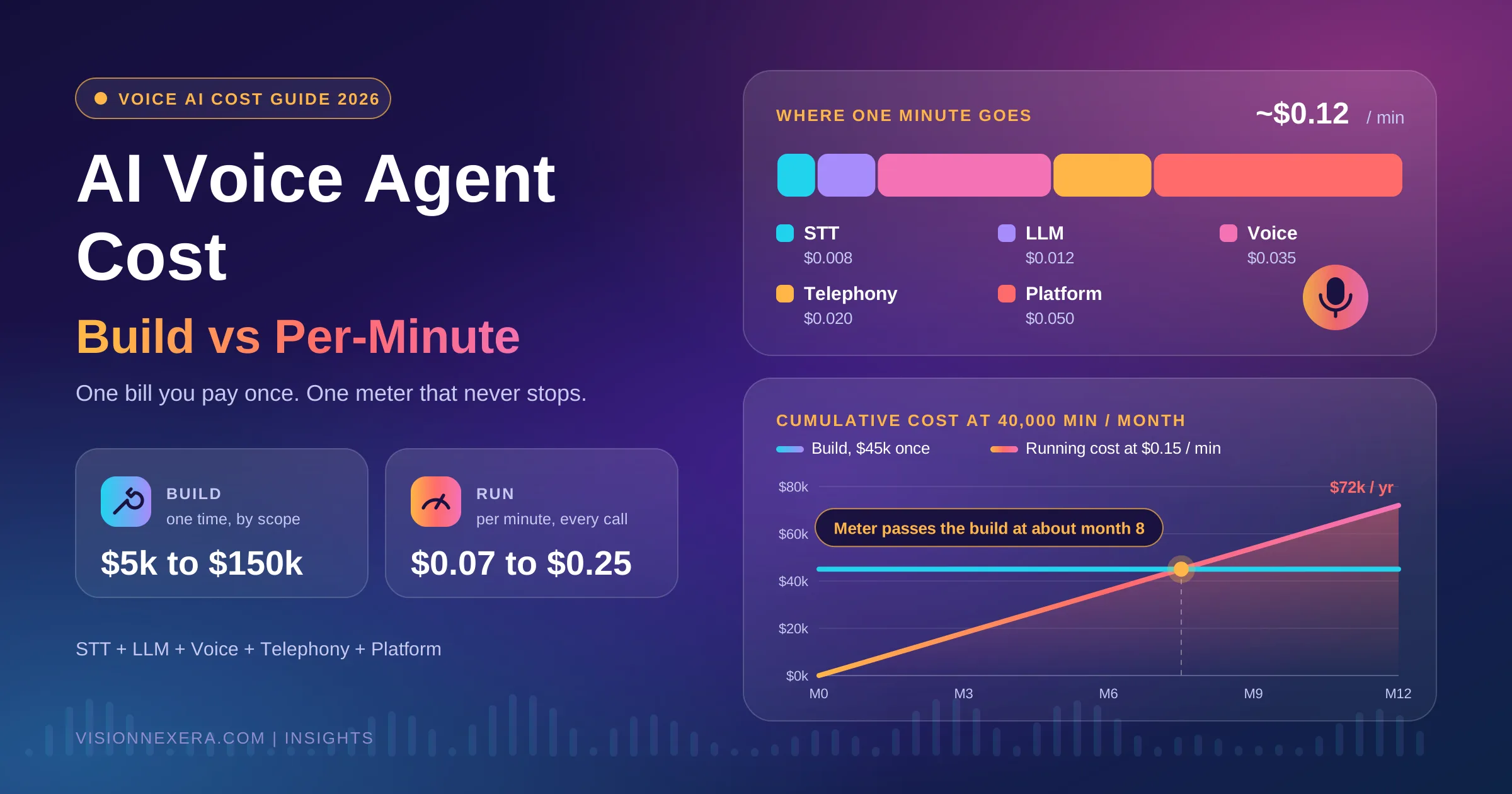
What an AI voice agent really costs in 2026: build cost ranges, a per-minute breakdown of speech, LLM, voice, telephony and platform fees, and how to model both against call volume.
AI Voice Agent Development Cost: Build Costs vs Per-Minute Inference Costs
Most quotes for an AI voice agent give you one number. That number is almost always the build cost, and it hides the bill that actually decides whether the project pays off: the cost of every minute the agent spends on the phone.
A voice agent has two cost lines that behave in completely different ways. The build is a one time engineering investment: design, integrations, prompts, testing, and launch. The running cost is a meter that never stops: speech recognition, the language model, the synthetic voice, the phone line, and the platform fee, charged for every minute of every call. At low volume the build dominates. At high volume the meter does, often within the first year.
This guide separates the two. It explains what each one costs in 2026, where every cent of a voice minute goes, how to model both against your call volume, and which engineering decisions move the per-minute number the most. It is written for founders, operations leads, and technical buyers comparing quotes. Treat every figure as a market range current to October 2026, not a quote, because vendor pricing in this space changes every few months.
If you want the broader picture for agents that are not voice based, our guide to AI agent development cost covers it in detail.
The quick answer
Build cost. A simple voice agent on a managed platform, with one flow and one or two integrations, typically costs $5,000 to $15,000 to build properly. A production agent with several integrations, call transfers, an evaluation suite, and monitoring usually lands between $15,000 and $60,000. Multilingual agents, regulated use cases, custom speech stacks, or self hosted deployments run from $60,000 to $150,000 and above.
Running cost. A fully loaded minute on a managed voice platform typically costs between $0.07 and $0.25 in 2026. A carefully tuned stack can come in under $0.10 a minute. Premium voices, frontier language models, and long calls can push it past $0.25.
The relationship between them. At 1,000 minutes a month, running costs are a rounding error next to the build. At 40,000 minutes a month, the meter can cost more in a single year than the entire build. That is why the right build budget depends on your call volume.
Cost line one: The build
The build is everything needed to turn a demo into an agent that real callers trust. Teams that skip parts of it pay for them later in rework and failed calls.
What the build includes
Discovery and conversation design. Mapping the calls the agent will handle, the questions callers really ask, the edge cases, and the points where a human must take over.
Prompting and call flow. The system prompt, conversation states, guardrails, and the logic for interruptions, silence, and voicemail.
Integrations. Connecting the agent to your calendar, CRM, order system, or knowledge base through tool calls, usually the largest single block of engineering.
Telephony setup. Numbers, routing, SIP trunks where needed, call transfers, and recording.
Knowledge grounding. A retrieval layer when the agent must answer from your documents, policies, or product data.
Evaluation and testing. A suite of test conversations, latency measurement over real phone lines, and testing with real callers in the languages you serve.
Monitoring and launch. Dashboards, alerts, cost tracking, and a staged rollout.
What moves the build cost
The number and quality of integrations. One clean calendar API is quick. Three legacy systems with no documentation are not.
Languages and accents. An English only agent is the baseline. Urdu, Arabic, code switching between languages, or strong regional accents mean more speech provider testing, more prompt work, and more evaluation.
Compliance. Healthcare, finance, and government projects add consent flows, retention rules, audit logs, and sometimes data residency, which can change the whole architecture. Our guide to PDPL compliant AI in Saudi Arabia shows how residency requirements shape a build.
Platform versus custom stack. Building on a managed platform such as Vapi, Retell, or Bland is faster and cheaper to build. A self hosted stack on an open source framework costs more to build and operate, but can cut per minute costs at scale and keep data where you need it. Our engineering comparison of Vapi, Retell and Bland covers the platform trade offs.
Who builds it. The same scope costs very different amounts depending on the team's location and seniority, which we break down in our guide to AI developer hourly rates by country.
Cost line two: The per-minute meter
Every minute of a live call passes through the same chain, and every link in it charges you. In a standard cascaded voice agent, the chain looks like this.
Speech to text
The caller's audio is transcribed in real time. Streaming transcription from major providers typically costs between $0.003 and $0.008 a minute. Deepgram's Nova-3 streaming, for example, is listed at about $0.0077 a minute on pay as you go. This is usually one of the smallest lines on the bill.
The language model
The transcript goes to a language model, which decides what to say and which tools to call. For a cascaded agent on a small, fast model, the raw model cost is often between $0.001 and $0.01 a minute. A frontier model, a long system prompt, retrieval results, and tool outputs all push it up, because the whole conversation is sent again on every turn. Platforms that bundle the model often charge more than the raw API price.
Text to speech
The reply is turned into a voice. This is frequently the largest and most variable line. Fast, efficient voices typically cost between about $0.015 and $0.05 a minute of generated speech. Premium, highly expressive voices can cost several times that, and some published comparisons put top tier voice plans above $0.10 a minute. The voice you choose can move the total bill more than any other single decision.
Telephony
The call itself needs a phone line. On Twilio in the United States, inbound calls are about $0.0085 a minute and outbound calls about $0.013 to $0.022 a minute, depending on destination, plus around $1.15 a month per local number. Media streaming and call recording add small amounts on top. Wholesale carriers and direct SIP trunks can be cheaper, and international destinations can be much more expensive.
The platform fee
If you build on a managed platform, it charges for orchestration on top of everything else. Published 2026 rates put Vapi at about $0.05 a minute plus providers, Retell's infrastructure at about $0.055 a minute plus voice and model, and Bland at about $0.11 to $0.14 a minute with a monthly plan. Concurrency limits, compliance add ons, and minimum charges sit on top of these.
Adding it up
A typical managed stack for a US support call might look like this:
Speech to text: about $0.008
Language model: about $0.005 to $0.02
Voice: about $0.02 to $0.05 for an efficient voice
Telephony and streaming: about $0.015 to $0.025
Platform fee: about $0.05
That lands roughly between $0.10 and $0.15 a minute, which matches what independent 2026 comparisons report for real totals on the major platforms. Swap in a premium voice and a frontier model and the same call can cost $0.20 to $0.30 a minute.
The speech to speech alternative
Some agents skip the chain and use a single speech to speech model that listens and replies in audio directly, such as OpenAI's realtime models. This cuts latency and simplifies the stack, and it changes the cost structure.
Realtime models bill audio by the token. Based on OpenAI's published rates as of October 2026, an analysis of typical support calls puts the flagship realtime model at roughly $0.06 to $0.11 a minute when context caching works, and the smaller mini model at roughly $0.02 to $0.05 a minute. When caching fails, the same analysis found costs of $0.18 to $0.46 a minute, because the entire conversation is billed again on every turn.
The lesson applies to every architecture: the context grows with every turn, so long calls cost more per minute than short ones, and keeping the system prompt and tool definitions stable is a direct cost control, not a style choice. You still pay telephony and any platform fee on top.
Why the real bill is higher than the rate card
The advertised rate is rarely the number on the invoice. These are the usual gaps.
Silence and hold time are billed. The meter runs while the caller looks for an order number, while a tool call waits for a slow API, and while the agent listens to hold music on a transfer.
Context grows with every turn. A ten minute call costs more per minute than a two minute call, because each turn carries the full history.
Outbound campaigns waste minutes. Voicemail, unanswered calls, and wrong numbers still cost money, and some platforms charge a minimum per call attempt.
Transfers cost twice. When the agent hands off to a human, both legs of the call may be billed while the transfer completes.
Add ons are monthly. HIPAA compliance, extra concurrency, zero data retention, and dedicated infrastructure are often flat monthly fees. On Vapi, the HIPAA add on has been reported at $1,000 to $2,000 a month.
Post call processing is separate. Summaries, sentiment analysis, CRM updates, and quality scoring run additional model calls after every conversation.
Retries and failures. Dropped calls, callbacks, and repeated questions all add minutes that did not produce an outcome.
A good rule: model your costs at about 1.3 to 1.5 times the headline per minute rate until you have a month of real data.
Modelling both lines together
The only way to compare quotes honestly is to put the build and the meter on the same timeline. Here are two illustrations using the ranges above.
A low volume agent
A clinic receptionist agent handles 300 calls a month averaging 3 minutes, so about 900 minutes.
Build: a focused platform build at around $12,000.
Running cost: 900 minutes at $0.15 a minute is about $135 a month, or about $1,620 a year.
Here the build is more than 85 percent of first year cost. The right move is to keep the build lean, use a managed platform, and not spend engineering time shaving cents off a minute.
A high volume agent
A support line handles 10,000 calls a month averaging 4 minutes, so 40,000 minutes.
Build: a production build with integrations and evaluation at around $45,000.
Running cost at $0.15 a minute: $6,000 a month, or $72,000 a year.
Running cost at $0.25 a minute: $10,000 a month, or $120,000 a year.
Now the meter costs more than the build within the first eight months. A difference of $0.05 a minute is worth $2,000 a month, or $24,000 a year. Spending an extra $15,000 on optimisation, such as a tuned speech stack, a cheaper voice tier that tests just as well, prompt caching, and better call handling, pays for itself in about seven and a half months.
The break even question
A simple test tells you how much engineering to put into per minute cost:
Estimate your monthly minutes at steady state.
Multiply by the per minute saving an optimisation would deliver.
Divide the optimisation's build cost by that monthly saving.
If the payback is under twelve months, invest in it. If it is years away, keep the stack simple and spend the budget on call quality instead.
The levers that cut per minute cost
These are the changes that move the number most, roughly in order of impact.
Choose the voice tier deliberately. Test two or three voices with real callers. A faster, cheaper voice often scores the same on satisfaction as a premium one, and voice is usually the biggest line on the bill.
Right size the model. Use a small, fast model for routine turns and reserve a larger model for the steps that need reasoning. Smaller models also cut latency.
Keep context lean and cacheable. Keep the system prompt and tool definitions stable, put dynamic data last, trim retrieved content, and summarise long histories instead of resending everything.
Tune endpointing and silence handling. Shorter dead air means fewer billed minutes and a better caller experience.
Detect voicemail and dead lines early. On outbound campaigns, hanging up quickly on voicemail is one of the easiest savings available.
Bring your own telephony. A SIP trunk with a wholesale carrier can cut telephony costs and keeps your numbers portable between platforms.
Set call length limits and clean handoffs. Cap runaway calls and transfer early when the agent cannot help.
Move post call work off the live path. Run summaries and analytics in batch with a cheaper model.
Consider a custom stack at real scale. Once volume is high and stable, an open source framework such as Pipecat or LiveKit Agents on your own infrastructure can remove the platform fee entirely, at the cost of more engineering and operations.
Hidden costs on the build side too
Running costs are not the only thing quotes leave out. Budget for these as well.
Ongoing maintenance. Providers change models, voices, and APIs. Prompts drift as your business changes. Plan for a monthly maintenance retainer after launch.
Evaluation upkeep. Every new flow or prompt change needs testing against your suite, and the suite itself needs new cases as callers find new ways to derail a call.
Monitoring and cost tracking. Without per call cost and latency dashboards, a broken cache or a runaway prompt can double your bill before anyone notices.
Compliance reviews. Recording consent, retention, and data processing agreements need review whenever a provider in the chain changes.
Platform, bring your own keys, or self hosted
The way you buy the stack changes both lines.
All in managed platform. The lowest build cost and the fastest launch. You pay the platform's margin on every minute and accept its limits on control and data location.
Platform with your own provider keys. You keep the orchestration but pay speech, model, and voice providers directly at their rates, which usually lowers the per minute cost and gives you more control.
Self hosted on an open source framework. The highest build and operations cost and the lowest per minute cost at scale, with full control over where data lives. Usually the right second step, not the first.
Many teams start on a managed platform, move to their own keys once the agent proves itself, and consider self hosting only when volume or data residency demands it.
How Vision Nexera approaches voice agent costs
Vision Nexera designs, builds, and runs production AI voice agents and AI agents, with teams in Lahore and Doha. The voice interviews inside NexeraHR run on Vapi with Twilio, Deepgram, and ElevenLabs, which is where our view of per minute economics comes from: we have watched what silence, context growth, and voice choice do to a real bill.
We model both cost lines before we build. Discovery produces a written scope, a build estimate, and a per minute cost model based on your expected call volume, so you can see the total cost of ownership for the first year rather than just the build. We are platform neutral, so the recommendation follows the numbers: a managed platform at low volume, your own provider keys as volume grows, and a custom stack only when it pays back. You can see how an engagement runs on our process and pricing pages.
Frequently asked questions
How much does it cost to build an AI voice agent?
A simple agent on a managed platform typically costs $5,000 to $15,000. A production agent with several integrations, evaluation, and monitoring usually costs $15,000 to $60,000. Multilingual, regulated, or self hosted agents can run from $60,000 to $150,000 and above.
How much does an AI voice agent cost per minute?
Most production agents on managed platforms cost between $0.07 and $0.25 a minute fully loaded in 2026, covering speech recognition, the language model, the voice, telephony, and the platform fee. A tuned stack can come in under $0.10 a minute.
Why is the real per minute cost higher than the advertised rate?
Advertised platform rates usually exclude speech, model, voice, and telephony costs. Silence, hold time, growing context, voicemail on outbound calls, transfers, compliance add ons, and post call processing add more. Plan for 1.3 to 1.5 times the headline rate until you have real data.
Which part of a voice agent costs the most per minute?
The voice is often the largest single line, especially with premium voices, followed by the platform fee and telephony. Speech recognition is usually small. The language model can become significant on long calls with a large model and a heavy context.
Is a speech to speech model cheaper than a cascaded stack?
It can be, but it depends on caching and call length. Published analysis of OpenAI's realtime models puts typical costs between about $0.02 and $0.11 a minute when caching works, and far higher when it does not. Telephony and platform costs are extra.
When should I build a custom voice stack instead of using a platform?
When call volume is high and stable enough that the per minute saving pays back the extra engineering within about a year, or when data residency or control requirements rule out hosted platforms. For most teams that is a second step after launching on a platform.
How can I lower my voice agent's per minute cost?
Test cheaper voice tiers with real callers, right size the model, keep the prompt stable and cacheable, cut dead air, detect voicemail early, bring your own telephony, and move post call processing off the live call.
Do I pay for minutes when the caller is on hold or silent?
In most setups, yes. Billing runs for the duration of the call, including silence, hold time, and the time a tool call takes to return.
Budget for the meter, not just the build
A voice agent is not a one time purchase. The build decides whether it works. The per minute cost decides whether it is worth running at scale. The teams that get this right model both lines against their real call volume before they sign anything, keep the build lean when volume is low, and invest in per minute efficiency only when the payback is clear.
If you are planning a voice agent and want both numbers before you commit, book a scoping call with Vision Nexera. You will leave with a build estimate, a per minute cost model for your volume, and a clear recommendation on platform, stack, and voice.